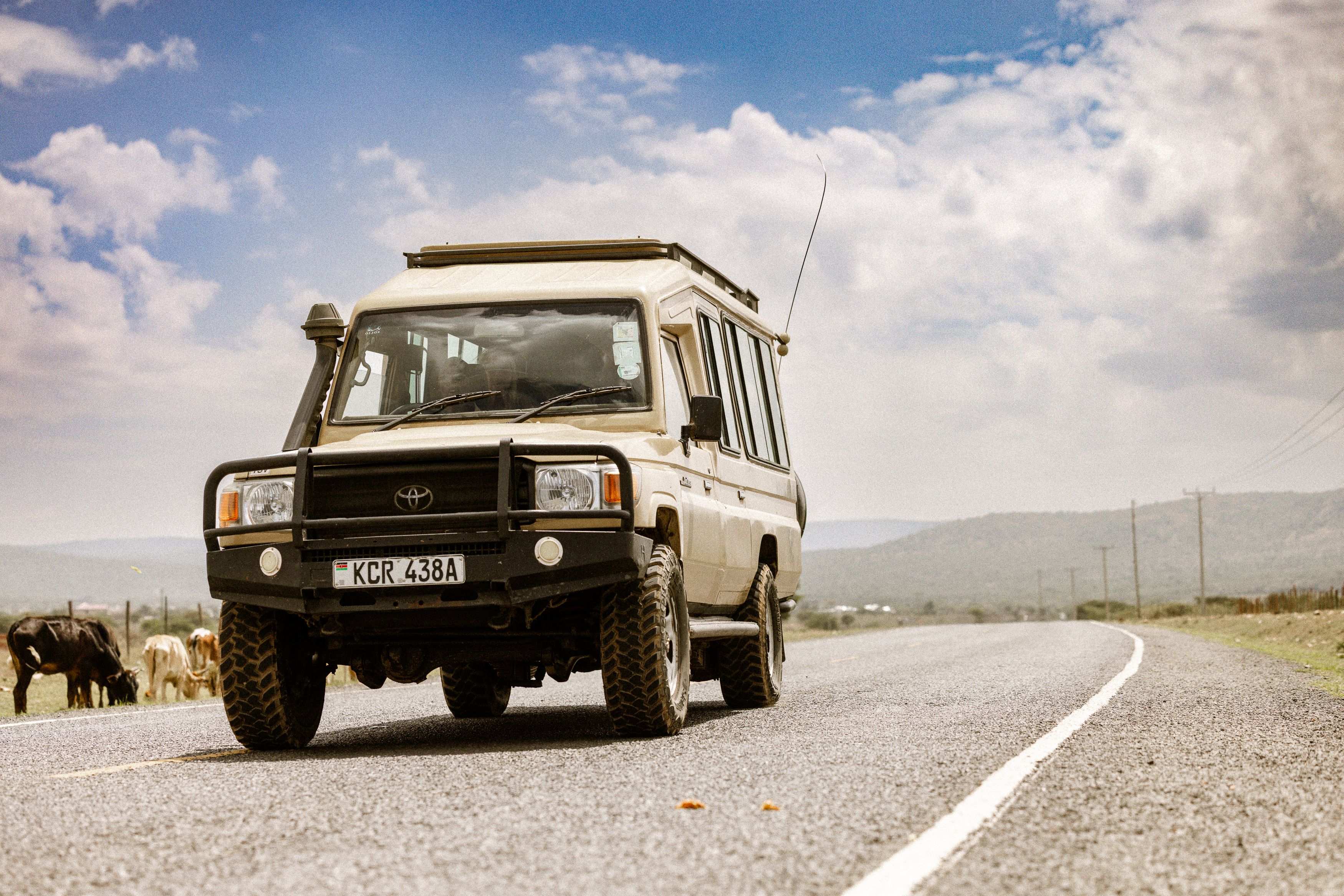
Safari Vehicles in Tanzania
the short answer
why a 4x4
the pop-up roof
a window seat for all
open vs closed
what makes one good
vehicle vs guide
what to ask
how we do it + talk
The Short Answer
A Purpose-Built 4x4
On a Tanzania safari, you'll almost always ride in a purpose-built 4x4 with a pop-up roof and guaranteed window seats.
It's a fair question to ask before booking, because you'll spend a lot of your safari in this vehicle. On the Northern Circuit, the answer is almost always a purpose-built four-wheel-drive, typically a Land Cruiser-type vehicle adapted specifically for game viewing, with a pop-up roof and a window seat for every guest.
That matters more than it sounds. The vehicle shapes how well you see wildlife, how comfortable the long park roads feel, and how good your photographs are. It isn't a detail to leave to chance, and it's worth knowing what to expect before you pay for a trip.
Why a 4x4
The Roads Decide
Park roads are rough gravel, dirt, and thick mud. Standard vehicles simply can't handle these wild tracks, making a purpose-built 4x4 essential.
Once you leave the main roads and enter the parks, tarmac largely disappears. You're on gravel, dirt tracks and, during the wetter months, ground that turns to thick mud. Some of the best wildlife areas sit at the end of tracks an ordinary car would never manage.
A purpose-built 4x4 exists for exactly this. It has the clearance, the traction and the durability to reach the animals rather than staying on the easy roads. It's also why safari drives feel bumpy at times, guests sometimes call it the "African massage." The bumps aren't a fault; they're the price of going where the wildlife actually is.
The Pop-Up Roof
Stand, See, Photograph
The pop-up roof changes everything: stand up for an unobstructed, 360-degree view and shoot photos without glass in the way.
The single most important feature on a Tanzania safari vehicle is the pop-up roof. When you reach wildlife, the roof lifts, and you stand up to view and photograph in the open air with a clear line of sight over the grass.
This is a genuine advantage over vehicles where you're stuck shooting through a closed window. You get an unobstructed 360-degree view, no glass reflections or window frames in your photos, shade from the raised roof panel while you stand, and the sense of actually being in the landscape rather than looking at it through glass. For most guests, standing up through the roof as elephants pass is one of the moments they remember most.
A Window Seat for All
No Middle Seats
A proper safari vehicle guarantees every guest a window seat with no cramped middle seats. If an operator can't promise this, it's a major warning sign.
A properly organised safari vehicle gives every guest their own window seat. Nobody should be squeezed into a middle position with a poor view and no window to photograph through, that's a genuine frustration on a trip you've travelled a long way for.
This is also a useful signal when comparing operators. A guaranteed window seat for everyone usually points to a vehicle that isn't overloaded and an operator who takes the game-viewing experience seriously. If you can't get a straight answer about seating, or a vehicle is being filled to the last seat regardless of comfort, treat it as a quiet warning sign. Our guide on private versus group safaris explains how seating differs between the two.
Open vs Closed
Different Parks, Different Setups
You'll see two main styles: the Northern Circuit's classic pop-up-roof 4x4 and the open-sided vehicles of private reserves, each suited to different conditions.
You'll come across two broad styles of safari vehicle. The most common on Tanzania's Northern Circuit is the closed-sided 4x4 with a pop-up roof, it protects you from sun, dust and cooler morning air while still opening up for viewing. Fully open-sided vehicles, with no windows at all, are more associated with certain private reserves and concessions.
For the classic northern parks, the pop-up-roof vehicle is generally the practical choice. Early mornings can be genuinely cold, especially up around the Ngorongoro Highlands, and the dust on dry-season tracks is real. A vehicle you can close between sightings and open when it matters tends to suit the conditions better than one that's open to the elements the whole day.
What Makes One Good
Beyond the Basics
Beyond seats and roofs, small details matter on long days: charging ports, a cool box for water, clear visibility, and, above all, excellent maintenance.
Beyond the pop-up roof and window seats, a few practical things make a real difference over long days in the bush:
- Charging points to keep cameras and phones alive between camps
- A cool box so there's cold drinking water throughout the day
- Good all-round visibility so every seat has a genuine view
- Enough space that the vehicle isn't packed to the last seat
- Above all, a vehicle that's well maintained and reliable
That last point matters most. A breakdown deep inside a park, far from the nearest gate, isn't a minor inconvenience, it can cost you hours of a game drive you've paid for. Reliable, well-serviced vehicles are one of the least glamorous but most important things a serious operator invests in.
Vehicle vs Guide
A Great Guide Behind the Wheel
The best vehicle is only as good as its guide. A skilled driver knows animal movements and positions the vehicle perfectly for your photos.
It's worth remembering that even the best vehicle is only half the equation. The person behind the wheel matters just as much. A skilled driver-guide knows where wildlife tends to move at different times of day, reads the bush for signs most visitors would miss, and positions the vehicle so the light and the angle work for your photographs rather than against them.
A good guide will also manage space at a sighting, holding back rather than crowding, and communicate with other vehicles by radio to share what's around. The vehicle gets you there; the guide turns it into a great safari. Our guide on whether a private driver-guide is worth it looks at this in more depth.
What to Ask
A Few Simple Questions
Before booking, ask a few key questions: what vehicle is used, are window seats guaranteed, how many guests share, and is the 4x4 well-maintained?
You don't need to be a mechanic to check you're getting a proper safari vehicle. A few straightforward questions tell you most of what you need to know:
- What type of vehicle will we actually use?
- Does every guest get a guaranteed window seat?
- How many people will share the vehicle?
- Is it a purpose-built 4x4 with a pop-up roof?
- How well maintained is the fleet?
A confident, specific answer is reassuring. Vague responses, or reluctance to commit to seating, tell you something too. Our guides on choosing an operator and the questions to ask before booking cover the wider checks worth making.
How We Do It + Talk
Built for the Bush, Run Properly
We use purpose-built, properly maintained 4x4s with pop-up roofs and guaranteed window seats for every guest.
As a Tanzania-based operator, the vehicle is something we take seriously because we see its impact on every trip. We use purpose-built four-wheel-drive safari vehicles with pop-up roofs and a window seat for every guest, and we keep them maintained for the demanding conditions of Tanzania's parks. We'd rather run reliable, well-set-up vehicles than pack in extra seats at the expense of your experience.
If you're comparing safaris, we're always happy to explain exactly what vehicle you'll travel in and how it's arranged, no vague answers.
A real example: a couple who had been on safari elsewhere told us their previous trip had been in a crowded minibus where they'd spent much of the time craning over other passengers to see anything. On their Tanzania safari, having their own window seats and a pop-up roof completely changed the experience, they could stand, photograph freely and actually feel part of each sighting. They said afterwards it was the difference between watching a safari and being on one. That's exactly why we treat the vehicle as part of the safari, not just the transport to it.
- Request a tailor-made quote (fastest, best for a real plan)
- WhatsApp: +255 740 666 662
- Email: info@safari-tz.com