Walking Safari vs Game Drive in Tanzania
the short answer
what each one is actually for
proximity, pace and what you notice
how each is run and where
the expectation worth correcting
why most guests do both
which balance is right for you
The Short Answer
They Do Different Jobs — Most Guests Do Both
Walking safari vs game drive in Tanzania: a drive covers ground and finds big game; a walk slows you to read tracks and detail. Most guests combine them.
A walking safari and a game drive aren't rivals — they're two different ways of experiencing the same bush, and most guests get the most out of doing both.
- A game drive covers distance, reaches the wildlife, and gives you close vehicle-based sightings of big animals across a wide area.
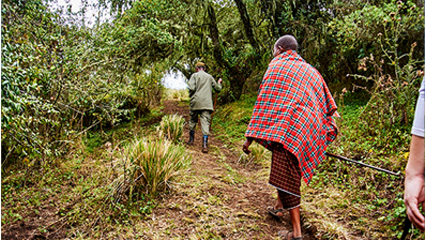
- A walking safari slows you right down to read what the vehicle passes: fresh tracks and their direction, dung and what it reveals, plants, termite mounds, bird calls, insects and the small wildlife you'd never notice from a seat.
- The drive is about the headline animals; the walk is about understanding the whole environment they live in.
- Walking is led by an authorised walking guide with an armed ranger, in designated zones only. A game drive goes wherever the park's roads and tracks allow.
- Most guests keep the game drive as the backbone of the trip and add a walk as a change of pace and perspective.
Neither is "better." If you want to cover ground and see big game, that's the drive. If you want to understand the bush at human scale, that's the walk. The rest of this page is the honest, side-by-side reality of each — so you can decide how much of each your trip should hold.
What Each One Is Actually For
Covering Ground vs Reading the Ground
A Tanzania game drive covers ground to find big game; a walking safari slows you to read tracks, plants and signs. Two different jobs, not competing versions.
The clearest way to think about it: a game drive is about covering ground, and a walking safari is about reading the ground.
On a game drive, the vehicle does the work of distance. You move across a wide area, your guide finding animals and positioning the vehicle for viewing, and you cover far more territory than any walk could. That's its strength — reach, and access to the big, mobile wildlife spread across a park.
On a walk, distance stops mattering and detail takes over. Your guide crouches at a track and works out which animal made it and which way it went. Dung gets read for what it says about recent activity. The trees, the termite mounds, the insects, the bird calls happening around you — all the texture a vehicle rolls past at speed — becomes the actual subject. You cover a tiny fraction of the ground and understand far more of it.
That's why they're not competing versions of the same thing. The drive answers "what big animals can we find across this park today?" The walk answers "what is actually going on in this patch of bush, and how does it all connect?" Both are real safari; they just point your attention in opposite directions. Guests who do both come home having seen the animals *and* understood the world those animals move through — which is a richer trip than either alone.
Proximity, Pace and What You Notice
More Animals From the Vehicle, More Meaning on Foot
You'll see more big game on a game drive, but notice more detail on a walking safari. Each rewards a different kind of attention.
If your question is purely "where will I see more animals?", the honest answer is the game drive. The vehicle covers more ground, reaches more sightings, and gets you to the big game a walk simply can't approach. For sheer quantity and variety of wildlife, and for the classic close vehicle sightings, the drive wins — that's what it's built for.
But "more animals" and "more meaning" aren't the same thing, and this is where the walk earns its place.
On foot, the pace changes everything about what you notice. Without an engine, you hear the bush — birdsong, insects, distant movement — in a way the vehicle drowns out. At ground level, with nothing between you and the landscape, the scale of it lands differently. And because your guide is reading signs rather than chasing sightings, you start understanding animal behaviour and the relationships in the ecosystem instead of just ticking species.
So the trade is real and worth stating plainly: the drive gives you more wildlife; the walk gives you more understanding of it. Guests chasing a big species list should weight their days toward drives. Guests who want to *understand* what they're seeing get something from a single walk that a week of drives doesn't quite deliver. Most people, once they grasp that, want a bit of both — which is exactly how we tend to build a trip.
How Each Is Run and Where
Different Rules, Different Team, Different Freedom
Game drives run on park roads; walking safaris are limited to designated zones with a guide and armed ranger. The practical differences.
Beyond the experience, the two work very differently in practice — and it's worth knowing before you plan, because it affects where and how each can happen.
A game drive operates across the park's roads and tracks, wherever game viewing is permitted, led by your safari guide in the vehicle. It's flexible: the guide follows sightings, adjusts the route, and covers whatever ground the day calls for.
A walking safari is more tightly governed. It happens in designated zones only, not park-wide. It's led by an authorised walking guide together with the mandatory armed ranger required under park regulations — not simply your vehicle driver-guide stepping out. It begins with a safety briefing, moves in a small group, usually single file behind the guide, and follows the guide's instructions throughout. Your Safari-TZ guide coordinates how the walk fits your itinerary, but the walk itself is run by the authorised walking team for that park.
That difference in freedom is the practical headline. A drive can go where the roads and the animals lead; a walk happens where walking is specifically permitted, with the specifically authorised team, under conditions on the day. Neither is a limitation to complain about — it's simply how each activity is structured to stay safe and lawful. It does mean, though, that a walk has to be planned into a park and zone that allows it, while a drive is available almost anywhere you're already going.
The Expectation Worth Correcting
Different Thrill — Not the One People Expect
A walking safari isn't a game drive on foot. It is a quieter, closer bush experience—not about approaching big game, which stays at a distance.
A lot of guests assume a walking safari is essentially a more thrilling game drive — the same big-game action, but on foot and closer. It's worth correcting that before you choose, because it sets people up to misjudge both activities.
A walk is not about approaching lions, elephants or buffalo on foot. Big game is experienced at a distance, responsibly, and much of the walk's interest is in tracks and signs rather than the animals themselves. If you're picturing a heart-pounding close encounter with a predator on foot, that's not what a walking safari is — and an operator promising it isn't being honest with you.
The thrill of a walk is a different kind entirely. It's the quiet intensity of being in the bush at ground level, the moment a guide reads a fresh track and the landscape suddenly fills with recent stories, the awareness that comes from having no metal around you. It's absorbing rather than adrenaline-driven — and for most guests, more lasting.
The game drive, by contrast, is where the classic big-game drama happens: the predator sighting, the herd on the move, the close encounter from the safety of the vehicle. So if raw wildlife excitement is what you're after, the drive delivers it. If a deeper, quieter connection to the bush is what you want, the walk does. Knowing which thrill you're actually chasing is how you get the balance right.
Why Most Guests Do Both
The Combination Beats Either One Alone
Most Tanzania guests combine game drives with a walking safari — the drive for big game and ground covered, the walk for detail and understanding. Best of both.
The reason we rarely frame this as an either/or: most guests get the richest trip by doing both, and the two genuinely complement each other.
Keep the game drive as the backbone. It's what covers the parks, finds the big game, and delivers the classic sightings most people come to Tanzania for. Then add a walk — often a morning — as a change of pace and a change of understanding. The walk doesn't replace a drive; it deepens everything the drives are showing you.
There's a compounding effect guests often mention. After a walk, they see the rest of their safari differently — they start noticing the tracks, the birds, the signs they'd been driving past all week, because the walk taught them how to look. One activity makes the other richer. That's why a single well-placed walk can lift an entire itinerary, not just the morning it happens on.
Practically, combining them is straightforward on most trips: the drives structure the days, and a walk slots into a park and zone that permits it, coordinated with the authorised walking team. In the wilder southern and western parks, walking can be a bigger share of the trip; on the northern circuit, it's usually a morning woven into a drive-based itinerary.
We'll help you strike the balance honestly — more drives for a big-game-focused trip, a walk or two added for guests who want to understand the bush as well as see it.
Which Balance Is Right for You
It Depends on What You Want to Come Home Understanding
Choosing between game drives and walking safaris in Tanzania comes down to priorities: big-game viewing, deeper bush understanding, or a balance of both.
There's no universal right answer — only the right balance for what you want from the trip. Here's how it honestly sorts.
- Weight toward game drives if your priority is seeing as much big game as possible, covering the famous parks, and the classic close vehicle sightings.
- Add a walking safari if you want to understand the bush, not just see it — the tracks, the signs, the ecosystem, the quiet intensity of being on foot.
- Lean into walking as a real feature if you're drawn to the wilder southern and western parks, where being on foot suits the remoteness.
- Keep it drive-led with a walk or two if you're doing a classic northern-circuit trip and want the best of both without reworking the itinerary.
None of these is more "correct" than another. A first-time visitor chasing the Big Five and a returning guest who wants a deeper experience are pointed at completely different balances, and both are right for who they are.
What we won't do is push walking on a guest whose heart is clearly set on big-game drives, or talk a curious walker out of the experience because it's less conventional. Tell us what you want to come home having seen — and having understood — and we'll build the balance of drives and walks that delivers it.
- Request a tailor-made quote (fastest, best for a real plan)
- WhatsApp: +255 740 666 662
- Email: info@safari-tz.com