Ngorongoro Crater: A Visitor's Guide
the short answer
what it is
how it formed
why it's famous
what you'll see
a crater day
the rim is high
crater vs conservation area
how it fits + talk
The Short Answer
Often the Trip Highlight
Many say their Ngorongoro Crater day was the trip highlight. No other place in Africa combines such scenery with concentrated wildlife in one basin.
Ask someone to picture a Tanzania safari, and they'll probably imagine the Serengeti. Ask someone who has already been, and many will tell you their Ngorongoro Crater day was the highlight of the entire trip.
Why? Because nowhere else in Africa combines such spectacular scenery with such concentrated wildlife in one self-contained landscape. It's one of Tanzania's most famous safari destinations, and for good reason.
What It Is
The Largest Intact Caldera
The Ngorongoro Crater is the world's largest intact volcanic caldera, formed when a giant volcano collapsed, leaving a bowl-shaped ecosystem.
Simply put, the Ngorongoro Crater is the world's largest intact volcanic caldera. Millions of years ago, a massive volcano collapsed in on itself, creating the enormous bowl-shaped landscape visitors see today. Over time, this natural basin developed into its own ecosystem, supporting an extraordinary variety of wildlife.
Today, the crater forms part of Tanzania's famous Northern Circuit and is recognised as one of Africa's most remarkable natural wonders.
How It Formed
A Collapsed Volcano
Though looking like a giant valley, the crater is the remains of a collapsed volcano. Grasslands, forest, wetlands, and a lake formed inside.
Although it looks like a giant valley, the Ngorongoro Crater is actually the remains of an ancient volcano. Rather than erupting away completely, the volcano's summit collapsed, leaving behind a vast circular caldera. Over thousands of years, grasslands, forests, wetlands and a shallow lake developed on the crater floor, creating a remarkably self-contained environment where wildlife can be found throughout the year.
You don't need to understand the geology to appreciate it. What matters is that this unique landscape creates one of the world's most rewarding safari experiences.
Why It's Famous
Wildlife in One Place
The crater offers what few places can: dense wildlife in one contained area allows a single game drive to deliver variety without long distances.
The crater offers something few other safari destinations can. Because so much wildlife lives within one contained area, visitors often enjoy an exceptional variety of sightings during a single game drive. Instead of travelling across huge distances, animals are concentrated within the crater's different habitats. That's why many people describe Ngorongoro as one of Africa's best places for a one-day safari.
The scenery adds to it, descending from the forested rim onto the open crater floor feels like entering a completely different world.
What You'll See
Dense, but Rhino Isn't Promised
Expect lions, elephants, buffalo, zebra, hyenas, hippos, and flamingos. The crater is your best bet for black rhinos, but views are never guaranteed.
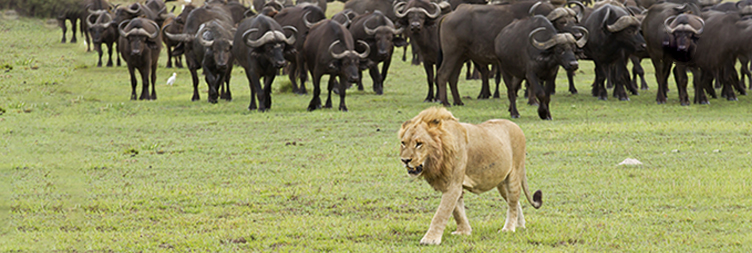
The Ngorongoro Crater supports an impressive variety of wildlife. Common sightings often include lions, elephants, buffalo, zebras, wildebeest, hyenas, hippos, gazelles, warthogs, and flamingos on the crater lake when conditions suit.
The crater is also one of Tanzania's better places to look for the endangered black rhino. That said, it's important to set realistic expectations, rhino sightings are never guaranteed, and when they do occur they're often from a considerable distance. Treat seeing one as a memorable bonus rather than something any operator can promise. Our wildlife guide covers what to expect more broadly.
A Crater Day
Down for the Day, Not Overnight
A crater visit is a full day: your guide descends the steep road early, you explore the habitats, then climb back up. No overnight stays are allowed.
A visit to the Ngorongoro Crater is usually a full-day experience. Early in the morning, your driver-guide descends the steep access road from the crater rim onto the floor below. Once there, you'll spend the day exploring different habitats in search of wildlife before climbing back up to the rim later in the afternoon.
Unlike the Serengeti, visitors do not stay overnight on the crater floor. Instead, accommodation is found either on the crater rim or elsewhere within the wider conservation area and nearby highlands.
The Rim Is High
Cold Mornings on the Rim
A surprise for many: the crater rim sits high at 2,200 meters, making mornings cold. Pack a warm fleece and jacket, then shed layers on the warm floor.
One thing surprises many first-time visitors. Although Tanzania is famous for its warm climate, the Ngorongoro Crater rim sits at approximately 2,200 metres (7,200 feet) above sea level, which means mornings can be genuinely cold.
Before descending into the crater, you'll often appreciate a fleece, a light jacket, long trousers and an extra layer for early morning. As the day warms up on the crater floor, you can simply remove those layers. Our guide to altitude on a Tanzania safari explains what to expect in more detail.
Crater vs Conservation Area
Not the Same Thing
The crater is just one feature inside the huge Ngorongoro Conservation Area, which also holds highlands, forests, plains, and Maasai communities.
These two terms are often confused, but they're not the same thing. The Ngorongoro Crater is one spectacular feature within the much larger Ngorongoro Conservation Area. The wider conservation area includes the crater itself, surrounding highlands, forests, open plains, Maasai communities, and the main route connecting the Northern Circuit with the Serengeti.
When people say they're "going to Ngorongoro," they usually mean visiting the crater, but the conservation area is much larger than the crater alone.
How It Fits + Talk
A Full Day in the Circuit
For most visitors, the crater is a full-day stop on a Northern Circuit loop linking Tarangire and the Serengeti. Density is real, but it gets busy.
For most visitors, the Ngorongoro Crater is included as a full-day safari within a classic Northern Circuit itinerary. Many safaris naturally flow Tarangire to Ngorongoro to Serengeti, or the reverse. Because a crater safari occupies most of the day, it fits naturally into a broader journey through northern Tanzania rather than as a destination requiring several nights on the floor.
The crater is one of the highlights of many of our itineraries, and before guests travel we explain exactly what to expect. We're honest: wildlife density really is exceptional, the scenery is unforgettable, black rhino sightings remain a bonus rather than a promise, and because it's so famous the crater can feel busier than more remote parks. By setting realistic expectations, guests usually leave appreciating exactly why it's one of Africa's most celebrated safari destinations.
A real example: a first-time couple told us before travelling that seeing a black rhino was their biggest dream. We explained the crater offered one of the better opportunities but that sightings were never guaranteed and often distant. They were fortunate enough to spot one through binoculars, but what surprised them most was that the lions, elephants and spectacular scenery became the real highlight of their day. They later said realistic expectations made the experience even more rewarding.
- Request a tailor-made quote (fastest, best for a real plan)
- WhatsApp: +255 740 666 662
- Email: info@safari-tz.com