Mount Meru Waterfall Guide
mount meru waterfall overview
napuru falls at a glance (quick facts)
what is mount meru waterfall famous for?
where is mount meru waterfall located?
why should i visit mount meru waterfall?
what wildlife can i see at napuru falls?
when is the best time to visit mount meru waterfall?
is napuru suitable for first-time visitors?
is mount meru waterfall safe to visit?
how many days do i need for napuru falls?
what activities are available at napuru?
where do i stay for mount meru waterfall?
is napuru suitable for families?
what should i pack for mount meru waterfall?
how much does a mount meru waterfall visit cost?
how do i get to mount meru waterfall?
can napuru be combined with other trips?
napuru vs themi vs tululusia: which falls?
why book napuru with safari-tz.com?
Mount Meru Waterfall Overview
A 78-Metre Drop Half an Hour From Town
Mount Meru Waterfall overview from Safari-tz.com: the Napuru falls above Arusha, a riverbed hike to a 78-metre drop with a swimmable pool.
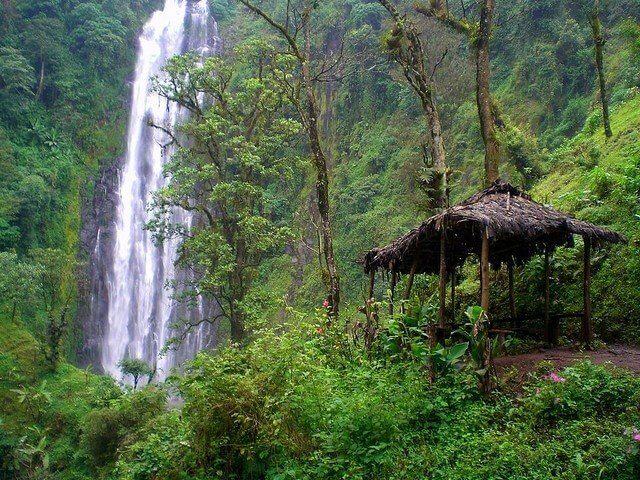
Mount Meru Waterfall drops a mountain river around 78 metres into a forested valley on Meru's southern slopes, roughly ten kilometres above Arusha, and it holds a distinction this series has been saving for its eighth page: the tallest waterfall you can stand beneath within easy reach of the safari capital, taller than everything else in the Arusha orbit put together, and hidden so well in its river valley that most of the city below has never seen it.
The visit is an adventure in the honest, small-scale sense. The approach climbs through the village and farm country of Meru's lower slopes to a trailhead in pine and forest-reserve country, the hike then descends a genuinely steep stairway of roots and earth into the river valley, and from the valley floor the trail is, for long stretches, the river itself: crossings on stepping stones, wading in the cold shallows, mossy rock, a smaller falls en route as the rehearsal, and finally the main drop, announced by its own mist and arriving with a force that soaks visitors well before the pool. Swimming, for those who want it, happens at the pool's edge on the day's conditions, and the difficulty section grades the whole outing plainly.
One housekeeping matter this page exists partly to settle: the falls answers to two names, Mount Meru Waterfall in the guidebooks and Napuru to the people whose home it is, and both mean this valley. It is not Themi Falls, a separate, smaller falls covered on its own page, despite the loose spellings that sometimes blur the two online. Section 4 sorts the map properly.
Safari-tz.com builds Napuru into Arusha stays, safari warm-up days and Kilimanjaro acclimatisation plans, exactly where the combinations section places it.
Napuru Falls at a Glance (Quick Facts)
Key Facts Before Your Napuru Hike
Quick Mount Meru Waterfall facts from Safari-tz.com: the 78-metre Napuru falls above Arusha, riverbed hiking, a swimmable pool and forest trail.
The short version: Arusha's giant, a 78-metre drop in a forest river valley half an hour above town, reached by a steep descent and a riverbed walk, with a swim at the end for the willing.
- The falls: Commonly given as around 78 metres, a single serious drop into a pool, with spray that reaches you long before the water does.
- The names: Mount Meru Waterfall and Napuru are the same falls. Themi Falls is a different, smaller one nearby, sorted on its own page.
- The hike: Roughly four to five kilometres out and back, one and a half to two hours plus pool time. A steep stairway descent, then the riverbed as the trail: crossings, wading, mossy stone.
- The swim: Genuine, in the pool below the drop, on the day's conditions and the guide's read. The spray zone soaks the unwilling anyway; dress accordingly.
- The access question: Two framings exist, the village and forest-reserve side most hikes use, and a park-side loop under full TANAPA machinery. Fees differ enormously between them, and Section 15 is honest about it.
- The guides: Local guiding from the Meru-slope villages, genuinely useful on braided paths and river route-finding.
- Base: Your Arusha bed. The orbit's third and biggest falls, same commute logic as its siblings.
- Best months: June to October and December to February; the rains swell the drop and raise the crossings.
- Fitness: Moderate. Steep stairs, wet stone, cold water. The difficulty section audits honestly.
What Is Mount Meru Waterfall Famous For?
The Height, the Riverbed, the Force
Mount Meru Waterfall is famous for its 78-metre drop, the riverbed trail that reaches it, and spray so forceful it soaks visitors at a distance.
Napuru's fame runs on three facts, and the first one reorganises the other two.
The height first. Around 78 metres is a serious number anywhere; half an hour from a major city it is nearly unreasonable, several times the drop of anything else in the Arusha orbit and within conversation distance of falls this series made expeditions of. The scale lands physically rather than statistically: the drop fills its valley wall, the sound arrives in the chest as much as the ears, and first-time visitors' photographs reliably include one attempt to fit the whole thing in frame and one admission of defeat.
The riverbed second, because the trail's format is half the memory. From the bottom of the descent stairway the river is the path, crossed and re-crossed on stones, waded where the stones give out, cold mountain water doing its work on ankles and mood alike, and the valley's green closing overhead, moss, roots, butterflies, the smaller rehearsal falls partway. Readers of this series will hear the echo of Ngare Sero's format and the comparison section prices the differences; the short version is that Napuru is the rainforest edition, gentler wading toward a much bigger finish.
The force third, and it is the fame guests retell: the main falls generates its own weather, mist rolling down the valley to meet you, spray that saturates at distances that seem safe until they are not, and a final approach that is a negotiation between the photograph you want and the soaking you are willing to accept. The safety section carries the rules; the memory carries itself.
Where Is Mount Meru Waterfall Located?
Finding Napuru, and Sorting the Names
Mount Meru Waterfall sits about ten kilometres above Arusha in the Kambiyachupa and forest-reserve country of Meru's southern slopes.
Napuru hides in a river valley on Mount Meru's southern slopes, roughly ten kilometres north of central Arusha in the Kambiyachupa-side village country, where the city's edge climbs through smallholdings into pine plantation and the Meru Forest Reserve's green. The approach road is steep, rough in its final stretches, and short: twenty to thirty minutes from town in the common telling, which places the series' biggest nearby drop inside the same commute logic as its doorstep siblings.
Now the map-sorting this page owes the internet, because the Arusha orbit's falls have tangled their names online and this website holds three of them. Mount Meru Waterfall and Napuru Waterfall are one falls, this page's falls, the names used interchangeably by guides, maps and reviews. Themi Falls is a different, smaller, spring-fed falls at Olgilai with its own page and its own no-swimming law, sometimes blurred with Napuru under loose "Temi" spellings in tour listings; they are neighbours in the same general slope country, and they are not the same place. Tululusia is different again, inside Arusha National Park at Momella with its armed-ranger walk. Three falls, three pages, three completely different days, and the comparison section prices the trio.
One more boundary matters practically: the valley sits in the seam between village land, the forest reserve and the national park's southwestern reaches, which is why two access framings exist with very different paperwork, the subject Section 15 handles with the honesty it needs. The falls does not move. The gate you use decides most of what you pay.
Why Should I Visit Mount Meru Waterfall?
The Case for the Giant Next Door
Why visit Mount Meru Waterfall: the biggest drop near any Tanzanian city, a genuine small adventure, a swim, and the best warm-up hike in Arusha.
Because Napuru answers the question this series' Arusha pages keep hearing in different forms: is there a real one near town? Themi is charming and honest about its size; Tululusia sells the safari more than the falls; and Napuru is the real one, the drop that needs no qualifying clause, at the same half-hour range.
The adventure argument carries the visit. This is not a viewpoint stroll: the stairway descent is steep enough to earn respect, the riverbed trail gets your feet wet by design, the rehearsal falls raises the stakes, and the finale soaks you in its own manufactured weather, a two-hour arc with a proper story shape, and precisely the scale of adventure that fits inside an Arusha day without consuming one. Guests use the word "expedition" with a laugh and mean the laugh affectionately: it is the pocket edition, and the pocket edition is a genuinely underrated product.
The warm-up argument seals it for two audiences this website serves in volume. Safari arrivals get legs moving, boots tested and Tanzania met at ground level before the vehicle week begins, the Lion King of acclimatisation days. And climbers bound for Meru or Kilimanjaro get the best rehearsal in the orbit: a descent-and-ascent with real gradient, wet-rock footwork, and altitude's gentlest foothills, all recoverable by dinner, slotting into the prep-day architecture our climbing pages build.
And the swim closes the case in this family's own currency: a genuine pool below a genuine giant, the orbit's only real swimming falls, Themi's law forbidding and Tululusia's force prohibiting, which makes Napuru, quietly, the answer to the question families ask first.
What Wildlife Can I See at Napuru Falls?
The Forest Valley Register, Honestly
Napuru wildlife runs the forest-valley register: monkeys, chameleons, butterflies and birdlife on the riverbed trail, with the park next door.
The honest register, forest-valley edition: Napuru's wildlife is the supporting cast to a headline waterfall, richer than its doorstep sibling's, gentler than its park sibling's, and priced here exactly in between.
The valley's cast earns its billing. Monkeys work the forest sections on their own schedule, met often enough on the trail to be an expectation worth carrying and never a promise worth printing; the chameleon economy runs at full Meru-slope strength, produced from foliage by guides whose sleight of hand this website has now documented across five ranges, and children audit it accordingly; and the butterflies deserve the specific mention the sources and our own guests keep making, the river's spray margins and damp valley air concentrating them in the hundreds on good mornings, an escort down the riverbed that photographs better than it has any right to. The birdlife runs the forest-and-water register throughout, the descent's canopy and the valley floor offering different bands of it, binoculars earning their carry per the standing rule, with the honest note that the riverbed's footwork owns your hands for real stretches.
The village country of the approach adds its usual working parade, coffee and banana smallholdings, produce stalls the guides know personally, the texture that starts the visit before the trailhead.
The redirect runs at orbit strength: the big-game register lives next door, Tululusia's ranger-led glades an hour away and the park's full menu behind it, and the trio's division of labour, covered in the comparison section, is exactly why all three pages exist.
When Is the Best Time to Visit Mount Meru Waterfall?
The Flow Trade, Riverbed Edition
Visit Mount Meru Waterfall June to October or December to February; the rains swell the giant but raise the crossings and grease the stairway.
June to October first, December to February second, the orbit standard, and the series' flow-versus-access trade arrives at Napuru in the form the riverbed format makes inevitable: here the rains do not close a road, they raise the trail itself, because the trail is the river.
The dry windows deliver the classic version: the stairway descent at its most trustworthy, the crossings at stepping-stone height, the wading at refreshing rather than committing depths, the pool at its most swimmable, and the falls still carrying the volume that makes its reputation, a 78-metre drop being generous even in its leaner months, with each window's early weeks holding the best of both. The valley's forest keeps the walk shaded and civil in hours that bake the open country, a small mercy the orbit's other pages cannot offer.
The rains invert the spectacle in the pattern the series knows, with the riverbed twist: the giant swells toward a force that visitors describe with weather metaphors, the spray zone expands down the valley to meet you early, and the price is paid in the trail's own currency, higher crossings, faster water, greased stairway earth, and days when the guides' read moves the turnaround downstream of the pool or reshapes the route entirely. The wet-season version stays a genuine product for the sure-footed and the waterproofed, briefed as exactly that at booking, and the guides' word on the river's day, this series' standing law since the Natron gorge, governs here in its rainforest form.
The daily law holds at orbit strength: mornings for the light in a deep valley, the butterflies' active hours, and the pool before the afternoon's small crowds, such as Napuru's crowds ever are.
Is Napuru Suitable for First-Time Visitors?
What the Stairway and the River Ask
Napuru suits reasonably fit visitors happy to get wet: a steep stairway descent, riverbed wading and slick stone, graded honestly at booking.
Yes for the reasonably fit and the willingly wet, and the audit at Napuru combines two questions this series has previously asked on separate pages: Kisasa's stairs question and Ngare Sero's water question, both at moderate settings, both honestly.
The stairs question first. The descent into the valley is genuinely steep, a stairway of roots, earth and improvised steps losing serious height quickly, and everything that goes down comes back up at the day's end on legs the river has already entertained; fit walkers find it invigorating, the knee-concerned should hear the Kisasa precedent applied here at slightly firmer grade, poles and the guide's hand endorsed without embarrassment, and the honest floor is that there is no stair-free version of this falls, the valley admitting visitors only the hard way, which is of course half the reason it stays quiet.
The water question second, at gentler settings than the Natron gorge asked: crossings on stones with wading between, ankle-deep as the standard and deeper after rain, cold enough to announce itself, current that asks for attention rather than courage, and the pool's swim graded per swimmer per day. The audit questions travel from Ngare Sero's page softened one notch: steady on wet stones, relaxed about wet feet as a certainty and a soaking as a likelihood, and swimming ability matched honestly to a pool below a very large drop. Children per the family section's terms.
Who routes elsewhere: the stair-averse to Themi's gentler valley, the wet-averse to Tululusia's dry-boots chamber, and the orbit, conveniently, holds a falls for every answer to this section's questions, which is the trio working as designed.
Is Mount Meru Waterfall Safe to Visit?
How Risk Is Managed Below the Giant
Napuru safety centres on the guides' river read, the falls' force at close range, stairway and wet-stone care, and honest swim matching at the pool.
Napuru runs a manageable risk profile with the riverbed format's signature items, and this page states them in the order the valley presents them.
The river leads, in the law this series wrote at Ngare Sero and applies here in its rainforest form: a valley trail that is the river answers to rain that may be falling out of sight higher on the mountain, rising water reshapes crossings before it threatens anyone who respects it, and the local guides' read of the day, the sky, the level, the water's colour and pace, is the operating system, their word to proceed, reroute or turn final in the standing form. Napuru's valley is more open and its normal flows gentler than the Natron slot's, stated plainly so the law reads as proportionate rather than borrowed drama, and the law stands anyway, because rivers do not grade on curves.
The falls' force comes second and Section 3 already confessed it: the drop's power at close range is genuinely serious, the spray zone disguises the transition from thrilling to unwise, and the final approach and any venture toward the drop itself happen at the guide's distances or not at all, the keep-back rule this series wrote at Tululusia applying here with a swimmable pool attached, which means it applies twice. The swim itself runs the standing register: entries where the guides indicate, swimmers matched honestly, the pool's far reaches and the fall-line respected absolutely, children per the family law.
The ordinary ledger closes: the stairway's steep earth, greased after rain; wet stone throughout, the tread commandment at full strength; sun on the approach country; and the orbit's gentle remoteness arithmetic, town half an hour away, the series' standing comfort.
The site-wide medical close stands, unamended, as always.
How Many Days Do I Need for Napuru Falls?
Half a Day, With a Story Attached
Mount Meru Waterfall fills a half-day from Arusha, two hours of hiking plus pool time, the orbit's biggest outing that still fits before dinner.
Half a day, honestly filled, and Napuru sits exactly where the Arusha orbit needed an entry: bigger than Themi's long lunch, lighter than Tululusia's stacked park day, the outing for the day that has a morning or an afternoon to spend properly and wants a story back for it.
The shape: the half-hour drive up through the village country, the guide meeting at the trailhead side, the stairway descent, the riverbed hour with its crossings and its rehearsal falls, the giant's finale with the pool time the day's conditions and the party's swimmers vote for, and the climb back out while legs still cooperate, town again inside four to five hours door to door in the standard telling. Morning versions buy the light, the butterflies and the emptiest pool per the daily law; afternoon versions serve the arrived-today crowd honestly, with the climb out timed against the valley's early dusk, a note the guides manage as routine.
The extensions exist for the appetite: loop variants that climb out by different lines, the city-viewpoint add-on that trades an extra hour for Arusha spread below, and the coffee-country pairings the approach villages have built into a genuine local industry, farm tours and home-grown cups bracketing the hike in the pattern several of the valley's guiding families have made their signature. A full Arusha day threads Napuru with the coffee morning or the city's stops per the combinations section.
What the visit never needs is the series' anti-compression sermon, retired for the orbit at Themi and staying retired: the half-day is the design. The one scheduling sin remains its Themi-page form, skipping the giant on a day that had the hours.
What Activities Are Available at Napuru?
Stairway, Riverbed, Pool and Coffee
At Mount Meru Waterfall: the riverbed hike, the rehearsal falls, the giant's pool and spray, viewpoint extensions and the coffee-country pairing.
Napuru's menu is the hike examined at its stations plus the country it climbs through, and the order below is the order the day serves it.
The descent opens the show: the stairway's steep green plunge from pine-country light into valley shade, the river's sound rising to meet you, and the first crossing as the formal start of the format, boots wet by design, the honest advice the sources and our guides agree on being to accept it early and enjoy the day it buys.
The riverbed is the main act's first movement: the crossings, the wading stretches, the mossy sculpture the water has made of the valley's rock, the butterfly escort on good mornings, and the rehearsal falls partway, a genuine smaller drop that resets expectations upward and doubles, on the return, as the drying-off sunbathing stop the veterans use it as.
The giant is the finale and needs no re-describing after Section 3: the approach negotiation, the spray, the photographs and their admitted defeat, and the pool for the swimmers the audit cleared, the orbit's only true swimming falls doing its work below 78 metres of white noise.
The extensions frame it: the city-viewpoint hike for the panorama the valley denies, the loop variants for parties who dislike retracing, and the coffee-country pairing that the approach villages have made the classic bracket, farm walks and home-grown cups before or after, an economy this website supports on principle and recommends on merit, the combination converting a half-day hike into the best full local day the orbit offers.
Where Do I Stay for Mount Meru Waterfall?
The Orbit's Answer, Third Verse
Mount Meru Waterfall visitors stay wherever their Arusha itinerary sleeps; the falls is a half-day outing from any bed in the city's orbit.
The orbit's accommodation answer, third verse, same as the first: your Arusha bed is the answer, the Themi page wrote the template, the Tululusia page amended it for gate hours, and Napuru sits between its siblings needing only the mildest verse of its own.
The full Arusha range serves the falls without preference, the half-hour commute flattening the positional arithmetic that mattered marginally at the park gate, and the choice among town hotels, garden lodges, coffee estates and guesthouses belongs entirely to the wider itinerary's logic. The one positional note worth its sentence mirrors Themi's: the city's northern-side properties shave minutes from an already short run, a gain we factor silently for the tightest arrival-day schedules and mention here only for completeness.
The stay-local curiosity gets its honest line, as the series' pattern requires: the approach villages' coffee-farm guiding families run their own modest hospitality in the local register, farm stays and lunches that the coffee-pairing itineraries naturally meet, bookable through the local arrangements and confirmed per trip for the travellers charmed into extending, filed, like Themi's treehouse cabins, as pleasant curiosity rather than strategy.
Booking pressure: none attributable to the falls itself, the orbit's beds filling on safari-season logic that has never heard of Napuru, which is, this series notes, roughly the falls' entire situation and much of its charm. We hold the Arusha beds when the wider itinerary locks, per standing practice, and the falls borrows whichever afternoon suits.
Is Napuru Suitable for Families?
The Family Answer: the Orbit's Adventure
Napuru suits adventurous families with steady, water-happy children: real stairs, river crossings, a swim finale and the orbit's biggest story.
A yes for the adventurous family, with the audit the difficulty section built applied at child scale, and a positioning sentence first: within the Arusha trio, Napuru is the family's adventure day, the one the children will call the real one, and it asks proportionally more than its siblings.
The case for: the day has the story shape children live inside, a descent into a valley, a river for a path, a rehearsal falls, a giant finale, a swim, and every element arrives at child-legible scale, crossings counted competitively, the chameleon-and-butterfly economy running at full strength, and the soaking-by-spray finale filed by most children as the trip's headline weather event. The guides hand-assist small walkers across the crossings as standing routine, the rehearsal falls serves as the honest turnaround for parties whose youngest members' morning has peaked, and the pool swim, for families whose children genuinely swim, is the orbit's only version of this series' happiest institution.
The terms, plainly: the stairway is real and doubled for small legs on the return, briefed in advance as the day's mountain per the Kisasa telling; the crossings demand the steady feet and held hands the safety section's river law implies, with the wet-season version belonging to sure-footed families only; the swim runs the full family register, actual swimmers, arm's reach, entries on the guide's word, the fall-line absolute; and the age floor sits, in practice, where confident walking and genuine swimming meet, a year or two above Themi's and below the Natron gorge's, graded honestly at booking.
The orbit's family sequence, now complete: Themi on the arrival afternoon, Tululusia's ranger morning mid-stay, Napuru's adventure when legs and confidence have warmed up, three falls, three registers, one city.
What Should I Pack for Mount Meru Waterfall?
Packing for Stairs, River and Spray
Napuru packing list: shoes that work wet, swimwear worn, dry bags as law, a towel in the vehicle, poles for the stairway and sun cover above.
Pack the Ngare Sero philosophy at rainforest settings: everything works wet or travels sealed, and the bag stays half-day light because the vehicle waits half an hour away.
The core: footwear that works submerged and grips wet stone, the series' first commandment at its Napuru double-duty, the same shoes handling the stairway's earth and the riverbed's crossings, with the sources' unanimous verdict on flip-flops and bare feet, uncomfortable and unwise, endorsed here as the cheap lesson it is; swimwear worn from town under quick-dry layers, the veterans' move at its third appearance in this series and its most useful, the pool and the spray between them guaranteeing the wetting the clothing should plan for; a light rain shell for the spray zone's final approach, worn by the photograph-takers and skipped by the surrendered; and sun cover for the open approach country and the pine-side trailhead, the valley's shade handling the rest.
The dry-bag law runs at Natron strength: one proper seal for phones, cameras and anything the crossings could collect, the spray zone auditing every zip at the finale, and the lens cloth carried accessible per the falls photographer's standing craft. Poles or the guide's hand for the stairway, endorsed by the difficulty section without embarrassment; water at half-day volumes despite the river's cold irony; and the towel and dry change waiting in the vehicle, not on your back, the Ngare Sero rule travelling intact.
The subtraction rule closes at orbit weight: it is a half-day, the daypack does the stairway twice and the crossings throughout, and your pool-edge self, soaked past negotiating and grinning below the giant, signs the series' second-wettest final bag.
How Much Does a Mount Meru Waterfall Visit Cost?
Two Gates, Two Invoices, One Honest Answer
Mount Meru Waterfall costs depend entirely on the access route: modest village and reserve fees one way, full TANAPA machinery the other, itemised.
Napuru's cost section has one job no other page in this series has needed, and it does it plainly: the same falls carries two completely different invoices depending on which side you enter from, visitor reports online conflict wildly because of it, and sorting the confusion is half of what arranging this visit properly means.
The village-and-reserve framing is the common one and the one most hikes use: access from the Kambiyachupa-side village country through the forest-reserve arrangements, local entrance and guiding fees at the modest register, the coffee-country pairings priced in the same local economy, and a total that rounds to a fraction of a park day. The park-side framing is the other animal entirely: the loop routing that enters under Arusha National Park's machinery carries the full TANAPA stack, conservation fees, walking fees, ranger and vehicle lines, the Tululusia page's registers applied to a different trail, and travellers who arrive expecting village prices at a park gate have written the internet's most consistent Napuru complaint. Neither framing is wrong; they are different products at different prices, the park version adding the ranger-led game country its fees imply, and the honest operator's job is matching the framing to what you actually want and quoting it before you are standing at a gate.
That is what we do: the routing chosen with you at booking, village-side for the classic falls hike and coffee pairing, park-side where the itinerary wants the machinery's additions, the fees of whichever gate stated itemised and current, and the functioning-structure defence applying to both registers, the village economy and the park system each kept working by being paid properly.
Figures stay off the page at standing strength, both registers revising on their own schedules; quotes arrive itemised, gate named.
How Do I Get to Mount Meru Waterfall?
A Steep Half Hour, Then the Stairs
Reach Mount Meru Waterfall by a half-hour drive from Arusha up the Kambiyachupa-side village roads, steep and rough at the top, then on foot.
By the orbit's steepest short drive, and the access story runs in the stages the whole page has rehearsed: the climb by road, then the climb down on foot.
The drive: from central Arusha, the route works north into the Kambiyachupa-side slope country, village roads climbing through smallholdings and coffee country into the pine and reserve belt, twenty to thirty minutes in the common telling, with the final stretches steep and rough enough that the sources' motorbike-taxi tradition exists for a reason and a capable vehicle earns its keep. Any arranged transfer handles it; the trailhead formalities run per whichever access framing Section 15 chose, village-and-reserve in the standard version; and the guides meet the party where the local arrangement appoints.
The walk needs no re-mapping after eleven sections: the stairway down, the riverbed along, the giant at the end, the same route home. The one access-craft note worth adding is the turnaround arithmetic the valley imposes: the climb out claims the day's last energy and the valley loses its light early, so afternoon visits build their exit margin at the pool rather than discovering its absence on the stairs, a calculation the guides run as routine and our schedules run for them.
The daily law closes in orbit form: morning versions collect the light, the butterflies and the empty pool at the cost of an alarm clock; afternoon versions serve the landed-today crowd with the exit-margin note applied; and the arrival-day conversion, the orbit's signature since Themi, works here for the traveller whose first Tanzanian afternoon deserves a giant, which, this page submits, most do.
Can Napuru Be Combined With Other Trips?
The Coffee Bracket, and the Trio
Combine Mount Meru Waterfall with coffee-farm tours, the Arusha falls trio, climb warm-up days, or the safari's ground-level opening act.
Napuru's combinations start in its own approach villages and widen through the orbit, and this section assembles them in the order the local economy built them.
The coffee bracket leads because the valley's own guiding families invented it: farm walks through the approach country's plantations, the crop explained by the people who grow it, home-grown cups served before or after the hike, and lunch in the farm register for the full version, the pairing that converts the half-day falls into the orbit's best complete local day and puts the visit's money into the slope economy twice. We build it as the default Napuru format unless the schedule votes otherwise, and the schedule rarely wins the argument.
The trio completes next, the orbit's three falls now all paged and their sequence stated at Themi and refined since: doorstep, safari, giant, in whatever order the stay's energy suggests, with the comparison section next door pricing the choices for the traveller who must choose. Longido's day summit joins the same spare-day family per its page, the orbit now holding four different on-foot answers to a free Arusha day, a menu this website assembled page by page and files under quiet satisfaction.
The climb-prep slot serves the mountain audience: Napuru as the boots-and-legs rehearsal before Meru or Kilimanjaro, the stairway and riverbed testing exactly what the huts will ask, recoverable by dinner per the prep-day architecture our climbing pages build, and threaded before the rest-interval the physiology rule schedules.
And the safari's opening act closes it, the orbit's standing sequencing claim: Tanzania met at ground level, wet boots and a giant's spray, before the vehicle week begins, and every game drive afterwards reading differently for it.
Napuru vs Themi vs Tululusia: Which Falls?
The Giant, the Doorstep and the Safari
Napuru, Themi or Tululusia? Compare Arusha's three waterfalls by size, cost, adventure and audience, and build the trio in its natural order.
The Arusha trio is complete, the orbit's falls sorting into three registers as cleanly as the Natron volcanoes sorted into temperaments, and this section prices the full hand.
Themi is the doorstep: the smallest falls and the smallest ask, the spring-and-city-water story, village fees, a long lunch's commitment, the arrival-afternoon conversion, and the family floor at its lowest, its page's honest concession standing, sold on placement, not spectacle. Tululusia is the safari: the park machinery and the armed ranger, buffalo country on foot, the carved chamber, the stacked park day its fees unlock, and the discipline requirement its family section prices, the falls that is really a walking safari wearing a waterfall. Napuru is the giant: the real drop, around 78 metres of it, the riverbed adventure, the orbit's only true swim, the coffee bracket, moderate fees on the standard framing, and the highest physical ask of the three, stairs and water both.
The matching, by traveller: hours and jet lag, Themi; game country and a park's worth of curiosity, Tululusia; the adventure and the spectacle, Napuru, and if the stay holds only one falls slot, this page, with due respect to its siblings, submits that the giant is the one the photographs argue for. The trio answer stands as the orbit's real recommendation for any three-plus-night Arusha stay: doorstep, safari, giant, in rising order of ask, the sequence the family section set and the whole city's water story told in three walks.
Eight categories now stand across the series, and the standing note to the keeper survives its eighth page: the list awaits its final shape, though the Arusha orbit, at least, is now complete.
Why Book Napuru With Safari-Tz.Com?
The Right Gate, the Right Day, the Guide
Book Mount Meru Waterfall with Safari-tz.com: the access framing sorted, the river read respected, the coffee bracket built and quotes itemised.
Napuru is the page where the series' arrangement argument gets its plainest evidence, because the falls' online reputation carries the scar this page exists to prevent: the traveller who set out for a modest village hike and met a park gate's full invoice, or the reverse, the one who paid for machinery and wanted only the riverbed, the confusion Section 15 sorted living on in review after review because nobody sorted it before the vehicle left town. The improvised Napuru visit works often enough to tempt; the arranged version removes the ways it fails: the access framing chosen with you and quoted before departure, gate named; the guide engaged through the valley's own arrangements, the river read that the safety section called the operating system arriving with him; the day placed by the daily law's arithmetic, morning for the pool and the light, afternoon with the exit margin built; the family audit taken on the sofa rather than the stairway; the coffee bracket booked with the farm families whose economy the visit should feed; and the giant slotted where the wider itinerary, the safari's opening, the climb's rehearsal, the trio's sequence, makes it land hardest.
The day before the day, the sentence this series has now carried from a three-day western road to a half-hour village climb, and it has not lost a page yet. Lead guides Geoffrey Komba, William Mwasimba, and Isaac Munuo oversee our operations, and the standing sentence closes its twentieth page with its record intact: guests do not experience our logistics in proportion to their size.
Ready to plan your Mount Meru Waterfall hike?
- Request a tailor-made quote (fastest, best for a real plan)
- WhatsApp: +255 740 666 662
- Email: info@safari-tz.com
Tell us your dates, your party's stairs-and-water honesty, and whether coffee brackets the hike. You will get the right gate, the right guide and an itemised quote.