Things to Do in Bagamoyo, Tanzania
explore bagamoyo old town
the old fort & german boma
caravan serai & bagamoyo museum
holy ghost mission & livingstone
visit the kaole ruins
tasuba & the arts festival
local art studios
bagamoyo beach & dhows
coastal & heritage photography
fish market & town markets
swahili cooking classes
swahili culture & village life
mangroves & coastal birding
cycling tours
day trip to saadani park
wami river boat safari
Explore Bagamoyo Old Town
Swahili, Omani and German streets
Walk Bagamoyo’s old Stone Town (Mji Mkongwe) — narrow streets of Swahili, Omani, Indian and German buildings in one of the coast’s most historic towns.
The heart of Bagamoyo is its old town — Mji Mkongwe, a national monument — a tight grid of streets running back from the seafront, lined with the layered architecture of everyone who traded here: Swahili coral-stone houses with carved doors, Omani merchants’ homes, Indian shopfronts and the heavier stone of the German administration, including the ruined old customs house on the shore.
It is best explored slowly on foot with a local guide, who can read the buildings and tell you which was a trader’s house, which a colonial office, and how the whole port worked at its nineteenth-century height. An hour’s wander becomes a real history lesson in the right company.
One honest note: this is not the polished, restored Stone Town of Zanzibar. Many buildings are faded, crumbling and lived-in, and that air of gentle decay is part of Bagamoyo’s sombre character rather than a fault. Good walking shoes and a guide are what you need. We arrange the guide. Pricing on request.
The Old Fort & German Boma
Two landmarks, two colonial eras
Visit Bagamoyo’s Old Fort and German Boma — the 1860s Arab fort once used to hold enslaved people, and the 1890s German colonial headquarters.
Two of Bagamoyo’s most recognisable buildings tell two different chapters of its past. The Old Fort — Ngome Kongwe — is the older, a squat whitewashed building put up around 1860 by Omani and Arab traders. Its history is a hard one: it was used to hold enslaved people awaiting the dhows to Zanzibar, and over later years served as a prison, police post and store. Standing in it is a sobering experience, and rightly so.
A short way off is the German Boma, a far grander structure built in the 1890s as the administrative headquarters of German East Africa, in the years when Bagamoyo was its capital. After the First World War the British used it too, right up to independence in 1961.
A guide is what turns these from old walls into the stories they hold — and helps keep the two straight, as they are often confused. We arrange the guide and access. Pricing on request.
Caravan Serai & Bagamoyo Museum
Where the caravans ended their march
Visit the Caravan Serai and Bagamoyo Museum — where inland caravans ended their march to the sea, now museums of the town’s trade and slave history.
Before the railway, everything that left the interior of East Africa came out on foot, and Bagamoyo was where the great caravans finally reached the sea. The Caravan Serai was their staging post — a walled compound, built before the German era, where the porters of the Wanyamwezi and others rested and the trade goods and animals were held before the crossing to Zanzibar. Today it houses a small museum on the caravan routes and the slave trade they carried.
A short walk away, the Bagamoyo Museum fills in the wider story of the town’s contact with the outside world, with old photographs, documents and relics, including sobering material on the slave trade.
Neither is large, but together with a guide they make sense of why this quiet town once mattered so much. Easy to fold into an old-town walk. We arrange entry and a guide. Pricing on request.
Holy Ghost Mission & Livingstone
The first mainland mission, and a tower
Bagamoyo’s Holy Ghost Mission — the oldest Catholic mission in mainland East Africa, with a slavery museum and the tower where Livingstone rested in 1874.
Two kilometres north of town, at the end of a long avenue of mango trees, the Holy Ghost Mission is one of Bagamoyo’s most moving places. Founded in 1868 by French missionaries of the Holy Ghost Fathers, it was the first Catholic mission on the mainland of East Africa, and from the start its purpose was bound up with the slave trade on its doorstep: it ran a ‘Freedom Village’ where ransomed and freed slaves were sheltered, cared for and taught.
The original 1872 church, the oldest on the mainland, carries a squat tower now known as the Livingstone Tower — it was here that the body of the explorer David Livingstone rested for a night in 1874, on its long journey by way of Zanzibar to burial in Westminster Abbey. The mission museum is quietly devastating, with photographs and exhibits on the trade in human beings; the grounds also hold an old grotto, the Fathers’ house, a cemetery and a baobab planted in 1868.
It is a place to go slowly and thoughtfully. A guide adds the history the buildings alone cannot. We arrange the visit. Pricing on request.
Visit the Kaole Ruins
13th-century mosques and pillar tombs
Explore the Kaole Ruins south of Bagamoyo — a 13th-century mosque among the oldest in East Africa, a 15th-century mosque, Shirazi pillar tombs and a museum.
Five kilometres south of town lie the Kaole Ruins, older by centuries than Bagamoyo itself and far less visited. This was a Swahili settlement of the Shirazi era, and at its centre stand the coral-stone remains of a thirteenth-century mosque — one of the oldest on the entire East African mainland, built when the Sultan of Kilwa ruled the coastal trade and long before Bagamoyo amounted to anything. A second mosque dates from the fifteenth century.
Around them are some two dozen graves, among them tall Shirazi pillar tombs in notably good condition, along with old wells and a small museum holding fragments of the Chinese porcelain that once reached this coast by trade. A great baobab and a silted old harbour in the mangroves complete the scene.
It is foundations and atmosphere rather than standing buildings, so a guide who can rebuild it in your imagination makes all the difference. Quiet, shaded and evocative. We arrange the guide and entry. Pricing on request.
TaSUBa & the Arts Festival
Tanzania’s home of music and dance
Experience TaSUBa, Bagamoyo’s national college of arts — music, dance, drama and visual arts, plus the annual arts festival that fills the town each year.
For all its sombre history, Bagamoyo is also one of Tanzania’s liveliest cultural towns, and the reason is TaSUBa — the Institute of Arts and Culture, long known as the Bagamoyo College of Arts or Chuo cha Sanaa. It is the country’s national home for music, dance, drama and the visual arts, and a visit can mean watching students rehearse, catching a drumming or dance performance, or simply seeing the creative side of a town better known for its ruins.
Once a year the college hosts the Bagamoyo Arts Festival, when performers from across Tanzania and beyond fill the town with music, dance and theatre for several days — a wonderful time to be here if your dates line up.
Performances depend on the term and festival calendar, so it is worth arranging ahead rather than just turning up. Great for families and anyone who loves live culture. We check what’s on and set it up. Pricing on request.
Local Art Studios
Carvers, painters and craft makers
Meet Bagamoyo’s artists in their studios — wood carvers, painters and craft makers in a town with a strong creative tradition, with work to watch and to buy.
The creative energy that TaSUBa generates spills out into the town, and Bagamoyo has a genuine community of working artists. Visiting their studios lets you meet wood carvers, painters and craft makers, watch pieces take shape, and buy directly from the person who made them — carvings, canvases, textiles and handmade crafts, often at far better value and with far more meaning than a souvenir stall.
These are working studios rather than polished galleries, which is the charm: you see the chisels and the half-finished work, and you can talk to the artist about what they are making and why.
Buying direct puts the money straight into the maker’s hands, which we think is the right way to take a piece of Bagamoyo home. Easy to combine with an old-town walk or a TaSUBa visit. We can point you to the studios worth your time. Pricing on request.
Bagamoyo Beach & Dhows
The working shore and its sailboats
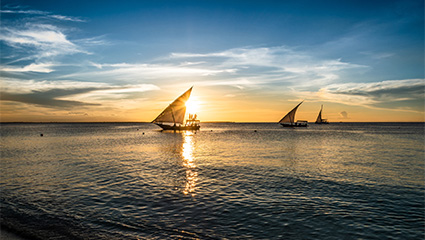
Relax on Bagamoyo’s beach and watch the dhows — still a dhow-building and fishing coast, with long sands, sailboats coming and going, and fine sunset walks.
After a morning among the ruins, Bagamoyo’s beach is the place to let the history settle. This is a working shore rather than a resort strip — the town has been a centre of dhow-building and fishing for generations, and the sand is shared with wooden boats under construction, fishermen mending nets and dhows coming and going under sail, exactly as they have for centuries.
It makes for atmospheric long walks, especially toward sunset when the light goes gold behind the masts, and there are quieter stretches for a swim away from the town.
Set your expectations rightly: this is a real coastal town’s beach, lively and lived-in near the centre, not a manicured hotel strand — for that, the Saadani coast or Zanzibar is the answer. Here the dhows and the daily life are the draw. We can arrange a guided shore walk or a dhow outing. Pricing on request.
Coastal & Heritage Photography
Old walls, dhows and ocean light
Photograph Bagamoyo — weathered colonial buildings, carved doors, dhows under sail, palm-lined beaches and coastal life, in soft morning and evening light.
Bagamoyo is a photographer’s town. The weathered textures of the old quarter — carved doors, peeling colonial plaster, the skeletal old customs house — sit a few minutes from dhows under sail, fishermen on the sand and palm-lined beach, and the whole lot takes light beautifully early and late in the day.
A guided photography outing is mostly about timing and access: catching the old town before the heat, being on the beach as the dhows come in, and getting into the corners of a working town where a local presence makes you welcome rather than intrusive. The one rule we hold to is asking before photographing people, which a guide makes easy and natural.
Soft morning and evening light is when the town performs; midday is harsh and bright. We arrange the guide and the timing. Pricing on request.
Fish Market & Town Markets
The daily catch and the town’s trade
Visit Bagamoyo’s fish market and markets — the morning catch landed off the dhows, plus produce, spices and trade in one of Tanzania’s oldest towns.
The fish market is Bagamoyo at its most alive. Come early and you can watch the dhows land the night’s catch straight onto the sand, the noisy bargaining that follows, and the whole shoreside economy of a town that has lived from the sea forever. It is loud, pungent and completely real — one of the best windows into daily coastal life on this coast.
In the town itself, the produce and spice markets carry on the same theme: vegetables, fruit, coconuts, spices and the everyday trade of one of Tanzania’s oldest settlements.
Mornings are the time — the fish market quietens as the day heats up. Go with a guide for the context and the bargaining, bring small cash, and wear shoes you don’t mind on a wet, fishy quay. We arrange the visit. Pricing on request.
Swahili Cooking Classes
Coconut, spice and the day’s catch
Take a Swahili cooking class in Bagamoyo — cook coastal dishes with seafood, coconut, spices and cassava, starting at the market, then share the meal.
Swahili coastal cooking is one of the great cuisines of the Indian Ocean — seafood and coconut, spices traded across these waters for a thousand years, cassava and tropical fruit — and learning it in Bagamoyo, with a local host, is a delicious way to understand the town through its food. You cook the dishes from scratch, then sit down and eat what you’ve made.
The best classes start at the market, choosing the fish and the produce, so the lesson runs from the dhow to the plate. It is hands-on, relaxed and as much about the conversation as the recipes.
Any time of year, and we can plan around dietary needs if you tell us in advance. It pairs naturally with a fish-market visit for a half-day in coastal life. We arrange the class with a host. Pricing on request.
Swahili Culture & Village Life
Coastal communities and traditions
Meet Bagamoyo’s coastal communities — the Swahili, Zaramo, Kwere and Zigua people, their fishing livelihoods, traditions and village life beyond the old centre.
Beyond the historic centre, Bagamoyo is a Swahili coastal town shaped by many peoples — the Zaramo, Kwere and Zigua of the mainland alongside the Arab and Indian families who settled here to trade. A village or cultural visit takes you into that living culture: the fishing livelihoods that still run the coast, the rhythm of daily life, food, music and craft, away from the monuments.
Done well, with community hosts, it is a genuine exchange rather than a staged performance — a chance to sit, talk and see how people actually live on this stretch of coast.
It sits naturally alongside a cooking class or a market visit for a fuller picture of Swahili life. We work with local hosts so the benefit stays in the community. We arrange it. Pricing on request.
Mangroves & Coastal Birding
Estuaries, mangroves and wetland birds
Explore the mangroves and wetlands around Bagamoyo — estuary and creek excursions through important bird habitat, home to resident and migratory species.
The coast and creeks around Bagamoyo are fringed with mangroves and estuary wetlands — the kind of rich tidal habitat that is easy to overlook between the history and the beach. A guided excursion by boat or on foot takes you into these channels to see how the mangrove forest works, why it matters for the fisheries and the shoreline, and the conservation efforts to protect it.
For birdwatchers, the coastal wetlands are the draw: a good list of resident shore and water birds, swollen by migratory species through the northern winter months. It is gentle, quiet nature rather than big game — the calm counterpoint to a heavy day of slave-trade history.
Trips work best around the tides, so timing matters; a local guide handles that. Best birding is roughly November to April when the migrants are in. We arrange the boat and guide. Pricing on request.
Cycling Tours
Two wheels through town and palms
Cycle around Bagamoyo — a flat, easy ride through historic neighbourhoods, coastal villages and coconut plantations around the old town, at a gentle local pace.
Bagamoyo and its surroundings are flat, which makes a bicycle the perfect way to cover the ground between the sights and out into the country around the town. A guided ride links the historic neighbourhoods with coastal villages and the coconut plantations that spread inland, at the easy local pace where you actually notice things — a roadside shrine, a boat-builder, a school letting out.
It is undemanding riding suited to most fitness levels and to families, and it reaches corners of everyday Bagamoyo that the standard history walk never gets to.
One honest caveat: this is a hot, humid coast, so an early start beats the midday heat, and some lanes are sandy going. Bikes and a guide are part of what we set up. Pricing on request
Day Trip to Saadani Park
Where the bush meets the ocean
Visit Saadani National Park from Bagamoyo — the only Tanzanian park on the Indian Ocean, with game drives, a Wami River boat safari and beach. Best overnight.
Saadani is the reason many travellers come up this coast at all: it is the only national park in Tanzania that runs right down to the Indian Ocean, the one place you can genuinely watch elephants on a beach with the surf behind them. A trip combines game drives — for elephant, giraffe, buffalo and antelope, with lion present but elusive — with a boat safari on the Wami River and time on a wild, empty shore where green turtles nest and dolphins pass offshore.
Set expectations honestly: Saadani’s wildlife is at lower densities than the famous northern parks, so it is not the place for sheer numbers. Its magic is the combination — bush, river and ocean in one — found nowhere else in the country.
From Bagamoyo it is a fair drive on rough roads, so while a long day trip is possible, it really rewards an overnight to do the game drive, the river and the beach justice. We arrange the park, the transfer and a lodge or camp. Pricing on request.
Wami River Boat Safari
Hippos, crocs and birds by boat
Take a Wami River boat safari in Saadani, reached from Bagamoyo — cruise past hippos, crocodiles and birds to the estuary where the river meets the ocean.
The Wami River, which winds through Saadani to the sea, gives one of the finest boat safaris in Tanzania, and it is the highlight of many a trip up this coast. Drifting upriver you pass pods of hippo, crocodiles basking on the banks, and a superb cast of water and forest birds, with elephants and antelope sometimes coming down to drink. The cruise ends among the mangroves where the river meets the Indian Ocean — a beautiful, wild meeting of fresh and salt water.
Because it sits within Saadani rather than at Bagamoyo itself, the Wami boat safari is done as part of a Saadani trip rather than a quick outing from town, which is another reason an overnight up there works so well.
It is relaxed, scenic and brilliant for photography and birds. We build it into a Saadani itinerary. Pricing on request.