Things to Do in Kigoma, Tanzania
chimpanzee trekking in gombe
mahale mountains national park
explore lake tanganyika
go sport fishing
ujiji & livingstone memorial
ride the central line railway
sunsets & hilltop viewpoints
local culture & markets
Chimpanzee Trekking in Gombe
Where Jane Goodall began
Trek chimpanzees in Gombe National Park from Kigoma — the small forest park on Lake Tanganyika where Jane Goodall began her studies, reached only by boat.
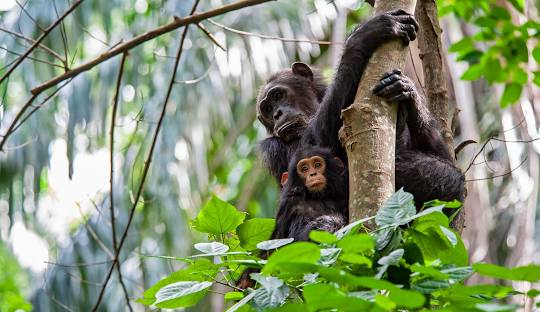
Kigoma’s most famous draw lies an hour or two up the lake by boat: Gombe, the smallest national park in Tanzania and one of the most storied. This steep, forested strip of shore is where Jane Goodall began her landmark study of wild chimpanzees in 1960 — the longest-running study of any wild animal anywhere — and tracking its chimps through the forest, sitting quietly as a family grooms and plays a few metres away, is a genuinely profound wildlife experience.
Beyond the chimps there are forest hikes to waterfalls and viewpoints, and beautiful beaches where the forest meets the clear lake.
Gombe can only be reached by boat from Kigoma, and the trekking is steep, humid forest walking with sightings likely but never guaranteed. We cover it fully on the Gombe page [link], and arrange the boat, permits and guide. Pricing on request.
Mahale Mountains National Park
Chimps where the mountains meet the lake
Visit Mahale Mountains National Park from Kigoma — a remote, mountainous wilderness on Lake Tanganyika with the largest wild chimpanzee population in Africa.
Further down the lake, deep into the wild south, rises Mahale — for many the most beautiful and exclusive of all Tanzania’s parks. Forested mountains plunge straight into the impossibly clear waters of Lake Tanganyika, and within them lives the largest known population of wild chimpanzees, the focus of decades of research and of some of the most rewarding chimp trekking in Africa.
It is a place of rare magic: you can trek chimps in the mountains in the morning and snorkel, kayak or swim in the gin-clear lake in the afternoon, with barely another soul around.
Mahale is genuinely remote — reached by a long boat journey or a charter flight, served by a handful of exclusive camps, and very much an overnight destination rather than a day trip. We cover it in full on the Mahale page [link] and arrange the flights, camp and trekking. Pricing on request.
Explore Lake Tanganyika
The world’s longest lake
Explore Lake Tanganyika from Kigoma — the world's longest and Africa's deepest freshwater lake, with clear water for cruises, swimming, kayaking and sunsets.
No trip to Kigoma is complete without time on Lake Tanganyika, and it is no ordinary lake. This is the longest freshwater lake in the world and the deepest in Africa — plunging nearly 1,500 metres — and among the oldest lakes on earth, a vast inland sea shared by four countries and home to hundreds of brilliantly coloured cichlid fish found nowhere else. Its water is famously, astonishingly clear, more like a tropical ocean than a lake.
That clarity makes it a joy to be on and in: boat cruises along the mountainous shore, swimming and kayaking from the beaches, fishing, and sunsets that are the stuff of photographs. Plying these waters is the MV Liemba, a German-built ferry launched in 1913 and said to have inspired the gunboat in The African Queen — a piece of living history in its own right.
Calm, warm and beautiful, the lake is the soul of Kigoma. We arrange boat trips and time on the water. Pricing on request.
Go Sport Fishing
Lines on an ancient lake
Go fishing on Lake Tanganyika from Kigoma — sport and traditional fishing on a lake of hundreds of species, with visits to its lamp-lit fishing communities.
Lake Tanganyika teems with life — hundreds of fish species, from its jewel-like endemic cichlids to large predatory fish and the vast shoals of tiny dagaa that feed the region — and fishing here is both sport and culture. Visitors can head out on catch-and-release sport-fishing trips, join a traditional fishing outing, or simply visit the lakeshore fishing communities to see how the lake has been worked for generations.
The unforgettable sight is the night fishery: after dark, the lake fills with rows of small boats carrying bright lamps to lure the dagaa to the surface, so the black water glitters with floating constellations of light — one of the great spectacles of the Tanganyika shore.
Whether you fish or just watch, it is a window into the rhythm of lake life. We arrange the boats, gear and village visits. Pricing on request.
Ujiji & Livingstone Memorial
Dr Livingstone, I presume?
Visit Ujiji and the Livingstone Memorial near Kigoma — the historic trading town where Stanley met Livingstone in 1871, on a shore shaped by the slave trade.
A few kilometres south of Kigoma lies Ujiji, one of the oldest towns in East Africa and a place heavy with history. In the nineteenth century it was the lake-end terminus of the great caravan routes from the coast and a major hub of the Arab slave and ivory trade — a sombre past that shaped the whole region and that the town does not hide.
Ujiji is best known, though, for a single famous moment. It was here, beneath a mango tree in 1871, that the journalist Henry Morton Stanley finally tracked down the long-missing explorer David Livingstone and, so the story goes, greeted him with the immortal, possibly apocryphal line, ‘Dr Livingstone, I presume?’ A small memorial museum marks the spot, with descendants of that mango tree, artefacts, slave-trade displays and figures of the two men.
It is a modest museum, but the history it holds — of exploration and of the slave trade — is anything but. A thought-provoking half-day with a guide. We arrange the visit. Pricing on request.
Ride the Central Line Railway
End of the line at the lake
Ride the historic Central Line railway from Kigoma — the German-built line running 1,250km to Dar es Salaam, a slow, scenic Tanzanian train adventure.
Kigoma is literally the end of the line — ‘Mwisho wa Reli’ — the western terminus of Tanzania’s historic Central Line railway, built under German rule and running some 1,250 kilometres across the country to Dar es Salaam. The old station itself, with its early-twentieth-century colonial architecture, is an evocative sight, and a reminder of how this remote port once connected to the wider world.
For the adventurous, the train journey is a classic Tanzanian experience: a slow, rattling roll across the heart of the country, through farmland and bush, sharing the carriage with local life and watching the landscape unspool for hour after hour.
Be honest with yourself about it, though — this is a long, basic and unpredictable journey of a day or more, for those who love rail travel and the journey itself rather than speed or comfort. We can arrange the trip, or just a visit to the historic terminus. Pricing on request.
Sunsets & Hilltop Viewpoints
The lake at golden hour
Catch Kigoma's sunsets — among Tanzania's finest, from hilltop viewpoints and the lakefront, where mountains, lake and fishing boats make perfect photographs.
Because Kigoma faces west across the lake, its sunsets are rightly famous — many visitors rate them among the finest in Tanzania. As the sun drops, the sky and the huge expanse of Lake Tanganyika turn molten gold and crimson, the distant mountains of the Congo shore darken to silhouettes, and the traditional fishing boats putter out for the night’s catch, lamps glowing — a photographer’s dream.
Several hilltop viewpoints around the town give sweeping panoramas over the lake and the rooftops, while the lakefront itself puts you right at the water’s edge for the show.
It costs nothing and asks nothing but that you stop and watch, and it is one of the simplest pleasures of a Kigoma stay. We know the best spots for the light. Pricing on request.
Local Culture & Markets
Fish, cassava and lake life
Experience Kigoma's local life — the central market, fishing communities and food markets, where fresh fish, cassava and plantains are local staples.
Away from the lake and the history, Kigoma is simply a vibrant western Tanzanian town, and getting among its everyday life is a pleasure in itself. The Kigoma Central Market is the hub — a busy sprawl of fresh lake fish, produce, household goods and the full clamour of daily trade — while down by the water the fishing communities bring in and dry their catch much as they always have.
The local food is built on what the lake and land provide: fresh fish in every form, cassava (the staple crop of the whole region) and plantains, simple and satisfying.
It is an unvarnished, genuine slice of western Tanzania, and a local guide opens it up and eases the way. A great counterpoint to the chimps and the lake. We arrange a guided wander. Pricing on request.