Things to Do in Ngorongoro
descend into the crater
search for the big five
visit lake magadi
explore the lerai forest
enjoy crater rim viewpoints
guided nature walks
hike empakaai crater
olmoti crater & munge falls
explore olduvai gorge
wildlife photography safaris
maasai cultural experiences
explore the ndutu region
bird watching
scenic highland drive
stargazing in the highlands
conservation & education
Descend into the Crater
Into the great caldera
Descend into the Ngorongoro Crater — the world's largest intact caldera and one of Africa's densest gatherings of wildlife, on a game drive across its floor.
This is what most people come to Ngorongoro for, and it lives up to it. From the rim you drop down a steep one-way track into the crater — a vast bowl some twenty kilometres across, its grassy floor walled by six hundred metres of cliff — and onto a stage holding one of the densest gatherings of large animals anywhere in Africa: an estimated twenty-five thousand of them, year-round. Lion, elephant, buffalo, hippo, hyena, jackal, and great herds of zebra, wildebeest, eland and gazelle, all in a single, self-contained world.
It is a genuinely extraordinary few hours of wildlife viewing, with sightings coming thick and fast.
Now the honest planning notes. The crater is very popular and gets busy with vehicles, especially in the dry season; day visitors are capped at six hours on the floor, and access runs roughly seven to four. The fixes are simple — descend the moment it opens, and where possible stay on the rim so you are first down and last up. It also carries a steep crater fee on top of the conservation-area charge, which we build into your costs upfront. We arrange it all. Pricing on request.
Search for the Big Five
The Big Five in a single day
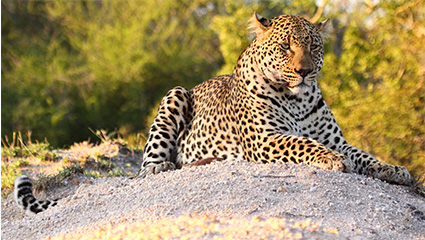
Look for the Big Five in the Ngorongoro Crater — one of few places to see lion, elephant, buffalo, leopard and rare black rhino in a day. Rhino stay distant.
The Ngorongoro Crater is one of the very few places on the continent where you can realistically hope to tick off all of the Big Five — lion, elephant, buffalo, leopard and rhino — in a single day. Lions are numerous and often easy, big bull elephants haunt the Lerai forest, and buffalo are everywhere.
The real prize is the black rhino. Hunted to the edge of extinction across Africa, a small, fiercely protected population survives on the crater floor, and this is the most reliable place in all of Tanzania to see one — a genuinely moving sight given how few remain.
Two honest notes so you are not disappointed. The rhino are usually distant figures out on the open grass rather than close encounters, so binoculars matter; and the leopard is the joker of the pack here, preferring the forested rim and rarely showing on the floor — so four of the five is the realistic, and still thrilling, day. Our guides know where each is favouring. Pricing on request.
Visit Lake Magadi
Flamingos on the soda lake
See Lake Magadi on the Ngorongoro Crater floor — a shallow soda lake often fringed pink with flamingos, and a magnet for water birds and photography.
Spread across the western crater floor lies Lake Magadi, a shallow, faintly blue soda lake so alkaline that little can live in it — except the algae that draw the flamingos. On a good day its edges are fringed pink with them, mostly lesser flamingos with their dark bills, among pelicans and other water birds, and it makes one of the crater’s defining images.
In the dry season the lake shrinks and crusts into glittering salt pans, which jackals, hyenas and other animals visit to lick for minerals.
As with all flamingos, numbers rise and fall with the water and the algae, and the birds are often spread far across the shallows, so a long lens or binoculars help. Either way the lake is a beautiful, ever-changing heart to the crater. We work it into your drive. Pricing on request.
Explore the Lerai Forest
Fever trees and big bulls
Explore the Lerai Forest on the Ngorongoro Crater floor — a grove of yellow fever trees that draws the crater's biggest bull elephants, plus bushbuck and birds.
In the south-east of the crater floor stands the Lerai Forest, an airy grove of tall, yellow-barked fever trees that feels like a different world from the open grassland around it. It is the haunt of the crater’s most magnificent residents — the great old bull elephants, some carrying the heavy, sweeping tusks that have grown rare elsewhere in Africa, who come for the shade and the foliage.
Around them you may find eland and bushbuck slipping through the trees, baboons and hyrax, browsing rhino, the occasional leopard up a branch, and a wealth of birds.
A quiet ecological footnote our guides will share: the old forest is regenerating only slowly, because elephants tear off whole branches rather than just grazing — a reminder that even a place this protected is always changing. A beautiful, shaded stop on any crater drive. Pricing on request.
Enjoy Crater Rim Viewpoints
The view over the bowl
Take in the Ngorongoro Crater rim viewpoints — panoramic vistas across the whole caldera and highlands, among the most breathtaking views in Africa.
Some of the most breathtaking views in all of Africa are had without leaving the rim. Standing on the lip of the caldera, two thousand three hundred metres up, the whole crater opens below you — the silver glint of Lake Magadi, the dark smudge of the Lerai forest, cloud shadows sliding across grassland scattered with distant animals, the far wall rising on the other side. The first sight of it stops people in their tracks.
Several viewpoints around the rim give different angles over the bowl and out across the highlands beyond.
One practical truth of the altitude: the rim is cool and frequently wrapped in cloud or mist early and late in the day, so a clear mid-morning often gives the best view — and a warm layer is wise up here. A wonderful experience even for those not descending. We include the best viewpoints. Pricing on request.
Guided Nature Walks
The highlands on foot
Take a guided walk on the Ngorongoro Crater rim — explore the highland forest on foot with a ranger, learning the ecology, geology and plants a drive misses.
For a complete change of pace from the vehicle, guided nature walks are allowed in certain parts of the conservation area, particularly along the crater rim and through the highland forest. With a ranger and guide you go slowly and on foot, learning the things a game drive sweeps past — the geology of this collapsed volcano, the highland plants and their uses, the birds, the tracks and the smaller creatures of the forest.
It is a quieter, more intimate way to feel the place, with the crater itself often spread out below as you walk.
The walks are ranger-led and confined to permitted areas, and the altitude makes them cool and sometimes steep, so a little fitness and a warm layer help. A lovely complement to the crater drive. We arrange the ranger and route. Pricing on request.
Hike Empakaai Crater
A soda lake in a green bowl
Hike Empakaai Crater in the Ngorongoro highlands — a steep guided descent through forest to a deep soda lake fringed with flamingos, far off the beaten track.
For travellers willing to go beyond the famous crater, Empakaai is one of the most rewarding experiences in northern Tanzania — and a near-empty one. About an hour’s drive north-east through the highlands (a lovely game-spotting journey in itself), this smaller caldera is half-filled by a deep, dark soda lake that draws thousands of flamingos, ringed by steep, forest-clad walls alive with bushbuck, blue monkeys and birds.
A guided hike leads down through the forest to the lakeshore — a steep descent of around three hundred metres, perhaps three hours there and back — and the rim views are simply astonishing, out to the perfect cone of the Ol Doinyo Lengai volcano, Lake Natron, and on a clear day even Kilimanjaro.
Be ready for it to be a real hike, with a stiff climb back up, and for a full day with the drive; in return you get scenery to rival the crater with almost nobody else there. An armed ranger comes along. We arrange it. Pricing on request.
Olmoti Crater & Munge Falls
A gentle hike to a waterfall
Hike Olmoti Crater in the Ngorongoro highlands — a gentle walk through Maasai grazing land to the rim and the Munge Waterfall, which feeds the crater below.
Gentler than Empakaai but lovely in its own right, Olmoti is a shallow, grassy highland crater that makes for an easy, beautiful walk. The path up to the rim — around an hour there and back — climbs through open Maasai grazing land, where you will likely pass herders with their cattle sharing the grass with eland, bushbuck, reedbuck and the odd buffalo, a perfect picture of the coexistence that makes this conservation area unique.
The reward at the top is the Munge Waterfall, where the Munge River spills off the crater’s wall and plunges several hundred metres down toward the main Ngorongoro Crater, feeding Lake Magadi far below.
It is a manageable hike for most reasonable walkers, far easier than the Empakaai descent, and reached on a scenic drive into the highlands. A ranger guides you. We arrange it. Pricing on request.
Explore Olduvai Gorge
The Cradle of Mankind
Visit Olduvai Gorge in the Ngorongoro highlands — the 'Cradle of Mankind', with a museum on the famous hominin finds and the Laetoli footprints.
Out on the plains between the crater and the Serengeti lies one of the most important places in the human story: Olduvai Gorge, often called the Cradle of Mankind. For more than eighty years, beginning with the Leakeys, this layered ravine has yielded some of the earliest evidence of our ancestors — including ‘Nutcracker Man’ and early Homo habilis, going back nearly two million years. A renovated museum tells the story with fossils, casts and clear exhibits, and a viewpoint looks out over the excavation sites, with guides on hand to explain it.
Nearby Laetoli is where the astonishing 3.6-million-year-old hominin footprints — proof our ancestors walked upright that long ago — were found.
One honest point: the Laetoli footprints themselves were reburied to protect them from erosion and cannot be visited, so what you see is the story and the casts at the museum rather than the prints in the ground. An easy, fascinating stop on the Serengeti road. We arrange the visit. Pricing on request.
Wildlife Photography Safaris
The most photogenic crater
Photograph Ngorongoro — the crater's wildlife, dramatic walls, soda lake and volcanic highlands give some of Tanzania's most iconic safari images, best at dawn.
Few landscapes pack as much into the frame as Ngorongoro. Down in the crater you have an unmatched density of wildlife set against those towering walls, the pink-rimmed soda lake and the fever-tree forest; up in the highlands you have volcanic craters, forests, Maasai settlements and big mountain skies. Between them they yield some of the most iconic safari images in Tanzania, for phone-photographers and professionals alike.
The light does much of the work, and the trick is timing: descend the moment the gate opens, when the crater is quiet and the low sun is golden, before the vehicles arrive and harden the shadows.
Bring a long lens for the distant rhino and flamingos, and keep something wide for the crater walls and highland scenery. We plan the day, and the early start, around your photography. Pricing on request.
Maasai Cultural Experiences
Living with the wildlife
Meet the Maasai of Ngorongoro — uniquely, they live and graze inside this protected area alongside the wildlife, and a guided boma visit shows their life.
Ngorongoro is unlike any other great wildlife area in Africa in one crucial way: people live here. The Maasai have grazed their cattle across these highlands for generations and continue to do so inside the conservation area, sharing the land with the lions and elephants — a rare ‘multiple land use’ arrangement found almost nowhere else, and part of what makes the place a cultural as well as a natural World Heritage Site.
A guided visit to a Maasai boma opens a window onto that life: the cattle that are the centre of everything, the low houses built of mud and dung, the songs and the leaping dance, the beadwork, and the daily rhythm of a highland pastoral world.
As ever, we choose genuine, community-run visits over staged shows, set up so the money reaches the families directly. Approached with respect, it adds a deeply human layer to the wildlife. We arrange it. Pricing on request.
Explore the Ndutu Region
The migration’s nursery
Visit the Ndutu plains in southern Ngorongoro — from December to March the Great Migration herds gather here to calve, drawing predators and superb photography.
The southern reach of the conservation area opens onto the short-grass plains of Ndutu, which spill over into the Serengeti — and for a few months each year this quiet corner becomes one of the greatest wildlife stages on earth. Between roughly December and March the Great Migration pauses here to calve, and across a few intense weeks hundreds of thousands of wildebeest give birth on the open plains.
The newborns draw the predators, and the result is raw, concentrated drama — lions, cheetahs and hyenas constantly working the herds — with some of the finest wildlife photography anywhere.
Be clear that this is strictly seasonal: outside those months the herds have moved on and Ndutu is empty, and even within the season the timing shifts with the rains, so it is never guaranteed to the week. We cover the migration in full on the Serengeti page [link] and time a visit to the calving. Pricing on request.
Bird Watching
From flamingos to cranes
Birdwatch in Ngorongoro — over 500 species across crater, lake and highland, from flamingos and crowned cranes to ostriches, kori bustards and eagles.
With more than five hundred recorded species across its range of habitats — the crater grassland and soda lake, the highland forests, the open plains — Ngorongoro is a superb birding destination as well as a big-game one. On the crater floor alone you can run from the flamingos of Lake Magadi to ostriches striding the grass, the stately grey crowned crane, the huge kori bustard, and the long-striding secretary bird hunting snakes.
Overhead, the open country draws raptors in number, from eagles to the vultures that gather at every kill.
Birding is rewarding all year, with extra variety when migrants arrive in the green season, and it folds naturally into a crater drive or a highland walk. Bring binoculars and ask for a guide with a good bird eye. We arrange one. Pricing on request.
Scenic Highland Drive
The journey is the attraction
Drive through the Ngorongoro Highlands — the journey itself is an attraction, passing crater viewpoints, Maasai villages, volcanic landscapes and wildlife.
In Ngorongoro, even getting from place to place is part of the experience. The roads that thread the highlands — between the crater, the hiking craters and on toward the Serengeti — climb through some of the most beautiful country in Tanzania: misty highland forest, open volcanic uplands, crater rims opening to sudden views, and everywhere the Maasai with their herds, their red cloaks bright against the green.
Wildlife wanders the verges too — zebra and gazelle on the rim grass, the odd elephant in the forest — so the camera rarely rests even between sights.
A fair warning: the roads up here are largely rough and dusty, as befits genuinely wild country, but the scenery and the glimpses of highland life turn the journey from a transfer into a pleasure. We plan the routes to make the most of it. Pricing on request.
Stargazing in the Highlands
The high, dark sky
Stargaze in the Ngorongoro Highlands — the high altitude and minimal light pollution make for exceptionally clear, dark skies, often with guided astronomy.
When the sun goes down over the highlands, look up. At well over two thousand metres, with almost no artificial light for miles, Ngorongoro’s night sky is extraordinary — crisp, deep and crowded with stars, the Milky Way arching clean across it and the southern constellations sharp overhead. Many of the lodges make the most of it, offering a little guided astronomy or a telescope on a clear night.
It is a quiet, awe-tinged way to round off a day of wildlife, and a reminder of just how wild and high this country is.
Two honest notes: it gets genuinely cold up here after dark, so wrap up warm, and the highland weather can roll cloud across the sky without warning — but on a clear night it is unforgettable. We can arrange a stay set up for it. Pricing on request.
Conservation & Education
Understanding the area
Engage with conservation in Ngorongoro — learn how wildlife, the Maasai and one of the world's richest fossil records share one unique protected area.
Ngorongoro is one of the most interesting places in Africa to think about conservation, because it is trying to do something almost no one else attempts: keep thriving wildlife, a living pastoral culture, and one of the richest fossil records on earth all in the same protected landscape. Several lodges and programmes let you learn how that balancing act works — how the black rhino are guarded, how human-wildlife coexistence is managed, how the ecosystem and the archaeology are cared for.
It is not a simple or finished story — holding wildlife, people and heritage in balance brings real tensions — which is exactly what makes engaging with it worthwhile rather than glib.
For travellers who want to understand the place rather than just photograph it, an hour with the people doing this work is time well spent, and steers your spending toward them. We can include it. Pricing on request.