Things to Do in Southern Zanzibar
relax on paje beach
jambiani beach & village
bwejuu & michamvi
low-tide walks & seaweed farms
safari blue excursion
menai bay snorkel & dive
dhow sailing & sunset cruise
deep-sea fishing
mangroves, lagoons & birdlife
dolphin tours in kizimkazi
kitesurfing & wind sports
cycling through villages
swahili culture & cooking
cave swimming: maalum, kuza & salaam
makunduchi & mwaka kogwa
the rock restaurant
seafood & beachfront dining
spa, yoga & romance
stone town day trip
jozani forest day trip
spice farm tour
prison island day trip
Relax on Paje Beach
The kite capital’s wide white sands
Relax on Paje Beach in southern Zanzibar — a white-sand beach and shallow lagoon that's the island's kitesurfing capital, laid-back and lined with beach bars.
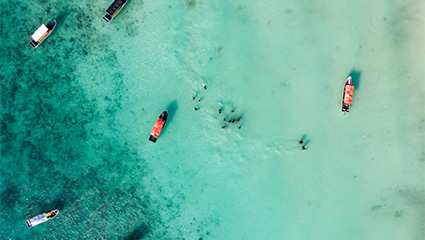
Paje is the beating heart of the southeast and the most famous beach in southern Zanzibar — a broad sweep of white sand backing onto a wide, shallow turquoise lagoon. It has a laid-back, slightly bohemian energy, with beach bars, yoga decks, seafood shacks and a young international crowd drawn by the wind.
That wind is the headline: the steady trades and the flat, shallow lagoon have made Paje one of the best kitesurfing spots on the planet, and on a breezy afternoon the sky fills with kites (more on that below). When the wind drops it is simply a gorgeous beach for lounging and barefoot walks.
The honest catch is the tide — at low water the sea pulls a long way out across the lagoon, so swimming is tide-dependent and the scene is more about the sand, the kites and the bars than all-day bathing. For wind, atmosphere and a sociable barefoot vibe, Paje is the pick. We arrange the stay and the activities. Pricing on request.
Jambiani Beach & Village
Authentic village life on the sand
Explore Jambiani in southern Zanzibar — a long, quiet beach and one of the island's most authentic fishing and seaweed-farming villages.
Just south of Paje, Jambiani is its quieter, more traditional neighbour — a long ribbon of white sand fronting a genuine working village rather than a resort strip. Fishermen launch at dawn, women tend the seaweed gardens on the flats, and daily Swahili life carries on much as it has for generations, which is exactly its charm.
You can walk for miles along the beach, swim when the tide is in, and wander into the village to see the coral-rag houses, the little shops and the rhythm of the place. It is the south at its most authentic and unhurried.
Like all of this coast it is tidal, so swimming follows the sea, and it is low-key by design — come for peace, character and real village life rather than nightlife. Lovely for slow travellers and culture-minded couples. We arrange the stay and a village walk with a local guide. Pricing on request.
Bwejuu & Michamvi
Quiet sands and sunset shores
Discover Bwejuu and the Michamvi Peninsula in southern Zanzibar — quiet beaches, calm mangrove-lined waters and the island's best sunsets over the sea.
North of Paje and Jambiani, the coast gets even quieter. Bwejuu is a peaceful, palm-backed beach regularly named among Africa’s prettiest, with little but a few small hotels and a lot of space. Beyond it the Michamvi Peninsula curls north, and here something unusual happens: because the peninsula has a west-facing side, you can watch the sun set over the sea — a rarity on Zanzibar’s east coast and some of the best sunsets on the island.
Michamvi’s western shore is also calmer and more sheltered, fringed with mangroves, and it is home to the famous Rock Restaurant (below).
This is the relaxed, romantic end of the southeast — quieter than Paje, still tidal, and made for couples and anyone wanting space and sunsets. We arrange the stay, the sunset spots and dinner. Pricing on request
Low-Tide Walks & Seaweed Farms
The coast the low tide reveals
Walk southern Zanzibar's low-tide flats — explore sandbanks, tidal pools and coral, and meet the women whose seaweed farms are a key coastal industry.
On the southeast coast the tide is not a nuisance but an attraction. When the sea draws far out, it uncovers a vast, glistening world of rippled sandbanks, warm tidal pools full of starfish and small fish, and exposed coral — a landscape you can walk out into for hundreds of metres, barefoot, under a huge sky.
It is also when the coast goes to work. The seaweed farms come into view — neat rows of staked lines tended almost entirely by local women, whose seaweed harvest is one of the most important village industries on this coast. A seaweed-farming tour, led by the women themselves, is one of the most genuine cultural experiences in the south, and your visit supports them directly.
Wear water shoes for the coral and reef rock, and let the guide read the tide so you time it right. Fascinating for families and anyone curious about how the coast really lives. We arrange the walk and the seaweed tour. Pricing on request.
Safari Blue Excursion
The island’s great day on the water
Join Safari Blue from southern Zanzibar — the island's celebrated full-day dhow trip in Menai Bay: snorkelling, a sandbank, lagoon swimming and a seafood feast.
Safari Blue is Zanzibar’s most celebrated marine day out, and the south is where it happens — it launches from Fumba on the southwest coast, right on your doorstep here, rather than being the long-haul excursion it is from the north. A full day aboard a traditional dhow in the protected Menai Bay, it strings together snorkelling over healthy reef, a stop on a dazzling sandbank, swimming in a turquoise lagoon at Kwale Island, dhow sailing and a feast of grilled seafood, with dolphins often along the way.
It is justifiably popular and brilliant for families, groups and couples alike — a proper highlight-reel of everything good about the Zanzibar coast in one day.
Because it is so popular it can be busy, so we use good operators and time it well. From the southern beaches the transfer is short, which is one of the real advantages of basing yourself down here. We arrange the day. Pricing on request.
Menai Bay Snorkel & Dive
Reefs of a protected bay
Snorkel and dive Menai Bay off southern Zanzibar — a protected area of coral reefs and tropical fish, with dive sites for all levels and conservation tours.
The Menai Bay Conservation Area, off the southwest, is the south’s prime underwater playground — the largest marine protected area on Zanzibar, sheltering coral reefs, seagrass beds, turtles, dolphins and a wealth of reef fish. Snorkelling here, often as part of a Safari Blue day or a dedicated trip, drifts you over vivid coral gardens in clear, sheltered water.
For divers, the south has sites suited to beginners and experienced alike, with local dive centres running trips and courses.
Because it is a conservation area, the protection is real and so are the rules — reef-safe sunscreen and no touching coral — and several operators run marine-conservation experiences that explain the reef and the efforts to protect it. Good for snorkelers, divers and anyone who likes their sea life with a conscience. We arrange the operator and the trip. Pricing on request.
Dhow Sailing & Sunset Cruise
Swahili sails at golden hour
Sail a traditional dhow off southern Zanzibar — a sunset cruise on a hand-built wooden boat, with the Michamvi Peninsula offering rare west-facing sunsets.
The dhow — the hand-built, lateen-sailed wooden boat that has worked this ocean for a thousand years — is the soul of the Zanzibar coast, and sailing one here is a must. The classic outing is the sunset cruise, drifting along the coast as the day cools, very often with drinks and grilled seafood aboard.
The south has a quiet advantage for this: the west-facing shore of the Michamvi Peninsula gives you the sun setting straight into the sea, which much of the east coast, facing the sunrise, cannot.
As ever with a dhow, the wind decides whether you sail or motor — either way it is a beautiful, romantic couple of hours on the water. We pick the right spot and time it for the best of the light. Pricing on request.
Deep-Sea Fishing
Game fish off the south coast
Go deep-sea fishing from southern Zanzibar — charter offshore for tuna, sailfish, kingfish and wahoo in the rich game-fishing waters off the island's south.
The deep water off southern Zanzibar holds excellent game fish, and a charter out from the coast is a real draw for anglers. Crews target yellowfin tuna, sailfish, kingfish, wahoo and dorado in the productive offshore grounds, on half or full-day trips aboard equipped boats with experienced crew.
Billfish are usually tagged and released, the responsible way to fish them, and the rest of the catch can come back to be cooked for you — about as fresh as seafood gets.
The fishing is seasonal and the sea has the final say, so the crew will be honest about conditions and what is running; a little date flexibility helps. Great for a keen angler or a group. We arrange the charter and crew. Pricing on request.
Mangroves, Lagoons & Birdlife
Quiet water, mangroves and birds
Paddle southern Zanzibar's lagoons and mangroves by kayak or paddleboard — explore sheltered coastal ecosystems rich in birdlife at your own quiet, gentle pace.
Away from the open beach, the south’s sheltered lagoons and mangrove creeks are made for paddling. A kayak or stand-up paddleboard lets you slip quietly through the still water and into the mangrove channels — especially around Michamvi — at a pace that lets you actually notice the place.
And there is plenty to notice. The mangroves, lagoons and coastal scrub are rich in birdlife, from herons and kingfishers to waders and, in the northern winter, migrants passing through, so it doubles as gentle birdwatching. The mangroves themselves are the nurseries of the reef, which a guide will explain.
It is calm, low-effort and best in the morning before the wind builds — a peaceful contrast to the kite-filled lagoon at Paje. Lovely for families and nature lovers, with birding best from November to April. We arrange the boards, kayaks and a guide. Pricing on request.
Dolphin Tours in Kizimkazi
Wild dolphins of the deep south
Take a dolphin tour from Kizimkazi in southern Zanzibar — the island's best-known spot for wild dolphins, with operators who watch responsibly, not chase.
The fishing village of Kizimkazi, at the island’s southern tip, is Zanzibar’s best-known place to see wild dolphins, with resident pods of bottlenose and humpback dolphins in the waters offshore. A morning boat trip out to find them is one of the south’s signature experiences.
This is where we have to be straight with you: Kizimkazi has, in places, a poor reputation for boats chasing and crowding the dolphins, even pushing swimmers on top of them, which stresses the animals and is unpleasant to witness. We only use operators who keep a respectful distance and let the dolphins choose the encounter — better for the pods, and a far better experience for you.
Sightings are good but never guaranteed with wild animals, and calm early mornings are best. While you are down there, Kizimkazi also has the oldest mosque in East Africa, from the twelfth century, worth a look. We arrange a responsible operator. Pricing on request.
Kitesurfing & Wind Sports
Africa’s kitesurfing capital
Ride the wind in southern Zanzibar — Paje is one of Africa's top kitesurfing spots, with steady winds and a shallow lagoon, plus wing foiling and windsurfing.
If there is one thing the south does better than anywhere in the region, it is wind sports. Paje is internationally rated as one of Africa’s premier kitesurfing destinations — the combination of steady, reliable trade winds and a huge, flat, shallow lagoon behind the reef is close to perfect for learning and for ripping, and the town is full of professional kite schools, gear and a buzzing kite scene.
The same conditions suit the fast-growing sport of wing foiling and classic windsurfing, both taught at schools along the coast, so whatever your board of choice, the south delivers.
The wind blows most reliably in two seasons, roughly June to September and December to February. Lessons cater to complete beginners through to advanced riders, and the shallow lagoon makes it a forgiving place to learn. This is the reason many people choose the south over the north. We arrange the school and kit. Pricing on request.
Cycling Through Villages
Village life on two wheels
Cycle through southern Zanzibar's villages — a flat, easy ride past coastal communities, farms and coral-rag countryside on the southeast coast.
The flat lanes behind the southeast beaches are perfect for a bicycle, and a guided ride is a lovely way to see the everyday south beyond the sand. You pedal between the coastal villages — Paje, Jambiani, Bwejuu — through smallholding farms, coral-rag bush and palm groves, past schools, markets and mosques, at the gentle pace where you actually meet the place.
It is undemanding riding suited to most fitness levels and to families, and it reaches the real local life that the beach resorts sit quietly alongside.
One honest pointer: this is a hot, humid coast, so an early start beats the midday heat. Bikes and a guide are part of what we set up. Pricing on request.
Swahili Culture & Cooking
Cooking, markets and the sea
Experience Swahili culture in southern Zanzibar — cooking classes with spices and seafood, village markets, and going out with local fishermen.
The south is the place to get under the skin of Swahili coastal life. A cooking class with a local family teaches you to make Zanzibari dishes — spiced pilau and biryani, coconut curries, the catch of the day — often starting with a shop at the village market, a bright tangle of fish, fruit, spices and cloth, before you cook and eat together.
For something more hands-on, you can head out with local fishermen and learn the centuries-old techniques they still use — hand lines, nets and sailing dugouts — a humbling, genuine morning on the water that puts the seafood on your plate into context.
These are real communities and livelihoods, so we keep it respectful and led by local hosts, which keeps the benefit where it belongs. A delicious, authentic layer to a beach stay. We arrange it. Pricing on request.
Cave Swimming: Maalum, Kuza & Salaam
Swim inside sunlit limestone caves
Swim in southern Zanzibar's limestone caves — the polished Maalum pool in Paje, the sacred Kuza sinkhole in Jambiani, and turtle-filled Salaam near Kizimkazi.
One of the south’s most magical secrets is swimming inside its limestone caves — natural pools of cool, crystal-clear water hidden beneath the coral landscape, usually visited as a little circuit. Each has its own character. Maalum, near Paje, is the most polished: an open-top sinkhole where sunlight pours down onto turquoise freshwater, beautifully managed and best pre-booked. Kuza, in Jambiani, is a fifty-metre round sinkhole carved over a quarter of a million years, sacred to the local Swahili community and run as a cultural centre with music, food and history alongside the swim.
Salaam, down near Kizimkazi, is different again — a sea cave where you can snorkel with resident sea turtles in the clear water.
They suit all ages and swimming abilities, run year-round, and the freshwater caves are a glorious way to cool off out of the sun and the wind. Bring swimwear, a towel and water shoes; Maalum needs booking ahead. We arrange the circuit and a guide. Pricing on request.
Makunduchi & Mwaka Kogwa
An old town and its New Year
Visit Makunduchi in southern Zanzibar — one of the island's oldest settlements, known for the dramatic Mwaka Kogwa festival, the Shirazi New Year each July.
At the southern end of the island, Makunduchi is one of Zanzibar’s oldest settlements, a town with deep Shirazi roots and a strong sense of its own traditions, away from the tourist trail.
It is most famous for Mwaka Kogwa, the spectacular Shirazi New Year festival held each July. It is a remarkable thing to witness: men playfully fight each other with banana stalks to vent the past year’s grievances, a ritual hut is burned to read the fortunes of the year ahead, and the whole town gives over to feasting, singing and dancing, with visitors warmly welcomed to join in.
Outside the festival it is a quiet, authentic town to visit on a cultural tour; during Mwaka Kogwa it is one of the most extraordinary cultural events in Tanzania, well worth timing a trip around. We arrange the visit, and can plan around the festival dates. Pricing on request.
The Rock Restaurant
Africa’s most photographed table
Dine at The Rock Restaurant in southern Zanzibar — the famous seafood restaurant on a rock in the sea off Michamvi, reached on foot or by boat with the tide.
Perched on a coral rock in the turquoise sea off Michamvi Pingwe, The Rock is one of the most photographed restaurants in Africa — a tiny seafood restaurant on its own little island just off the beach, and a bucket-list lunch for many visitors to the south.
How you get there depends on the tide, which is half the fun: at low tide you simply walk across the sand to it, and at high tide a little boat ferries you over. The food is fresh seafood with an Italian-Swahili leaning, and the setting — ocean on every side — is unforgettable.
It is deservedly popular and small, so booking well ahead is essential, especially for sunset and the prime tide times. A lovely splurge for a couple or a special occasion. We can reserve a table and arrange the transfer. Pricing on request.
Seafood & Beachfront Dining
Lobster, octopus and ocean views
Eat well in southern Zanzibar — fresh lobster, octopus, prawns and tuna in Swahili dishes, oceanfront dinners on the sand, and the island's tropical fruit.
The south eats very well. This coast is renowned for its seafood — lobster, octopus, prawns, crab and tuna, landed that day and cooked simply and superbly, whether in a Swahili coconut curry, grilled over coals or served Italian-style at one of the smarter spots.
Much of it is enjoyed beachfront, with tables set on the sand and your feet near the water, which turns a simple dinner into one of the memories of the trip. And between meals, the island’s tropical fruit is a pleasure in itself: a tasting of sun-ripe mango, pineapple, passion fruit and fresh coconut, often straight off a local farm.
From a barefoot grill to a candlelit table, the south does food beautifully. We can book the standout places and arrange a fruit or farm tasting. Pricing on request.
Spa, Yoga & Romance
Wellness and honeymoon country
Unwind in southern Zanzibar — beachfront spa treatments, sunrise yoga and private romantic dinners, the island's honeymoon and wellness heartland.
The laid-back southeast is the island’s wellness and honeymoon heartland, and leaning into the slow, restorative side of a beach stay is half the point of coming here. Beachfront spas offer massages and treatments — many using local coconut, spices and seaweed — in open pavilions looking out at the sea.
Paje and the southeast in particular have become a hub for yoga, with retreats and daily classes on breezy decks and the sand, sunrise sessions especially lovely before the wind gets up.
And for couples it is hard to beat: private dinners on the beach, sunset picnics and quiet, unshowy romance come naturally to this coast, which makes it a favourite for honeymoons — particularly as the gentle finish to a mainland safari. We arrange the treatments, classes and private touches. Pricing on request.
Stone Town Day Trip
The island’s historic heart
Day-trip from southern Zanzibar to Stone Town — the UNESCO-listed old city of alleys, carved doors, markets and Swahili history, about an hour away.
No Zanzibar trip is complete without Stone Town, the island’s UNESCO-listed historic heart, and from the southern beaches it is an easy day trip of around an hour. This is the old Swahili and Omani city: a maze of narrow alleys and tall coral-stone houses, famous carved doors, the seafront Old Fort and House of Wonders, the spice-scented Darajani market, and the sobering site of the old slave market, now a cathedral and memorial.
A guided walk is the way to do it justice, reading the layers of African, Arab, Indian and European history street by street. Our full guide to the old city lives on the Stone Town page [link].
Treat it as a full day from the beach. We arrange the transfer and a guide. Pricing on request.
Jozani Forest Day Trip
Red colobus on your doorstep
Day-trip to Jozani Forest from southern Zanzibar — the island's only national park and home to the endemic red colobus, closest to the southeast coast.
Of all the day trips, Jozani is the one the south can almost call its own — the island’s only national park sits in the centre-south, the closest it comes to any coast, barely half an hour or so from the southeast beaches. Its star is the Zanzibar red colobus, a striking monkey found nowhere else on earth; the troops are used to visitors, so a guided walk almost always brings close sightings, along with Sykes’ monkeys, bush babies and forest birds, finished with a boardwalk through the coastal mangroves.
Being so near, it is an easy half-day rather than a big expedition from the south. Our fuller guide is on the Jozani page [link].
We arrange the transfer, entry and a guide. Pricing on request.
Spice Farm Tour
Why they call it the Spice Island
Take a spice farm tour from southern Zanzibar — see, smell and taste the cloves, vanilla, cinnamon and nutmeg that made Zanzibar the Spice Island.
Zanzibar earned its ‘Spice Island’ name on plantations like these, and a spice farm tour is one of the island’s most enjoyable outings. A guide walks you through a working farm in the centre of the island, pulling up roots, cracking pods and crushing leaves so you can see, smell and taste cloves, vanilla, cinnamon, nutmeg, cardamom and pepper straight from the plant, alongside tropical fruit.
It is hands-on, sensory and great for families, with the history woven in — how the Omani clove economy built the island’s wealth on enslaved labour.
From the south it pairs neatly with a Stone Town day, as the farms lie that way. We arrange the farm visit and guide. Pricing on request.
Prison Island Day Trip
Giant tortoises off Stone Town
Day-trip to Prison Island (Changuu) from southern Zanzibar — meet giant Aldabra tortoises over a century old and snorkel off the island, via Stone Town.
Changuu — better known as Prison Island — is a favourite half-day, reached by a short boat ride off Stone Town and usually combined with a Stone Town visit. Its celebrities are the giant Aldabra tortoises, a colony some of which are well over a century old; you can walk among them and meet the oldest of these gentle, ancient creatures, then swim and snorkel off the island’s little beach.
Its name comes from a prison built here that was mostly used as a quarantine station, on a site earlier linked to the holding of enslaved people — a darker history a guide will explain.
From the south it is a longer outing, via Stone Town, so it works best folded into a Stone Town day. We arrange the boat, transfer and guide. Pricing on request.