Things to Do in Tarangire
enjoy a classic game drive
the dry-season migration
observe large elephant herds
photograph the baobab trees
explore the tarangire river
search for predators
bird watching
experience a walking safari
night game drives
hot air balloon safari
silale swamp & wetlands
photography & sundowners
visit maasai communities
bush meals & stargazing
conservation & education
visit mto wa mbu & cycle
Enjoy a Classic Game Drive
The park’s headline activity
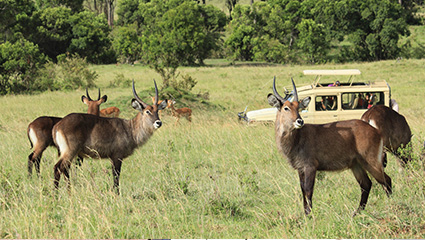
Take a game drive in Tarangire National Park — elephants, lions, leopards, giraffes and more, with the dry season concentrating wildlife along the river.
A game drive is the heart of any Tarangire visit, and the park rewards it richly. The cast is one of the most complete on the northern circuit: huge elephant herds and the lions, leopards and cheetahs that hunt them, alongside buffalo, giraffe, zebra, wildebeest, eland, waterbuck, impala, warthog and dry-country specials like lesser kudu and the tiny dik-dik.
Timing makes a real difference. In the dry season the animals press in around the Tarangire River and the southern swamps, and the game viewing is superb; a half-day drive slots neatly into a circuit itinerary, while a full day lets you push south into the quieter, wilder reaches.
Morning and late afternoon are when the predators move and the light is best. The dry months, roughly June to October, are the prime game-viewing window. We arrange the vehicle, guide and park fees. Pricing on request.
The Dry-Season Migration
Tanzania’s other great migration
Witness Tarangire's dry-season migration — from June to October thousands of animals pour into the park toward the river, a great wildlife concentration.
Tarangire holds one of Tanzania’s best-kept wildlife secrets: its own seasonal migration. As the rains end and the waterholes of the surrounding plains dry up, from around June to October, thousands of animals — zebra, wildebeest, eland, buffalo and great numbers of elephant — funnel into the park toward the permanent water of the Tarangire River and the swamps, drawn from as far as the Maasai Steppe and the lakes nearby.
The result is a concentration of game that, at its peak, rivals anywhere in the country outside the Serengeti, and it has been studied for decades by the long-running Tarangire Elephant Project.
The honest flip side is seasonality: this is the dry-season park. Come the rains, the animals disperse back out across the ecosystem and Tarangire grows quiet and green — lovely for birds and solitude, but without the great herds. To see the concentration, time your visit for the dry months. We plan around the season. Pricing on request.
Observe Large Elephant Herds
The land of big herds
See Tarangire's famous elephants — among the largest herds in East Africa, with family groups of dozens gathering around the river, the park's defining sight.
If one animal defines Tarangire, it is the elephant. The park holds some of the largest elephant populations in East Africa, and encounters here are on a different scale — not a lone bull but extended family groups dozens strong, and in the dry season hundreds gathering along the river, with tiny calves shadowing the matriarchs.
Watching a herd this size move through a grove of giant baobabs is one of the great sights of an African safari. The two are linked: in the hardest, driest months elephants gouge into the baobabs’ soft, water-storing trunks for moisture, and many of the park’s ancient trees carry the scars.
They are here year-round, but the dry season brings the biggest, most dramatic gatherings at the water. A guide who knows the herds and reads their mood keeps you at a safe, respectful distance. We arrange it. Pricing on request.
Photograph the Baobab Trees
The Trees of Life
Photograph Tarangire's ancient baobabs — vast, centuries-old 'Trees of Life' that store water in their trunks and define the park's unmistakable landscape.
More than any other northern park, Tarangire is baobab country, and these extraordinary trees are as much a draw as the wildlife. Vast, swollen-trunked and impossibly ancient — the largest are reckoned to be many hundreds, even over a thousand, years old — they stand scattered across the plains like something from another world and give Tarangire its unmistakable, instantly recognisable look.
Africans call the baobab the ‘Tree of Life’, and with reason: it is really a giant succulent, storing water in that massive trunk and bearing nutritious fruit in the dry season when little else does, feeding everything from elephants to baboons.
They are photogenic at any hour, but a baobab silhouetted against a fiery sky, an elephant herd passing beneath, is the shot people come for. We time the light and find the finest trees. Pricing on request.
Explore the Tarangire River
The lifeline of the park
Explore the Tarangire River — the park's namesake and dry-season lifeline, where wildlife gathers along the banks to drink, prime ground for game viewing.
The park takes its name from the river that snakes through it, and in the dry season that river is quite literally the difference between life and death for the wildlife. As the rest of the country bakes, the Tarangire keeps flowing, and its banks become the great gathering place: elephants bathing, long lines of zebra and wildebeest coming down to drink, buffalo and antelope crowding the water, and the lions, leopards and crocodiles that know exactly where dinner will be.
For game viewing and photography, the riverine areas are hard to beat in the dry months — the action concentrates here, with everything happening against a backdrop of doum palms, acacia and baobab.
In the green season, with water lying everywhere, the river loses its pulling power and the animals spread out. Dry-season mornings along the river are the prize. We work the river into your drive. Pricing on request.
Search for Predators
Lions, leopards and pythons
Search for Tarangire's predators — lions (sometimes up the trees), leopards, cheetahs, hyenas and rare wild dogs, plus the park's tree-climbing pythons.
Where the prey gathers, the predators follow, and Tarangire’s dry-season concentrations make for excellent hunting — for the animals and for those watching them. Lions are the headline, including the well-known prides around the Silale swamp, and like their cousins in Manyara they sometimes take to the trees, especially in the Matete woodland where leopards also lurk. Cheetah hunt the more open ground, and spotted hyena and jackal work the edges.
Tarangire has two rarer prizes. African wild dog, among Africa’s most endangered predators, pass through occasionally, and the park is famous for its tree-climbing pythons, which drape themselves along branches near the swamps — an only-in-Tarangire oddity.
Predators are most active in the cool of early morning and late afternoon, and the rarer sightings are luck, not a promise. Our guides know the territories. Pricing on request.
Bird Watching
Over 550 birds and rare lovebirds
Birdwatch in Tarangire — over 550 species make it one of Tanzania's richest birding parks, from yellow-collared lovebirds and kori bustards to hornbills.
Tarangire is one of Tanzania’s premier birding parks — well over five hundred species have been recorded, among the highest counts in the country, and it is recognised as an Important Bird Area. The variety of habitats, from baobab savanna to riverine woodland and swamp, packs in an enormous range.
The stars for many are the near-endemics of this corner of Tanzania: the dazzling little yellow-collared lovebird, the sooty ashy starling, the odd, social rufous-tailed weaver. Around them is a supporting cast to thrill anyone — the towering kori bustard and ostrich, hornbills, bee-eaters and kingfishers, and raptors from the bateleur to the martial eagle, with the swamps crowded with waterbirds.
Birding is rewarding all year, and the green season from November brings migrants and the quiet, lush park the birders love. Bring binoculars and ask for a birding guide. We arrange one who knows the calls. Pricing on request.
Experience a Walking Safari
The bush at eye level
Take a walking safari in Tarangire — explore the bush on foot with an armed ranger, reading tracks, plants and insects, a slower perspective than a drive.
For a more visceral connection to the bush, a guided walking safari takes you out of the vehicle and onto your own two feet, accompanied by an armed ranger and a walking guide. The pace changes completely: instead of racing to the next big sighting you read the story written in the dust — tracks and droppings, who passed and when, which plant heals and which stings, the insects and small creatures and birds a vehicle simply never registers.
There is also a particular thrill, calm but real, to standing on the ground in country where elephants and lions roam, with an expert reading the bush around you.
Walks are ranger-led for safety and run mainly from the camps and concessions in and around the park; they are about understanding rather than ticking off big game. A wonderful complement to your drives. We arrange it. Pricing on request.
Night Game Drives
The bush after dark
Take a night game drive near Tarangire — on the private concessions outside the park, where after-dark drives are allowed — find civets, genets and bush babies.
The main national park closes at dusk, but the private concessions bordering Tarangire allow night drives, opening up a side of the bush most safaris never see. Once the sun is down and the spotlight is out, a different cast emerges — porcupines trundling along the track, civets and genets on the hunt, wide-eyed bush babies in the branches, hyenas on the move and the occasional leopard slipping through the dark, along with nocturnal birds like nightjars.
It is an atmospheric, slightly thrilling experience, the familiar daytime bush turned mysterious.
The practical point is location: night drives run on the concession areas, so they work best if you are staying at or booking through one of the camps with access to that private land. We can build it into a stay that allows it. Pricing on request.
Hot Air Balloon Safari
Tarangire from the air
Drift over Tarangire on a hot-air balloon safari — a dawn flight over baobabs, elephant herds and river, less established than the Serengeti but breathtaking.
For a once-in-a-lifetime perspective, a few operators now offer dawn hot-air balloon flights over Tarangire. You lift off as the sun rises and drift in near silence over the baobab-studded plains, the winding river and, if the season is right, the elephant herds far below — usually rounded off with a champagne bush breakfast where you land.
It is a quieter, more intimate flight than the famous Serengeti balloons, over a landscape arguably more striking thanks to those giant trees.
Be aware it is less established here than over the Serengeti, runs seasonally — mainly the dry months — and depends on weather and minimum numbers, so it needs booking well ahead and a little flexibility. A memorable splurge for a special trip. We arrange it. Pricing on request.
Silale Swamp & Wetlands
The green heart of the south
Explore the Silale Swamp in Tarangire — a year-round wetland in the park's south that draws elephants, buffalo, lions and waterbirds deep into the dry season.
Deep in the park’s south lies one of its richest secrets, the Silale Swamp. Through the green season this broad wetland soaks up water like a sponge, then releases it slowly through the dry months, staying green and wet long after the surrounding country has turned to dust — which makes it a magnet for wildlife when they need it most.
The reward for getting there is concentrated game: big herds of elephant and buffalo come to feed, the famous Silale lions hunt the fringes, waterbuck and hippo wallow in the channels, and the birdlife, especially in and after the rains, is tremendous. The seasonal wetlands elsewhere in the park tell the same story on a smaller scale.
Honestly, the swamp lies a fair way south, so reaching it is full-day country and the tracks can be soft after rain — but for serious wildlife and birds it is worth every mile. We plan the day to reach it. Pricing on request.
Photography & Sundowners
Golden light among baobabs
Capture Tarangire's golden hours — baobabs, elephant herds and big skies make it hugely photogenic, best enjoyed with a sundowner as the sun sets.
Tarangire is one of the most photogenic parks in Tanzania, and the reasons are everywhere you point the lens: the sculptural baobabs, the great elephant herds, the river and plains, and the huge, dramatic skies that build over the savanna. Photographers — phone-snappers and professionals alike — find their best frames in the soft, golden light of early morning and late afternoon.
The day’s natural finale is the sundowner. Camps and lodges set up drinks at a scenic spot — a ridge, a lone baobab, a river bend — and you stand, glass in hand, watching the sun drop and the colours run while the bush settles into evening. It is a quintessential safari moment.
Because the best light and the sundowner hour fall at the edges of the day, having flexibility, and often a camp with concession access, makes the most of both. We arrange the timing and the spot. Pricing on request.
Visit Maasai Communities
The people of the steppe
Visit a Maasai community near Tarangire — village visits, dances and crafts open an honest window into the pastoral life of the people who border the park.
Tarangire lies in the heart of Maasai country — the wildlife corridors that feed the park run straight through Maasai grazing land — and a visit to a community nearby adds a human dimension to the wildlife. Welcomed into a village, you meet the people whose pastoral life has shared this landscape with the elephants and lions for generations: the cattle that are the heart of Maasai life, the songs and the leaping dance, the beadwork and crafts, and the chance simply to talk and ask questions. Some areas also let you meet the Datoga, skilled metalworkers and farmers.
A word on doing it well: cultural visits range from genuine, community-run welcomes to rather staged performances, and we use the real ones, set up so the income supports the village directly.
Approached respectfully, it is one of the more memorable parts of a trip. We arrange a worthwhile visit. Pricing on request.
Bush Meals & Stargazing
Dining and the night sky
Savour bush meals and stargazing in Tarangire — meals set up in the wild, followed by some of Africa's clearest, darkest, star-filled night skies.
A safari in Tarangire is not only about the drives. One of the quiet joys is eating in the wild — a bush breakfast as the morning warms, a shaded picnic lunch among the baobabs, or, most special of all, a lantern-lit dinner set up under the open sky, the sounds of the bush all around. The camps and lodges do this beautifully, choosing a scenic, safe spot and laying on a proper spread.
Then night falls, and Tarangire delivers another gift: with almost no light pollution for miles, the African sky blazes with stars, the Milky Way thrown right across it. Many camps offer a little guided astronomy, picking out the southern constellations.
Both are really experiences of where you stay, so we factor them into the choice of camp. A bush dinner under that sky is a memory that outlasts most sightings. We arrange it. Pricing on request.
Conservation & Education
Behind the wildlife
Engage with conservation in Tarangire — elephant research, human-wildlife coexistence and community projects that protect the corridors keeping the park alive.
For travellers who like to understand what they are seeing, Tarangire is a rich place to engage with conservation. Its elephants have been studied here for decades by the Tarangire Elephant Project, and some lodges and community projects open a window onto that work — how the herds are tracked, how human-wildlife coexistence is managed, and how the wider ecosystem is cared for.
It matters more than it might sound. Tarangire’s great dry-season migration depends entirely on corridors that run outside the park, across community and grazing land, and keeping those open in the face of farming and fencing is the single biggest challenge to the park’s future.
Learning this, and seeing the community initiatives working on it, turns a safari into something you understand rather than just photograph, and steers your spending toward the people protecting it. We can include it. Pricing on request.
Visit Mto wa Mbu & Cycle
A village and bike rides nearby
Pair Tarangire with Mto wa Mbu — the famously diverse village between Tarangire and Lake Manyara, with village walks, farm visits, crafts and easy cycling.
On the road between Tarangire and Lake Manyara sits Mto wa Mbu, one of the most culturally diverse villages in Tanzania, where people from more than 120 ethnic groups farm side by side — and it is an easy, rewarding add-on to a Tarangire day. A guided visit takes in the lush banana and rice farms, the market, local food, and artisan and craft workshops, and the flat lanes around it are perfect for a gentle mountain-bike ride through the fields and villages.
It is the best bit of cultural immersion in this part of the circuit, set up so the proceeds stay with local families.
Because it sits at the Lake Manyara gate, we cover it in full on the Lake Manyara page [link], and pair it easily with your Tarangire safari. We arrange the visit and the cycling. Pricing on request.