Christmas Tanzania Safari for Americans: An Honest Guide
the short answer
december weather, honestly
where the migration is at christmas
what christmas actually costs
how early to book
what christmas day on safari looks like
the dec 20 – jan 2 itinerary
new year's eve: bush or beach?
five mistakes holiday travellers make
christmas safari questions, answered
The Short Answer
Yes — but it's a different safari
Christmas is a good time for a Tanzania safari — green landscapes, herds moving south, festive-season prices. Just not the same trip as July. The honest view.
Yes, Christmas is a good time for an American family to do a Tanzania safari — but it isn't the same safari you'd get in July, and it rewards early planning. The honest picture:
- Your calendar actually fits. The typical US school winter break — roughly December 20 to early January — lines up almost perfectly with a safari-plus-Zanzibar trip, and with December 25 and January 1 as federal holidays, a two-week trip costs fewer PTO days than almost any other time of year.
- Weather: you're swapping American winter for warm days and green landscapes, with the possibility of short rains. Heavy rain can occur — don't expect guaranteed sunshine, and don't fear a washout either.
- Wildlife: excellent; the Serengeti herds are generally moving toward the southern plains ahead of calving. Christmas is early for the newborn spectacle — January–February is stronger if that's your priority.
- Price: Christmas/New Year is a genuine high-demand window — published 2026 lodge rate sheets jump roughly 30% from 20 December, and US holiday airfare carries its own premium.
- Booking from the US: lodges first, flights by early fall, the $100 US eVisa by Thanksgiving. An October start shifts you from choosing the best itinerary to taking what's left.
- Best shape: northern-circuit safari over Christmas, then Zanzibar for New Year, home in time for work and school.
- Biggest misconception: "rainy season = bad safari." It doesn't.
The rest of this page proves each of those, honestly.
December Weather, Honestly
Short rains, not a washout
December sits in northern Tanzania's short-rain period — green landscapes, occasional showers, sometimes heavier storms. What that really means for your safari.
Start with what you're leaving: a US December. While your neighbours are de-icing driveways, you'll be in daytime temperatures that feel like a pleasant American June — so pack for warm days and cooler dawns, not for the winter you left at JFK or O'Hare. Now the honest part. Don't picture "Tanzania's rainy season" as weeks of grey drizzle: northern Tanzania's short rains generally run from around October/November through December, with the northern highlands, northern coast and Zanzibar following a bimodal rainfall pattern (Tanzania Meteorological Authority). Rainfall does not mean continuous rain.
A December safari day typically brings warm daytime conditions, green and refreshed landscapes, dramatic skies — and, some days, a shower; occasionally a proper storm. We won't sell you the tidy "just a 30-minute afternoon shower every day" line, because sometimes it is exactly that and sometimes it's heavier: TMA recorded normal-to-above-normal rainfall across much of Tanzania in December 2023, including heavy-rain periods that disrupted some locations. Rainfall varies real year to year. What you're trading is some of the dry season's predictability for a landscape that's genuinely alive — which is why the Tanzania Tourism Board itself promotes green-season Serengeti for its lush landscapes, dramatic skies and photography (TTB).
For photographers specifically, December can be the gift: greener vegetation, diffused light, cleared air after storms, reflections, and none of the dry season's dust. Wildlife doesn't disappear because it rains. The practical question isn't whether Tanzania works in December — it's which areas and roads make the most sense for the conditions on your specific dates, and that's an operations decision your operator should be making for you. Full month-by-month context in our best time to visit Tanzania guide.
Where the Migration Is at Christmas
Gathering herds, not yet calving
By late December the wildebeest generally move toward the southern Serengeti and Ndutu ahead of calving. What Christmas week actually shows you — honestly.
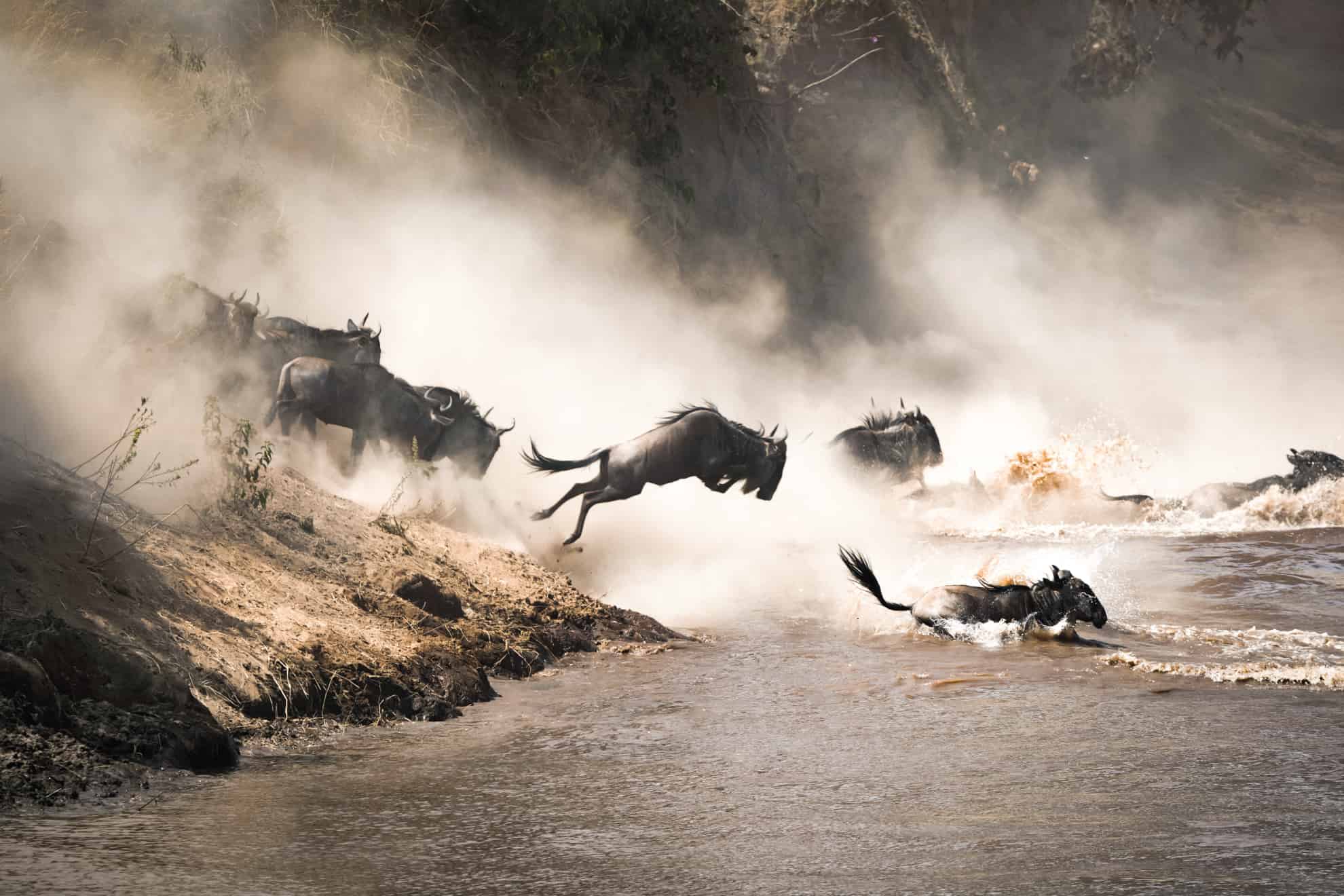
The migration is not a train timetable, so here's the careful version. By late December, the wildebeest are generally moving toward or concentrating around the southern Serengeti and Ndutu ecosystem, drawn to the nutrient-rich short-grass plains that will support the coming calving period. The Tanzania Tourism Board describes the migration accurately: a continual movement of wildebeest and zebra seeking new pasture — not a fixed event at one location (TTB).
What that means for your Christmas week: think gathering herds, migration positioning, and anticipation — big concentrations building on green plains, with the predators that follow them. What it doesn't mean: we will not promise you the herds at a specific spot on December 25, and no honest operator will.
And the distinction that matters most for planning: Christmas is not calving season. The southern-Serengeti/Ndutu calving spectacle — thousands of newborns and the predator drama around them — becomes properly established in January and February. Christmas can put you in the right region at the right time; if newborn wildebeest are the primary reason for your trip, January–February is the safer target. We'd rather tell you that now than after you've booked. Deeper detail in our Great Migration timing guide.
What Christmas Actually Costs
The 20 December price line
Published 2026 rate sheets show festive-season lodge rates jumping ~30% from 20 December — $920 to $1,200 a night at one camp. Why Christmas costs what it costs
Festive-season pricing isn't an operator invention — it's visible in the industry's published rate sheets, and the line falls almost universally around 20 December. Two current examples from Asilia's public 2026 rates: Dunia Camp moves from $920 per person per night through 19 December to $1,200 from 20–31 December — roughly a 30% jump; The Highlands moves from $1,080 to $1,390 — about 29% (Asilia published rates, 2026). Some higher-end properties swing further still. Those are one company's rates, quoted as evidence of the pattern, not as our pricing — your Safari-TZ quote states exactly what your dates cost.
Why does the premium exist? Because accommodation, vehicles, guides and internal flights all hit peak demand in the same two weeks — American and European families travelling on the same school calendar, competing for a fixed number of beds in a finite ecosystem. Your flights from the US behave the same way: the holiday fare premium on top of the normal $950–$1,700 US round-trip ranges is real, and holiday seats sell through earliest. One consolation worth naming: every place Americans holiday in late December — Hawaii, the Caribbean, ski country — charges its own peak-week premium. Here, the premium buys Christmas morning in the Serengeti.
Two honest ways to soften it: travel the first half of December (same green season, pre-premium rates — the value window very few Americans know about, though it needs school-flexible kids), or weight the trip toward Zanzibar, where beach nights typically carry a gentler festive premium than the migration-corridor camps. Where Christmas sits in the full trip budget — flights included — is covered in our Tanzania safari from the USA guide.
How Early to Book
Fixed dates need early decisions
Christmas safari lodges sell by property and room, months ahead. Book early if your dates are fixed, an October enquiry chooses from what left, not what's best
Here's the structural problem with Christmas: your dates can't move, and neither can the lodges. A July traveller with flexible weeks can chase availability; a family fixed to Dec 20–Jan 2 is competing for specific rooms, in specific camps, in the specific corner of the Serengeti where the herds are heading — at the exact moment every other school-calendar family wants the same thing.
So the advice is blunt: if Christmas is non-negotiable, don't wait until October. An October enquiry isn't hopeless — but by then you've moved from choosing the best itinerary to seeing what remains available: perhaps not your preferred lodge, room configuration, Serengeti location, vehicle or Zanzibar resort.
For an American family, the working timeline looks like this:
- Spring–early summer: fix dates around your school district's winter break and secure the safari accommodation — the scarcest piece.
- By early fall: book the flights from the US — the 5–6-months-ahead rule for peak travel puts holiday flights in the June–September booking window, before the fare premium hardens.
- By Thanksgiving: apply for the $100 US eVisa — the official window is "within ten days," but the holidays are exactly when you don't leave it late.
- December departure week: build slack into the US end. Winter weather at American hub airports is a real December variable — favour itineraries with comfortable connections, and consider flying out a day earlier than strictly necessary rather than gambling Christmas on the last possible departure.
General context on lead times year-round is in our guide to how far in advance to book.
What Christmas Day on Safari Looks Like
You're not sacrificing Christmas
A Christmas Day on safari: dawn game drive, brunch back at camp, an afternoon drive, and whatever festive programme your property runs. What's real, what varies
American families sometimes worry that Christmas in the bush means giving Christmas up. It doesn't — it means trading the living room for the Serengeti. A typical Christmas Day runs: early game drive while the wildlife is most active → back to camp for a late breakfast or brunch and a slow midday → an afternoon drive → dinner, drinks and whatever festive programme your property has arranged. Presents still get opened; the view during is somewhat upgraded. (Pack small, unwrapped gifts — wrapped items can invite questions at customs, and space is tight on safari luggage anyway.)
And you don't lose Christmas with the family back home — the time zones actually cooperate. Tanzania runs 8 hours ahead of Eastern time and 11 ahead of Pacific, so when it's Christmas morning in New York, it's early evening at camp: you're back from the afternoon game drive, on the lodge Wi-Fi, calling the grandparents while their day is starting. Christmas dinner in the bush, then a video call home over dessert — it works better than most families expect.
What we won't tell you: that "every Tanzanian lodge serves a traditional Christmas dinner under the stars." That's marketing fiction. The reality is that many safari properties create a festive atmosphere, but it varies widely — from a special meal to full Christmas programming with decorations and carols, to a deliberately low-key evening at camps whose guests prefer the bush unadorned. The right move is simple: ask your operator what your specific property is planning for December 24–25 and 31 before you book — we check this for every festive-season guest, because it's exactly the detail that makes or breaks the family memory. Travelling with children? Our family safari guide covers the wider practicalities.
The Dec 20 – Jan 2 Itinerary
Safari first, beach second
The two shapes that work for a US family over the holidays: northern safari then Zanzibar for New Year, or a longer safari — and why rushed trips waste the fare
Most US school districts break from roughly December 19–20 to January 2–5, and December 25 and January 1 are federal holidays — which means a family can run a genuine two-week Africa trip on only five or six days of actual PTO. Few windows in the American calendar are that efficient. Within it, two shapes work:
Option A — Safari + Zanzibar (the favourite). Depart the US Dec 19/20, arrive Dec 20/21 → northern-circuit safari Dec 21–26 (Christmas in the bush) → fly to Zanzibar Dec 26/27 → beach through New Year → depart Jan 1/2, landing home with a day to recover before work and school. Christmas among the animals, New Year on the sand, and the trip ends in recovery mode rather than a scramble.
Option B — The longer safari. Arusha → Tarangire → Ngorongoro → Serengeti, then a shorter Zanzibar tail or none at all. More time in the wildlife areas as the herds gather in the south — the shape for families whose priority is the safari itself.
On minimum length, the honest framing isn't "what's the shortest safari we can sell" — it's what justifies the 18–24-hour journey from the US and the Christmas premium. Flying halfway around the world for two rushed game-drive days wastes both. You'll land 8–11 hours ahead of your body clock; give the safari enough nights to absorb the travel, the time-zone swing and one imperfect-weather day, and the whole trip changes character. Both shapes above are built from our standard northern-circuit itineraries — the packages module below shows the current festive departures.
New Year's Eve: Bush or Beach?
It depends who you are
Families usually want Zanzibar's resorts for New Year; couples split between beach nightlife and a bush NYE that no city party matches.
December 31st comes down to personality, not a formula:
Families usually do best on Zanzibar — beach, swimming, restaurants, resort activities, and relaxed downtime after the safari's early mornings. The resort environment carries the evening; the kids are entertained; nobody's driving anywhere.
Couples genuinely split. Zanzibar works if you want a social, celebratory New Year. But a New Year's Eve in a safari camp can be the memorable one precisely because it isn't another city party — a fire, the bush at night, and a year that starts with a dawn game drive. Some of our couples call it the best NYE they've had; it's not for everyone, and we'll tell you honestly which camps do it well.
One thing we won't publish: a tidy "Kendwa = party, elsewhere = quiet" map of Zanzibar. The New Year atmosphere depends heavily on the specific property and the specific year. For a family we'd prioritise the resort environment over proximity to the busiest beach; for a couple chasing a lively night, a more social area can make sense — tell us which you are and we'll place you accordingly. Honeymooners: the Serengeti–Zanzibar honeymoon itinerary is this exact shape.
Five Mistakes Holiday Travellers Make
Blunt corrections
December isn't a bad safari month, the migration isn't where Google froze it, Christmas isn't calving season — the five holiday-planning myths, corrected.
The five we correct most on calls with American families, bluntly:
- "December is rainy season, so safari is a bad idea." No. December has a real rainy component; it also has green landscapes, dramatic light and full wildlife. The Tanzania Tourism Board actively promotes the green season for exactly these reasons.
- "The migration is wherever Google says it is." The migration moves. Continuously. A blog's static map is not a promise about your dates.
- "Christmas means guaranteed calving." Not necessarily — the newborn spectacle belongs to January–February. Christmas gets you gathering herds and positioning.
- "We'll book after Halloween, like we do for Hawaii." A Caribbean or Hawaii Christmas can sometimes be booked late; a Serengeti Christmas cannot — you're competing for specific rooms in specific camps, not a resort with 400 keys. By October you may not get your preferred lodge, room configuration, Serengeti location, vehicle or Zanzibar resort.
- "Christmas in Africa must be hot and dry." Warm days, yes — alongside green landscapes, possible showers and cooler early mornings. Leave the US winter coat in the car at the airport, but pack layers for dawn game drives (packing list here).
Christmas Safari Questions, Answered
Quick answers
Is Christmas a good time for a Tanzania safari, does it rain, where's the migration, what does it cost — the holiday questions, answered honestly.
Is Christmas a good time for an American family to do a Tanzania safari? Yes — the US school winter break fits a safari-plus-Zanzibar trip almost perfectly, and with Dec 25 and Jan 1 as federal holidays it costs unusually few PTO days. Expect green landscapes, gathering herds in the southern Serengeti, holiday pricing and real booking pressure.
Does it rain in Tanzania at Christmas? December sits in northern Tanzania's short-rain period. Expect warm days with possible showers — occasionally heavier storms — alongside green scenery and excellent photographic light. Rain rarely stops a safari; it changes its character.
Where is the Great Migration at Christmas? Generally moving toward or concentrating around the southern Serengeti and Ndutu plains ahead of calving. The herds' exact position on any date can't be guaranteed — the migration is continual movement, not a timetable.
Can I see wildebeest calving at Christmas? Usually not the main spectacle — calving establishes in January–February in the southern Serengeti/Ndutu. Christmas offers gathering herds; book January–February if newborns are the priority.
How much more does a Christmas safari cost? Published 2026 rate sheets show festive-season lodge rates rising roughly 29–30% from 20 December at sample properties ($920→$1,200 and $1,080→$1,390 per person per night). Early December offers the same green season before the premium.
How far ahead should Americans book a Christmas safari? As early as your school-break dates are fixed — lodges first (they sell by specific room, months ahead), US flights by early fall, and the $100 US eVisa by Thanksgiving. By October you're choosing from what remains, not what's best.
Can we call family in the US on Christmas Day? Yes — Tanzania is 8 hours ahead of Eastern time and 11 ahead of Pacific, so Christmas morning in the US is early evening at camp. Most lodges have Wi-Fi; you'll be back from the afternoon game drive in time to call the grandparents.