Marangu Route Kilimanjaro — 5-Day & 6-Day Hut Climb

The Marangu route is the only way to climb Kilimanjaro sleeping in huts rather than tents, and it is the cheapest route on the mountain. Nicknamed the "Coca-Cola route," it approaches from the southeast and is the only out-and-back trail — you climb and descend the same path, sleeping in dormitory huts at Mandara, Horombo, and Kibo. It is run as a 5-day or 6-day climb, and here we have to be honest: Marangu has the lowest summit success of any route — around 50% on the 5-day and about 65% on the 6-day. That is not because the route is hard, but because most people climb it too fast. The out-and-back profile gives less of the "climb high, sleep low" acclimatization that the camping routes build in, and the popular 5-day version simply does not give your body enough time to adjust. If you choose Marangu, choose the 6-day with the extra acclimatization day at Horombo — it meaningfully improves your odds.

Marangu summits differently from the other routes too: you reach the crater rim at Gilman's Point (5,681m), then walk one and a half to two hours around the rim to Uhuru Peak (5,895m). The honest reasons to pick Marangu are real but specific: you want a bed and a dining hall instead of a tent, you are climbing in the rainy season when hut shelter matters, or budget is the deciding factor. If your priority is reaching the summit, the camping routes score higher — a 7-day Machame is around 85% and an 8-day Lemosho around 90%. Below: the full 5-day and 6-day itineraries with an altitude profile, the huts, summit night via Gilman's Point, honest success factors, cost, and how Marangu compares to Machame. After 35 years running this route from Arusha, we recommend the 6-day and tell you the truth about the odds.

5-6 days
5-day primary, 6-day recommended
Huts, not tents
The only hut route
Cheapest route
Budget choice on Kilimanjaro

Marangu Route at a Glance

  • Duration: 5 days (primary) or 6 days (recommended for better odds)
  • Success rate: ~50% (5-day) / ~65% (6-day) — lowest of all routes
  • Accommodation: Dormitory huts (the only hut route)
  • Approach: Southeast, via Marangu Gate (1,860m), out-and-back
  • Summit access: Gilman's Point (5,681m), then Uhuru
  • Best for: Budget, hut comfort, rainy-season shelter

5-Day or 6-Day Marangu? Why We Push the 6-Day

This is the within-route choice that matters most on Marangu, because the route's success problem is largely a duration problem. The 5-day is the cheapest climb on the mountain and the most-booked Marangu, but it summits only about half of climbers — four nights is simply too fast for most bodies to acclimatize. The 6-day adds an acclimatization day at Horombo Hut (3,720m) and lifts success to around 65%. We will be honest about the limit of that, though: even the 6-day Marangu scores below the camping routes, because the out-and-back profile does not let you "climb high, sleep low" as effectively. So if maximum odds matter, the route choice itself — not just the duration — is the lever you should pull. But within Marangu, the 6-day is clearly the responsible version, and it is the one we recommend to anyone set on this route.

Most Booked · Cheapest

5-Day Marangu

~50%
Typical Summit Success

The cheapest climb on Kilimanjaro and the most-booked Marangu. But about half of climbers do not summit — the four-night profile is simply too fast for most bodies to acclimatize. Choose it only if budget is the hard constraint and you arrive genuinely fit.

  • Lowest cost
  • One day shorter
  • Hut accommodation
  • Lowest success on the mountain
  • Honest warning: ~50% summit
Recommended · Better Odds

6-Day Marangu

~65%
Typical Summit Success

Adds an acclimatization day at Horombo Hut (3,720m) — usually a half-day hike toward Zebra Rocks and back. That extra night lifts success from ~50% to ~65%. If you are climbing Marangu, this is the version to book.

  • Extra Horombo acclimatization day
  • ~65% success
  • Same huts
  • Costs ~$300-400 more
  • The responsible Marangu
Our honest take: if you are set on Marangu, book the 6-day — the 5-day's odds are genuinely poor. And if your real priority is summiting rather than sleeping in huts, know that the camping routes score much higher: a 7-day Machame is around 85% and an 8-day Lemosho around 90%. Marangu earns its place on comfort, cost, and rain shelter — not on summit odds. This mirrors the trust spine across our routes hub: more days on the mountain beats more time in the gym.

Marangu Route Day-by-Day — The 5-Day Climb

Here is the 5-day Marangu primary itinerary, hut by hut and altitude by altitude — the version most people search and book. You start and finish at Marangu Gate (1,860m), because this is the only out-and-back route on the mountain: you ascend and descend the same trail, which is why you pass through Horombo twice. The trail climbs through rainforest to Mandara, onto open moorland at Horombo, across the stark alpine-desert saddle to Kibo, and then up to the crater rim at Gilman's Point before the rim walk to Uhuru Peak. The 6-day version adds an acclimatization day at Horombo, which is the single change that lifts the odds. Read the days in order; each one builds on the acclimatization of the one before, and the summit is reached via Gilman's Point, not the Barafu and Stella Point approach the southern routes use.

Marangu Route — Altitude Profile (5-Day, Out-and-Back)
Marangu route altitude profile20,00015,00010,0005,00001,860 m6,102 ft2,700 m8,858 ft3,720 m12,205 ft4,703 m15,430 ft5,681 m18,638 ft5,895 m19,341 ft3,720 m12,205 ft1,860 m6,102 ftMarangu GateMandara HutHorombo HutKibo HutGilman's PointUhuru PeakHorombo HutMarangu Gate~8 km~12 km~10 km~6 km~1 km~7 km~10 km

Altitude on the left axis (feet); hut altitudes shown in metres and feet. Marangu is out-and-back — you descend the same trail, which is why Horombo Hut and Marangu Gate appear twice. The 6-day adds an acclimatization day at Horombo (3,720m). Summit is reached via Gilman's Point on the crater rim, then the rim walk to Uhuru.

DAY 01Marangu Gate → Mandara HutMandara Hut · 2,700m
Morning
Register at Marangu Gate (1,860m)Transfer from Arusha to the southeast side of the mountain, sign in at the park gate, and meet your guides and porters. Loads are weighed to the 20kg KPAP limit before anyone sets off.
4-5 hrs
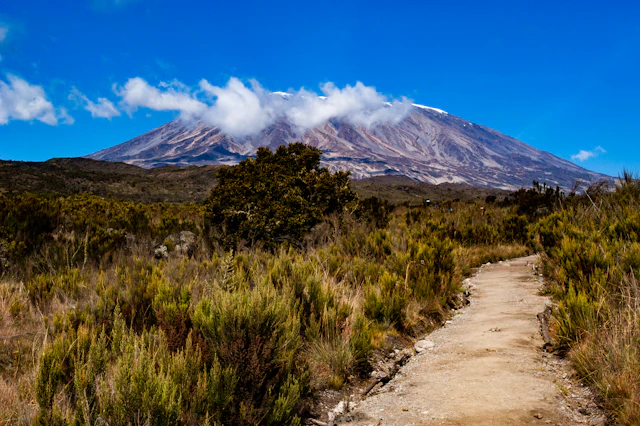
Ascend through rainforest (~840m gain)A steady climb through cool, green montane forest — the wettest, most humid stretch of the route. Colobus monkeys and birdsong overhead. A gentle first day to find your rhythm.
Evening
Arrive Mandara Hut (2,700m)Your first night in the A-frame huts at the forest edge. There is an optional short side-trip to Maundi Crater nearby for sunset views over the foothills toward Kenya.
DAY 02Mandara → Horombo HutHorombo Hut · 3,720m
6-7 hrs
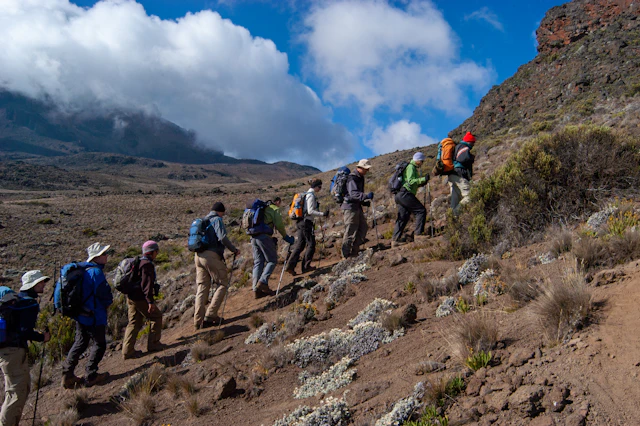
Out of the forest onto the moorlandThe forest gives way to open heather and moorland, with giant lobelia and senecio along the path and the jagged peak of Mawenzi coming into view. The first big altitude gain — pole pole pace matters from here.
Afternoon
Reach Horombo Hut (3,720m)The biggest and busiest hut on the route, with around 120 bunks and a large dining hall. A health check and an early night. On the 6-day climb, you spend an extra acclimatization day and night here.
DAY 03Horombo → Kibo HutKibo Hut · 4,703m
6-7 hrs
Cross "the saddle"A long, exposed walk across the stark alpine-desert plateau between Mawenzi and the Kibo cone. Dry, dusty, and increasingly thin air. Little grows up here — it feels like another planet.
Afternoon
Arrive Kibo Hut (4,703m)A basic stone dormitory at the foot of the summit cone — cold, no heating, dormitory bunks. Eat early, prepare your gear, and rest before the midnight summit start.
DAY 04Summit Day: Kibo → Gilman's Point → Uhuru → HoromboHorombo Hut · 3,720m
Midnight
Depart Kibo by headlampA light meal, then off into the dark around midnight. Temperatures sit between minus 10 and minus 20 Celsius. Steep scree switchbacks above the hut — pole pole from the first step.
5-6 hrs
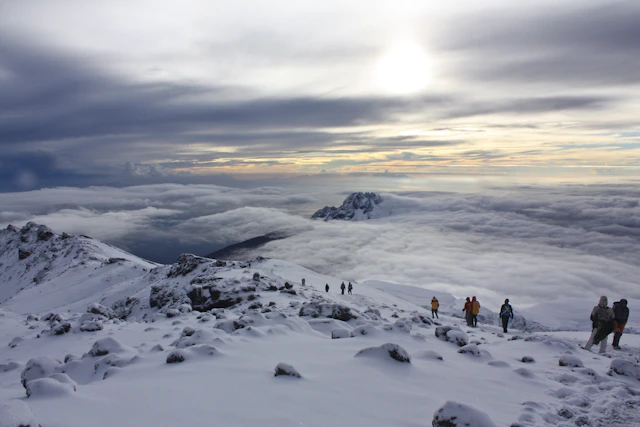
Up to Gilman's Point (5,681m)Relentless zig-zags up scree to the crater rim, usually reached around sunrise. This is Marangu's summit-access point, and many climbers stop here — Gilman's still earns a summit certificate.
1.5-2 hrs
Rim walk to Uhuru Peak (5,895m)From Gilman's, a longer crater-rim traverse than the southern routes, past Stella Point to the true summit and the Uhuru sign. Glaciers, the photo, then down — you do not linger at altitude.
Afternoon
Descend all the way to Horombo (3,720m)Back down to Kibo, then on to Horombo Hut — nearly 2,000m of descent the same day. A very long summit day of 12 to 15 hours, the hardest and most rewarding of the climb.
DAY 05Horombo → Marangu GateEnd of Climb · 1,860m
5-6 hrs
Final descent through moorland and forestRetrace the same trail back down through Mandara to Marangu Gate (1,860m), back into the green. Knees will be tired, but the hard work is behind you.
Midday
Certificates and transfer to ArushaSummit certificates are issued at the gate — green for Gilman's Point, gold for Uhuru Peak. Tips are distributed to the crew, then it is back to Arusha for a real shower and a proper bed.
6-day Marangu: the recommended version adds an acclimatization day at Horombo Hut (3,720m) after Day 2 — usually a half-day hike toward the Mawenzi foothills and Zebra Rocks, then back to sleep at Horombo. That extra night lifts success from ~50% to ~65%, and it is the change we recommend to anyone climbing this route.

The Huts — What Makes Marangu Different

Marangu is the only route on Kilimanjaro where you sleep in huts rather than tents, and that single fact is why most climbers who pick it do so. The honest reality is dormitory-style accommodation: A-frame wooden cabins and a cold stone hut at the top, each with bunks, basic mattresses, and shared dining halls. It is warmer and drier than canvas when it rains, which is a genuine advantage in the wetter months, but it is communal and gets busy in peak season — Horombo in particular fills with climbers from every Marangu group on the mountain. You still bring your own sleeping bag, because the huts provide mattresses, not bedding. There are no showers, just washing water in basins. If the idea of a bed under a roof rather than a tent on the ground is what draws you to Kilimanjaro, this is the one route that gives you that.

The three Marangu huts

Three hut complexes mark the stages of the climb, one for each night on the way up. They are spartan but solid, and after a long day on the trail a dining hall and a bunk are no small thing.

Mandara Hut
2,700m · Day 1

A-frame wooden cabins at the forest edge. Four to six bunks per room, a shared dining hall, basic mattresses, and some flush toilets. The most comfortable hut on the route.

Horombo Hut
3,720m · Day 2 (+ acclim. day on 6-day)

The biggest and busiest hut, with around 120 bunks. A-frame cabins and a large dining hall. Fills in peak season. Where the 6-day acclimatization day is spent, with Mawenzi views.

Kibo Hut
4,703m · Day 3 (summit base)

A basic stone dormitory at the foot of the summit cone. Cold, no heating, dormitory bunks. You sleep here only briefly before the midnight summit start.

Huts mean you carry less, sleep on a mattress under a roof, and stay drier when it rains — which is why Marangu is the go-to route in the wetter shoulder months. The trade-offs are honest: dorms are communal, Horombo gets crowded in peak season, there are no showers, and you still bring your own sleeping bag. If hut comfort is what draws you to Kilimanjaro, Marangu is the only route that offers it.

How Hard Is Marangu — and the Honest Truth About Success

Marangu is often wrongly called the gentle, simple route, and it is worth correcting that head-on. The trail itself is non-technical and genuinely kind underfoot — no ropes, no scrambles, gradual gradients, and a clear well-trodden path. But Marangu has the lowest summit success of any route on the mountain: around 50% on the 5-day and about 65% on the 6-day. The walking is not the problem. The altitude and the rushed schedule are. The out-and-back profile gives less of the "climb high, sleep low" acclimatization that the camping routes are built around, and the popular 5-day version simply does not give your body enough time to adjust before summit night. Read that plainly: the kindest trail on Kilimanjaro is also the one most likely to turn you back, and almost always because of how fast it is climbed rather than how steep it is. Booking the 6-day, and climbing it pole pole with daily health checks, is the most effective thing you can do to improve your odds — our lead mountain guides Geoffrey Komba, William Mwasimba, and Isaac Munuo run twice-daily SpO2 checks on every climb for exactly that reason. None of this makes Marangu a poor choice — it makes it a route to climb honestly, with eyes open about the numbers.

The "easy route" label is the most dangerous myth on this mountain. Climbers who book Marangu because it sounds simple often underestimate the altitude, rush the 5-day, skip training, and turn back above Kibo. The trail is gentle; the summit is not. Treat Marangu with the same respect as any 5,895m climb — book the 6-day, train for it, and choose an operator running oxygen and daily SpO2 checks. See the beginner's guide if this is your first big mountain.

Pick Marangu, or pick another route — honestly

Pick Marangu if
  • Budget is the hard constraint — it is the cheapest route
  • You want a bed and a dining hall, not a tent
  • You are climbing in a wetter month and want shelter
  • You prefer the simplest logistics and a gentle trail
Pick something else if
  • Summit success is your priority — Machame or Lemosho score far higher
  • You want scenic variety — Marangu is the same trail twice
  • You want the best acclimatization profile of all
  • You are nervous about your first climb — see our beginner's guide

Ready to climb Marangu?

Tell us your dates and whether you want the 5-day or 6-day. We'll confirm hut bookings, crew, and pricing within 24 hours — and give you our honest view on the odds.

Summit Night — Kibo to Gilman's Point to Uhuru

Marangu's summit night is different from the southern routes, and it helps to know exactly what is coming. Where Machame and Lemosho push from Barafu to Stella Point, Marangu climbs from Kibo Hut to Gilman's Point on the crater rim, then walks the rim to Uhuru. You leave Kibo at midnight, not for drama but because the scree is firmer when frozen and the timing puts you on the rim near sunrise. The first five to six hours are the hardest — slow switchbacks up dark scree by headlamp, in deep cold, with the air thinning toward the rim. Then Gilman's Point arrives, the sky lightens, and the steepest climbing is behind you. Be honest with yourself here: many climbers stop at Gilman's, and that still earns a summit certificate. From Gilman's it is another one and a half to two hours along the rim to Uhuru Peak — a longer rim section than the Stella Point routes, and demanding at that altitude. Our lead mountain guides Geoffrey Komba, William Mwasimba, and Isaac Munuo set a deliberately slow pace up the switchbacks for exactly that reason, after hundreds of summit nights between them.

Summit night — the stage-by-stage

From Kibo Hut (4,703m) to Uhuru Peak (5,895m) via Gilman's Point, then down to Horombo — 12 to 15 hours
4,703m
Midnight: Kibo Hut departure

Wake around 23:00, a light meal, layer up for the minus 10 to minus 20 Celsius ahead. Depart by headlamp around midnight from the stone hut. Pole pole into the dark.

5,150m
~02:00-03:00: Hans Meyer Cave

Roughly the halfway marker on the relentless scree switchbacks above Kibo. The hardest, coldest, steepest stretch — and the point where most climbers wonder why they signed up.

5,681m
~05:30-06:30: Gilman's Point

The crater rim, reached around sunrise. This is Marangu's summit-access point. Many climbers stop here — Gilman's earns a summit certificate. Uhuru is still 1.5 to 2 hours along the rim.

5,895m
~07:00-08:00: Uhuru Peak

The true summit, reached by the rim walk past Stella Point from the Gilman's side. The sign, the glaciers, the photo. Time at the top is short — altitude means you do not linger.

3,720m
Afternoon: Descent to Horombo

Back down to Kibo, then all the way to Horombo Hut (3,720m). A very long summit day — 12 to 15 hours from the midnight start.

Marangu is the one route that does NOT summit via Barafu and Stella Point — it reaches the rim at Gilman's Point and walks round to Uhuru, a longer rim section than the southern routes. Be clear-eyed that the rim walk from Gilman's to Uhuru is itself demanding at altitude, and stopping at Gilman's still earns a certificate. For the route-by-route summit comparison, see the routes hub.

What a Marangu Climb Costs — the Cheapest Route, Honestly

Marangu is the cheapest route on Kilimanjaro, and the reason is structural: huts mean fewer porters to carry tents and camping kit, and no camping equipment to haul up the mountain, so the crew is smaller and the costs are lower. Start with the part nobody can discount: park and hut fees come to roughly $700-900 or more per climber, paid straight to the authorities and identical for every operator — the fee structure uses hut fees rather than the camping fees on other routes, but the conservation charge still adds up day by day. Add fair porter wages, food for the whole crew, certified guides, transport, oxygen, and hut bookings, and a fair Marangu climb cannot legitimately sit under about $1,400. So when an operator advertises Marangu well below that, the maths does not close — the gap is recovered somewhere you cannot see, usually in oxygen, guide ratios, or porter wages. The table below sets out the real tiers for both the 5-day and the 6-day, with park and hut fees shown as the fixed line every tier includes.

Tier5-day price6-day priceWhat you get
Budget (danger zone)under $1,400under $1,550Corner-cutting — avoid
Mid-range (reputable)$1,600-2,400$1,900-2,800Proper crew, oxygen, fair wages, hut bookings
Premium$2,800-3,600$3,000-4,000+Smaller groups, extra guides, premium support
Park + hut fees (included above)~$700-900~$800-1,000Paid to government
Marangu being the cheapest route does not mean cheap operators are safe. A climb under $1,400 still cuts corners on oxygen, guide ratios, or porter wages. And be wary of the cheapest 5-day Marangu specifically — it pairs the lowest-success duration with the lowest budget, which is the worst combination on the mountain. People have turned back, and some have died, because operators trimmed the things that do not show in a brochure. See the operator safety checklist on our routes hub before booking with anyone.
Included in a fair Marangu climb: park and hut fees, certified guides, fair-wage KPAP-aligned porters, full board on the mountain, hut bookings, oxygen and a pulse oximeter, Arusha transfers, and the rescue fee. Excluded: international flights, your visa, tips for the crew (roughly $220-320), personal gear, your own sleeping bag, and travel insurance covering high-altitude evacuation, which we require.

Marangu vs Machame — Huts or Tents, Budget or Odds

This is the comparison most Marangu buyers actually want, because the two routes pull in genuinely different directions. Marangu is the hut route: the cheapest on the mountain, out-and-back on the same southeast trail, summiting via Gilman's Point, with a lower success rate of around 50% on the 5-day and 65% on the 6-day. Machame is the classic camping route: tents rather than huts, a varied loop with a different descent, summiting via Barafu and Stella Point, more scenic, and reaching about 85% success on the 7-day — but it costs more. Put plainly, the honest split is comfort and cost against odds and scenery. Marangu wins on a bed, a roof, rain shelter, and a smaller bill; Machame wins on materially higher summit success and more varied views. Neither is "better" in the abstract — they suit different priorities. Compare the two side by side below.

Marangu

  • Sleeping: Dormitory huts (beds)
  • Days: 5-6
  • Success: ~50-65%
  • Trail: Out-and-back (same path twice)
  • Summit via: Gilman's Point
  • Cost: Cheapest route
  • Best for: Budget, huts, rain shelter

Machame

  • Sleeping: Tents (camping)
  • Days: 6-7
  • Success: ~85% (7-day)
  • Trail: Varied loop (different descent)
  • Summit via: Barafu / Stella Point
  • Cost: Higher than Marangu
  • Best for: Scenery + much higher odds
The honest split: choose Marangu for huts, budget, or rain shelter; choose Machame for materially higher summit odds and more varied scenery. If summiting is the priority, Machame (or Lemosho) is the better spend. If a bed and a roof matter more than the statistics, Marangu is the only route that gives you that. Read the full Machame route guide →

Best Time to Climb the Marangu Route

Marangu follows the same broad seasons as every route: the two dry windows give the best conditions — January to mid-March, and June to October. January and February are typically the warmest and clearest, while June through October is the long dry season and the most reliable stretch, which is exactly why July to September is also the busiest. But Marangu has one genuine, route-specific edge that is worth knowing: because the huts give shelter, it is the most rain-tolerant route on the mountain. For climbers who can only travel in the wetter shoulder months — parts of November, or early March as the long rains build — Marangu is often the most sensible pick over a miserable tent climb on an exposed camping route. The trade is real on both sides: rain lowers visibility and can make summit night harder, so we still steer most climbers to the dry windows for the best odds. One practical note on this route in particular: the huts must be reserved through the park, and Horombo fills fast in July to September and over January and February, so peak dates need booking well ahead. The month grid below shows the picture at a glance.

Jan
Best
Warmest, clearest
Feb
Best
Warmest, busiest
Mar
OK / Avoid late
Dry early, rains late
Apr
Rain (huts help)
Long rains
May
Avoid
Long rains
Jun
Best
Dry season begins
Jul
Best
Busiest, Horombo fills
Aug
Best
Busiest, Horombo fills
Sep
Best
Reliable, clear
Oct
Best
Dry, thinning crowds
Nov
Rain (huts help)
Short rains
Dec
OK
Variable, festive
The dry-season trade-off is the same as every popular route: the best weather brings the highest traffic, and on Marangu that shows up as full dorms at Horombo. Marangu's hut shelter is what softens the shoulder months — it is the one route where a wetter departure is genuinely defensible. For strong conditions with thinner trails, aim for the shoulder edges — late January, early March, or October — over the July-to-September peak, and book your hut dates early whatever month you choose.

Marangu Route Climbs — Book Direct

These are our scheduled and private Marangu climbs, so you can match the route straight to a bookable trip. Each card links to the full climb page for current dates, group departures, and exact pricing — the figures shown here are indicative starting points. Every climb runs to the same standard, whether you choose the 5-day or the 6-day: certified mountain guides, fair-wage porters under KPAP-aligned terms, emergency oxygen, hut bookings, and full board on the mountain. Reach out and we will confirm hut availability for your dates and give you our honest read on the odds.

Book Direct · Arusha Operator Since 1991

Climb Marangu with the team that runs the mountain.

5-Day Marangu Route Kilimanjaro hut climb5 DAYS

5-Day Marangu Climb

Marangu · Huts · ~50% success
From $1,790pp
Placeholder — developer updates with live pricing
View 5-day Marangu →
6-Day Marangu Route Kilimanjaro hut climb6 DAYS

6-Day Marangu Climb

Marangu · Huts · ~65% success
From $2,090pp
Placeholder — developer updates with live pricing
View 6-day Marangu →
6-Day Marangu Route plus safari combo6+ DAYS

6-Day Marangu + Safari Combo

Climb + safari · Huts + lodges
From $3,490pp
Placeholder — developer updates with live pricing
View climb + safari →

Marangu Route — Common Questions

Is the Marangu route really the easiest?
No — and this is the most common myth about Marangu. It is often called the easy route because the trail is gentle underfoot and you sleep in huts, but it has the lowest summit success of any route on Kilimanjaro: around 50% on the 5-day and about 65% on the 6-day. The walking is not what stops people; altitude is. Marangu's out-and-back profile gives less climb-high, sleep-low acclimatization than the camping routes, and the popular 5-day version is simply too fast for most bodies to adjust. So Marangu is the gentlest trail but the hardest route to summit. If you choose it, choose the 6-day, and read our beginner's guide before booking.
Should I do the 5-day or 6-day Marangu?
The 6-day, almost always. The 5-day is the cheapest climb on the mountain and the most-booked Marangu, but it summits only about half of climbers because four nights is too fast to acclimatize. The 6-day adds an acclimatization day at Horombo Hut (3,720m) — usually a half-day hike toward Zebra Rocks and back to sleep at the same altitude — which lifts success from around 50% to about 65%. It costs roughly $300-400 more and asks for one extra day. After 35 years running this route from Arusha, our honest answer is plain: if you are set on Marangu, book the 6-day. If summit odds matter more than huts, a camping route like Machame scores higher still.
What is the Marangu route success rate?
Around 50% on the 5-day and about 65% on the 6-day — the lowest of any route on Kilimanjaro. The reason is acclimatization, not difficulty. Marangu is the only out-and-back route, so you do not get the climb-high, sleep-low profile that the camping routes build in, and the popular 5-day simply does not give your body enough time to adjust to the altitude. The 6-day adds a Horombo acclimatization day and raises the odds. Even so, the 6-day Marangu still sits below the camping routes — a 7-day Machame is around 85% and an 8-day Lemosho around 90%. These figures assume a reputable operator running the full schedule with daily health checks. See our routes hub for the full success-by-days data.
What are the Marangu huts like?
Marangu is the only route where you sleep in huts rather than tents. There are three: Mandara (2,700m) and Horombo (3,720m) are A-frame wooden cabins with four to six bunks per room, basic mattresses, and shared dining halls; Kibo (4,703m) is a colder stone dormitory at the summit base. You still bring your own sleeping bag — the huts provide mattresses, not bedding. There are no showers, just washing water in basins, and toilets are basic, though some lower huts have flush ones. Horombo is the biggest and busiest, with around 120 bunks, and it fills in peak season. The trade for that comfort is that dorms are communal. For many climbers, a bed and a roof are the real reason to pick Marangu.
Why does Marangu have the lowest success rate?
Because of its profile, not its trail. Marangu is the only out-and-back route on Kilimanjaro, so it gives less of the climb-high, sleep-low acclimatization that the camping routes use to prepare your body for the summit. On top of that, the route is most often climbed in five days, which is too fast for most people to adjust to the altitude. The combination — a less effective acclimatization shape and a rushed schedule — is what pushes its summit rate down to around 50% on the 5-day. The walking itself is gentle; the altitude is the obstacle. Booking the 6-day, which adds a Horombo acclimatization day, is the single biggest thing you can do to improve your odds on this route.
What happens on summit night via Gilman's Point?
Marangu summits differently from the southern routes. You leave Kibo Hut (4,703m) around midnight and climb steep scree switchbacks for five to six hours by headlamp, in temperatures of minus 10 to minus 20 Celsius, reaching Gilman's Point (5,681m) on the crater rim near sunrise. That is Marangu's summit-access point — and many climbers stop there, which still earns a summit certificate. From Gilman's it is another one and a half to two hours along the crater rim to Uhuru Peak (5,895m), a longer rim walk than the Stella Point routes. Then you descend all the way back down to Horombo Hut (3,720m), making for a very long summit day of 12 to 15 hours. Pole pole is the rule from the first step.
How much does the Marangu route cost?
Marangu is the cheapest route on Kilimanjaro because huts mean fewer porters and no camping equipment. A reputable 5-day runs roughly $1,600-2,400 and a 6-day about $1,900-2,800, with premium climbs higher. Park and hut fees alone come to around $700-900 or more, paid straight to the authorities and identical for every operator. A climb advertised under $1,400 is cutting corners — and be especially wary of the cheapest 5-day Marangu, because it pairs the lowest-success duration with the lowest budget, the worst combination on the mountain. A fair price still has to cover certified guides, fair-wage porters, oxygen, food, and hut bookings. Treat a very low quote as a warning sign and ask exactly where the savings come from. See the routes hub for the operator safety checklist.
Marangu or Machame — which should I choose?
It depends on what you want most. Marangu gives you huts, the lowest cost, and shelter in the rain, but it is out-and-back, summits via Gilman's Point, and has a lower success rate of around 50-65%. Machame gives you tents, more varied scenery on a loop, a Barafu and Stella Point summit, and a materially higher success rate of around 85% on the 7-day — at a higher price. Put plainly: choose Marangu for a bed, a roof, and a smaller bill; choose Machame for better odds and better scenery. If summiting is your priority, Machame is the better spend. If hut comfort or budget is the deciding factor, Marangu is the only route that offers it. Read our full Machame route guide to compare the day-by-day detail.
When is the best time to climb Marangu?
The two dry windows are best, as on every route: January to mid-March and June to October. January and February are typically the warmest and clearest, while June through October is the long dry season and the most reliable, which also makes July to September the busiest — Horombo Hut fills, so peak dates need booking well ahead. Marangu has one season-specific edge worth knowing: because the huts give shelter, it is the most rain-tolerant route on the mountain, so for climbers who can only travel in a wetter shoulder month it is often the most sensible pick over a tent climb. The long rains of April and May and the short rains of November are still best avoided where possible.
Is Marangu good for the rainy season?
It is the best route for it. Marangu is the only route with hut accommodation, so when it rains you sleep dry under a roof in a dining hall rather than in a wet tent, which is a genuine advantage in the shoulder months. That is one of the honest reasons to pick this route. The caveats are real, though: rain lowers visibility and can make summit night harder, and the gentle trail can get muddy lower down. We would still steer most climbers toward the dry windows of January to mid-March and June to October for the best odds. But if your only chance to climb falls in a wetter month, Marangu's huts make it the most comfortable and sensible choice on the mountain.
What's included in a Marangu climb?
A fair Marangu climb with us includes all park and hut fees, certified mountain guides, fair-wage KPAP-aligned porters, full board on the mountain, hut bookings, emergency oxygen and a pulse oximeter, Arusha transfers to and from the gate, and the rescue fee. Not included are international flights, your Tanzania visa, tips for the crew (budget roughly $220-320), personal gear such as boots, your own sleeping bag, and travel insurance covering high-altitude evacuation, which we require. The clearest way to compare operators is to ask exactly what the price includes and excludes in writing. A cheap quote often looks competitive because it leaves out oxygen or trims porter pay. We list everything up front and run every climb to the same standard.
Can I combine Marangu with a safari?
Yes, and many of our climbers do. The usual pattern is climb first, then recover on safari, because the mountain is the demanding early-start part of the trip and the safari is the reward your legs will thank you for. Because we run both the mountain and the safari side under one Arusha team, your logistics are coordinated end to end — no handoff between operators and one point of contact. Popular pairings are a dedicated post-Kilimanjaro recovery safari built for tired legs, or a 4-day Northern Circuit safari, scaling up to a full Tanzania safari if you have the time. Message us with your Marangu climb dates and we will build a combined climb-and-safari itinerary around them, quoted as one trip rather than two bookings.
From Marangu Gate to Uhuru Peak — Start Here

Tell us your dates, 5-day or 6-day preference, and experience level. We'll send a Marangu climb proposal within 24 hours — with an honest view on your odds.

Or email info@safari-tz.com · Call +255 740 666 662

WhatsApp