How hard is the Lemosho route?
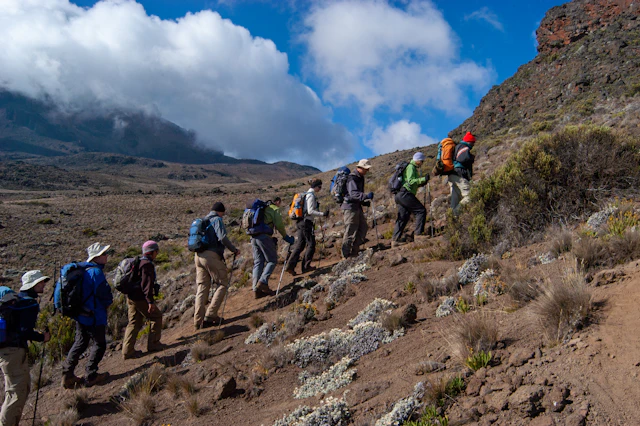
Lemosho is moderate-to-hard, but not technical. For the whole climb you are walking, not climbing — no ropes, no harnesses, no ice-axe skills. What makes Lemosho more comfortable than a shorter route is its pace: spread over eight days, the climb gives your body time to adjust, so the daily walking rarely feels brutal. The real difficulty is altitude and summit day. You finish at Uhuru Peak (5,895m), and the thin air is what stops climbers, not tired legs. Summit day runs 12 to 16 hours, starting at midnight and including a descent of nearly 3,000m. The Barranco Wall on Day 5 is a 257m scramble that needs no ropes and most climbers enjoy. If you can hike several hours on consecutive days, you have the base for Lemosho.
Should I do the 8-day or 7-day Lemosho?
If you are choosing Lemosho at all, do the 8-day. The whole reason this route scores around 90% is its acclimatization profile — separate Shira 1 and Shira 2 days plus a Karanga night before the summit push. The 7-day compresses one of those days and drops success to about 85%, which is close to a 7-day
Machame at a higher price. So the 7-day Lemosho gives back exactly the advantage that makes Lemosho worth choosing. The 8-day costs a little more and asks for one more day of leave, but those are what buy the higher odds and the full Shira Plateau crossing. After 35 years on this mountain, our honest answer is plain: pick Lemosho for the 8-day. If 7 days is your hard limit, a 7-day Machame is often the better value.
What is the Lemosho route success rate?
On the 8-day Lemosho, around 90% of climbers reach Uhuru Peak — among the highest of any route, second only to the 9-day
Northern Circuit. The 7-day version drops to about 85%. The reason Lemosho scores so high is its acclimatization: the gradual western approach, separate Shira 1 and Shira 2 days, the Lava Tower climb-high-sleep-low profile, and the Karanga night all give your body time to adjust before summit night. These figures assume a reputable operator running the full schedule with daily health checks and a slow pace. Budget operators who compress days score lower on the same trail. The single biggest lever you control is choosing the 8-day. After that, pace, hydration, and honest daily check-ins with your guide decide the rest. See our
routes hub for the full success-by-days data.
Why is Lemosho more expensive than Machame?
Lemosho costs more than
Machame for one straightforward reason: days. An 8-day Lemosho has two more nights on the mountain than a 6-day Machame, and every extra day adds park fees, camping fees, crew wages, and food. Park fees alone on Lemosho run to roughly $1,000-1,200 because the conservation fee is charged per day. Those extra days are not padding — they are the acclimatization that lifts Lemosho's success to around 90%. So the higher price buys the higher odds and the full Shira Plateau scenery, not just more time. A reputable 8-day Lemosho sits around $2,600-3,600, against roughly $2,000-2,800 for a 6-day Machame. If budget is the deciding factor, Machame is the better value; if odds and scenery matter most, Lemosho earns its price.
What happens on summit night?
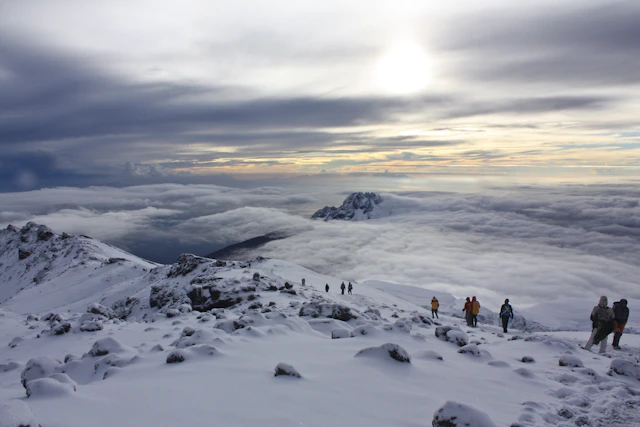
You leave Barafu Camp (4,673m) around midnight after a short rest and a light meal. The first 6 to 7 hours are slow switchbacks up scree in the dark by headlamp, in temperatures between minus 10 and minus 20 Celsius. This is the hardest psychological stretch — cold, dark, and thin air. You reach Stella Point (5,756m) on the crater rim around sunrise, where most of the climbing is done, then walk roughly an hour of gentler ground to Uhuru Peak (5,895m). Time at the top is short because of the altitude, just long enough for photos at the summit sign. Then comes the long descent — nearly 3,000m down to Mweka Camp (3,100m). The whole day runs 12 to 16 hours. Lemosho's 8-day acclimatization means you usually reach Barafu in better shape than on shorter routes, which is why its summit success is so high.
Is the Lemosho route good for beginners?
Lemosho is one of the routes we most often recommend to fit first-time high-altitude trekkers, precisely because the 8-day version gives the best realistic odds short of the Northern Circuit. It is a walk-up with no technical sections beyond the Barranco Wall scramble, so you do not need climbing experience. What a first-timer needs is time to acclimatize, a slow pace, and an honest operator — and the 8-day Lemosho delivers all three. The trade-offs are cost and that it is camping-only across eight days, so you should be comfortable in a tent. If you want the absolute highest odds, the 9-day
Northern Circuit edges it; if budget matters more, a 7-day
Machame is the value option. Read our
beginner's guide before you decide, and be honest with us about your fitness.
How much does the Lemosho route cost?
A safe, properly run 8-day Lemosho costs roughly $2,600-3,600 from a reputable operator, with the 7-day a little lower at about $2,400-3,200 and premium expeditions running higher. Lemosho costs more than Machame because of the extra days. Park fees alone are around $1,000-1,200 per climber — a conservation fee of about $70 a day, camping fees around $50 a day, and a rescue fee, all paid straight to the authorities and identical for every operator. Once you add fair porter wages, food, certified guides, transport, and safety equipment, a fair 8-day Lemosho cannot legitimately sit under about $2,000. A climb advertised below that is cutting corners — most often by trimming the very acclimatization days that make Lemosho worth choosing. Treat a very low quote as a warning sign.
Lemosho or Machame — which is better?
Both are scenic camping routes and both summit identically via Barafu, so the choice comes down to days, scenery, traffic, and budget. Lemosho starts on the quiet western side, takes 7-8 days, has the best early scenery on the mountain with the full Shira Plateau crossing, and reaches about 90% success on the 8-day — but it costs more.
Machame starts on the south side, takes 6-7 days, is busier, costs less, and reaches about 85% on the 7-day. Lemosho is essentially a longer, quieter, higher-success start that merges into the Machame trail near Barranco. If scenery and the highest odds matter most and budget allows, Lemosho edges it. If value matters more, Machame is the call. Read our full Machame guide to compare the day-by-day detail.
When is the best time to climb Lemosho?
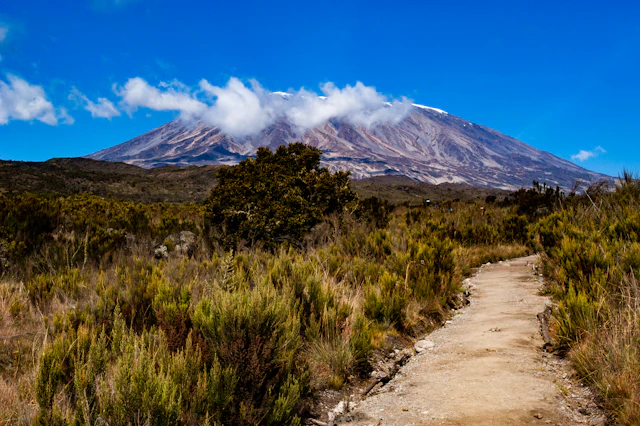
The two dry windows are best: January to mid-March, and June to October. January and February are typically the warmest and clearest. June through October is the long dry season and the most reliable weather, which also makes July to September the busiest. Avoid the long rains of April and May and the short rains of November. Lemosho's western approach and the open Shira Plateau are especially scenic in clear dry months, with long views across the plateau to Kibo. One route-specific note: Lemosho's higher start at 2,385m means a cold first night, so pack a warm bag from the outset. Full-moon summit dates are popular for the extra light. For strong conditions with thinner trails, aim for the shoulder edges — late January, early March, or October — over the July-to-September peak.
Is the Lemosho route crowded?
Lemosho's first two days are among the quietest starts on Kilimanjaro. The western approach sees far less traffic than the Machame Gate, so the forest and the climb onto the Shira Plateau feel genuinely remote. That changes near Barranco, where Lemosho merges with the
Machame trail and the southern routes converge — from there up, you share the path. Summit night is busy almost everywhere because Lemosho, Machame, and Umbwe all push to the summit via Barafu and Stella Point. So Lemosho gives you a quiet, scenic start and a busier finish. If solitude matters most across the whole climb, the Rongai route from the north or the
Northern Circuit are quieter throughout, though they cost more days or money. For most climbers, Lemosho's quiet opening is one of its best features.
What's included in a Lemosho climb?
A fair 8-day Lemosho climb with us includes all park fees, certified mountain guides, fair-wage KPAP-aligned porters, all camping equipment, full board on the mountain, emergency oxygen and a pulse oximeter, Arusha transfers to and from the gate, and the rescue fee. Not included are international flights, your Tanzania visa, tips for the crew (budget roughly $280-380 over eight days), personal climbing gear such as boots and a sleeping bag, and travel insurance covering high-altitude evacuation, which we require. The clearest way to compare operators is to ask exactly what their price includes and excludes in writing. A cheap quote often looks competitive because it leaves out oxygen, trims porter pay, or compresses the acclimatization days that make Lemosho worth choosing. We list everything up front and run every climb to the same standard.
Can I combine Lemosho with a safari?
Yes, and many of our climbers do. The usual pattern is climb first, then recover on safari, because the mountain is the demanding early-start part of the trip and the safari is the reward your legs will thank you for. Because we run both the mountain and the safari side under one Arusha team, your logistics are coordinated end to end — no handoff between operators, no gap days nobody owns, and one point of contact. Popular pairings are a dedicated
post-climb recovery safari built for tired legs, or a
4-day Northern Circuit safari, scaling up to a full 7-day Tanzania safari if you have the time. Message us with your Lemosho climb dates and we will build a combined climb-and-safari itinerary around them, quoted as one trip rather than two bookings.