Northern Circuit Route Kilimanjaro — The 9-Day Climb

The Northern Circuit is the longest route on Kilimanjaro and has the highest summit success of any route — around 95% on the 9-day climb. It is the route we recommend to climbers whose priority is reaching Uhuru Peak, and to anyone who wants quiet trails away from the crowds. It begins on the western Lemosho side, crosses the Shira Plateau, then does something no other route does: it swings around the remote northern slopes of the mountain — terrain most climbers never see — before summiting from the eastern side. That long, looping path is the whole point. It spends more nights acclimatizing between roughly 3,900m and 4,200m than any other route, which is exactly why its summit odds are the highest. The northern slopes are also the quietest on the mountain; for several days you may see almost no other groups. It is camping-only across eight or nine days, and it is the most expensive standard route — but the extra days are precisely what buy the highest odds and the solitude.

The summit push leaves School Hut (4,800m) around midnight and reaches Uhuru Peak (5,895m) near sunrise via the crater rim. A shorter 8-day version exists and still scores around 90-93%, but it compresses the very acclimatization that makes the 9-day the best on the mountain, so the 9-day is the version we recommend. Below: the full 9-day day-by-day itinerary with an altitude profile, why the route's acclimatization produces such high success, summit night, honest cost, and how the Northern Circuit compares to Lemosho. After 35 years running Kilimanjaro from Arusha, this is the route we point determined first-timers toward when their goal is simply to stand on the summit.

9 days
The longest route
~95% success
Highest on the mountain
Lowest traffic
The quiet northern slopes

Northern Circuit at a Glance

  • Duration: 9 days (primary, recommended) or 8 days (shorter alternative)
  • Success rate: ~95% (9-day) — highest of all routes
  • Accommodation: Camping only
  • Approach: Western start, circles the northern slopes, summits from the east
  • Traffic: Lowest of any route
  • Best for: Maximum summit odds + solitude

9-Day or 8-Day? Why the Length Is the Point

This is the within-route choice on the Northern Circuit, and it is different from every other route on the mountain. Both versions circle the quiet north; the 9-day keeps the full acclimatization profile with separate Buffalo Camp and Third Cave days, while the 8-day compresses one northern-slopes day. The 9-day summits around 95% against roughly 90-93% for the 8-day. On the budget routes the short version is the most-booked because it is cheapest, but here the logic inverts: the length is the reason to choose the Northern Circuit at all, so compressing it hands back the very advantage you came for. The extra days are not padding — they are the four nights near 4,000m that produce the highest odds on Kilimanjaro. We will be honest with you: if you want the absolute best chance of standing on Uhuru, the 9-day is it, and the 8-day is a fallback for strong climbers genuinely short on time, not a saving worth making lightly.

Recommended · Highest Odds on the Mountain

9-Day Northern Circuit

~95%
Typical Summit Success

The full route and the highest summit success of any climb on Kilimanjaro. Separate Buffalo Camp and Third Cave days give the most gradual acclimatization profile on the mountain. If your goal is to summit, this is the route and the version.

  • Best acclimatization on the mountain
  • ~95% success
  • Quietest trails
  • Full northern circumnavigation
  • The premium choice
Shorter · Still High Success

8-Day Northern Circuit

~90-93%
Typical Summit Success

Compresses one northern-slopes day. Still higher success than most routes, a day shorter and somewhat cheaper. Works for strong climbers short on time, but gives back part of the margin that makes the 9-day the best on the mountain.

  • One day shorter
  • Lower cost than 9-day
  • Still ~90%+
  • Slightly less acclimatization
  • For time-limited determined climbers
Our honest take: if you are choosing the Northern Circuit, you are choosing it for the odds — so book the 9-day. The whole reason this route beats every other is the extra acclimatization, and compressing it works against the one thing you came for. If 9 days is genuinely impossible, the 8-day still beats most routes; if even that is too long, an 8-day Lemosho at ~90% may be the better-value choice. This mirrors the trust spine across our routes hub: more days on the mountain beats more time in the gym.

Northern Circuit Day-by-Day — The 9-Day Climb

Here is the 9-day Northern Circuit primary itinerary, camp by camp and altitude by altitude. You start at Lemosho Gate (2,385m) on the western side, climb through rainforest, and cross the Shira Plateau — the same opening as Lemosho. Then, at Moir Hut, the route turns north and leaves the busy southern trails behind, traversing the remote northern slopes through Buffalo Camp and Third Cave before swinging round to School Hut (4,800m) on the eastern side and summiting from there. The 8-day version compresses one of the northern-slopes days, combining the Buffalo and Third Cave segments. Read the days in order, because the route is built around a single idea: that long, near-level stretch between roughly 3,900m and 4,200m — four nights near 4,000m — is the extended acclimatization that gives this route the highest summit success on the mountain.

Northern Circuit Route — Altitude Profile (9-Day)
Northern Circuit route altitude profile20,00015,00010,0005,00002,385 m7,825 ft2,780 m9,121 ft3,505 m11,499 ft3,900 m12,795 ft4,200 m13,780 ft4,020 m13,189 ft3,950 m12,959 ft4,800 m15,748 ft5,895 m19,341 ft3,100 m10,171 ft1,640 m5,381 ftLemosho GateMti MkubwaShira 1 CampShira 2 CampMoir HutBuffalo CampThird CaveSchool HutUhuru PeakMweka CampMweka Gate~6 km~8 km~11 km~7 km~12 km~8 km~9 km~5 km~12 km~10 km

Altitude on the left axis (feet); camp altitudes shown in metres and feet. The long, near-level stretch between Shira 2 and School Hut — Moir Hut, Buffalo Camp and Third Cave all between ~3,950m and 4,200m — is the extended acclimatization that gives the Northern Circuit the highest summit success on the mountain. Total distance about 90 km.

DAY 01Lemosho Gate → Mti Mkubwa CampMti Mkubwa · 2,780m
Morning
Drive to Lemosho Gate (2,385m)Transfer from Arusha to the western side of the mountain, register at the park gate, and meet your guides and porters. Loads are weighed to the 20kg KPAP limit before anyone sets off.
3-4 hrs
Ascend through quiet rainforestA gentle first climb through cool montane forest on the western approach — much quieter than the busier southern gates. A short day on purpose, to start the acclimatization slowly.
Evening
Arrive Mti Mkubwa (Big Tree) Camp (2,780m)Your first night under canvas at the forest edge. Camping only on this route. An early night before the bigger climb onto the plateau tomorrow.
DAY 02Mti Mkubwa → Shira 1 CampShira 1 · 3,505m
5-6 hrs
Out of the forest onto the moorlandThe forest thins into heather and open moorland as you climb onto the western edge of the Shira Plateau. The first big altitude gain of the route — pace matters from here.
Afternoon
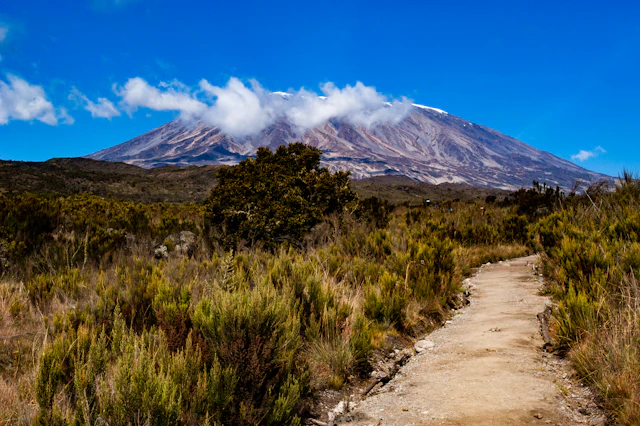
Reach Shira 1 Camp (3,505m)Camp on the plateau with the Kibo cone coming into view ahead. A health check and an early night. The thin air starts to make itself felt.
DAY 03Shira 1 → Shira 2 CampShira 2 · 3,900m
4-5 hrs
Cross the Shira PlateauA shorter, gentler day across the high plateau, Kibo growing ahead. A deliberately easy stage that doubles as acclimatization — the first of the days near 4,000m that build your odds.
Afternoon
Arrive Shira 2 Camp (3,900m)The start of the long acclimatization stretch. From here to School Hut you stay near 4,000m for several nights — the secret behind this route's success. Rest, hydrate, eat well.
DAY 04Shira 2 → Moir Hut (the turn north)Moir Hut · 4,200m
5-7 hrs
The route turns NORTHHere is where the Northern Circuit becomes itself. Instead of joining the busy southern trail, you turn north toward Moir Hut, often with a Lent Hills acclimatization walk to a higher point and back. Climb high, sleep low in action.
Afternoon
Arrive Moir Hut (4,200m)A quiet, high camp on the edge of the northern slopes. The solitude begins here — most groups have peeled off south. A cold but rewarding night at the route's high acclimatization base.
DAY 05Moir Hut → Buffalo CampBuffalo Camp · 4,020m
5-6 hrs
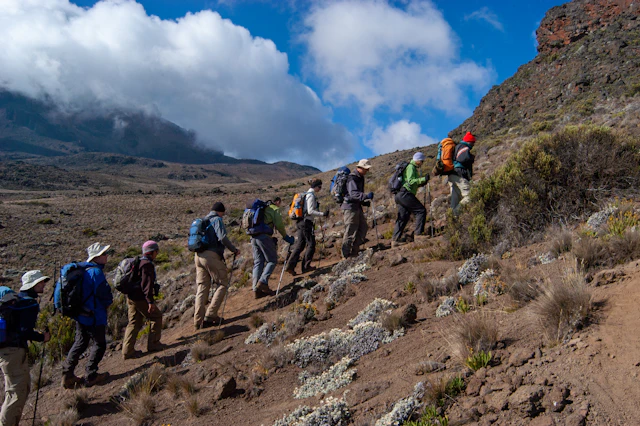
Traverse the remote northern slopesA long, scenic traverse around the quiet north side of the mountain that almost no other climbers ever see. A slight net descent to Buffalo Camp aids acclimatization — exactly the profile you want.
Afternoon
Arrive Buffalo Camp (4,020m)One of the quietest camps on Kilimanjaro, looking out over the northern plains. On the 8-day version, this segment is combined with the next to save a day.
DAY 06Buffalo Camp → Third CaveThird Cave · 3,950m
5-6 hrs
Continue the northern/eastern traverseThe traverse continues around toward the eastern side, with distant views toward Kenya on a clear day. Staying high without overexerting — this is the acclimatization secret working in your favour.
Afternoon
Arrive Third Cave (3,950m)The fourth consecutive night near 4,000m. By now your body is far better adjusted than it would be on any shorter route. Rest before the climb to the summit base.
DAY 07Third Cave → School HutSchool Hut · 4,800m
4-5 hrs
Ascend to the summit baseA steady climb on the eastern side to School Hut, the launch point for summit night. A shorter day by design, so you arrive with energy in reserve.
Afternoon
Arrive School Hut (4,800m)Arrive early, eat, and rest. School Hut sits slightly higher than Barafu, the southern routes' summit base, which means a marginally shorter climb tonight. Prepare your gear for the midnight start.
DAY 08Summit Day: School Hut → Uhuru Peak → Mweka CampMweka Camp · 3,100m
Midnight
Depart School Hut by headlampA light meal, then off into the dark around midnight, temperatures between minus 10 and minus 20 Celsius. You set off better acclimatized than on any other route — pole pole all the same.
5-6 hrs
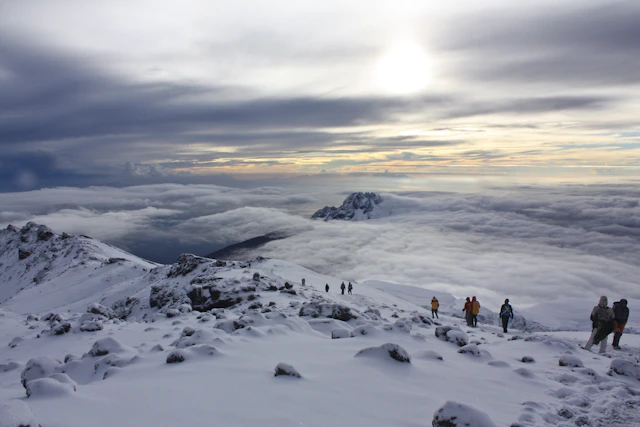
Up to the crater rim (Gilman's / Stella Point)Steep scree switchbacks in the cold and dark to the crater rim near sunrise. The hardest stretch of the whole route — but a well-adjusted body copes far better with the thin air here.
~1 hr
Rim walk to Uhuru Peak (5,895m)From the rim, a gentler walk to the true summit and the Uhuru sign — the highest point in Africa. Glaciers, the photo, then down. You do not linger at altitude.
Afternoon
Descend to Mweka Camp (3,100m)Nearly 2,800m of descent down the southern Mweka trail to camp. A very long summit day of 12 to 16 hours — the hardest and most rewarding of the climb.
DAY 09Mweka Camp → Mweka GateEnd of Climb · 1,640m
3-4 hrs
Final descent through rainforestDown the Mweka trail through moorland and back into green rainforest to Mweka Gate (1,640m). Knees will be tired, but the hard work is behind you.
Midday
Certificates and transfer to ArushaSummit certificates are issued at the gate. Tips are distributed to the crew after nine days together, then it is back to Arusha for a real shower and a proper bed.
8-day Northern Circuit: the shorter version compresses one northern-slopes day, combining the Buffalo Camp and Third Cave segments into a single longer stage. It still summits around 90-93% — higher than most routes — but it gives back one of the four nights near 4,000m that make the 9-day the highest-success climb on the mountain. We recommend the 9-day unless time is genuinely the constraint.

Why the Northern Circuit Summits More Climbers Than Any Route

The Northern Circuit's success rate is not luck, and it is not because the trail is easier — it is the acclimatization profile, plainly and honestly. The 9-day spends an unusually long stretch between roughly 3,900m and 4,200m before the summit push: four consecutive nights near 4,000m at Shira 2, Moir Hut, Buffalo Camp, and Third Cave. No other route gives your body that much time to adjust at altitude before asking it to climb to 5,895m. This is the textbook "climb high, sleep low" pattern, extended over more days than any climb on the mountain, and it is exactly what acclimatization science recommends. The result is around 95% summit success — the highest of all routes. The same principle runs through every route on our routes hub: a 5-day climb summits around half its climbers, a 7-day around 85%, and the 9-day Northern Circuit around 95%. The line is consistent, and it is about days, not difficulty. Our lead mountain guides Geoffrey Komba, William Mwasimba, and Isaac Munuo run twice-daily SpO2 checks across those high northern camps precisely to protect that advantage and catch any climber whose numbers are drifting.

The acclimatization advantage

The secret is that long, near-level stretch between Shira 2 and School Hut. While the shorter routes are pushing hard for the summit base by their third or fourth night, Northern Circuit climbers are still circling the north between 3,950m and 4,200m, sleeping at altitude and letting their bodies build the red blood cells and breathing patterns the summit demands. By the time you reach School Hut, you have banked more acclimatization than any other route can offer — and on summit night, that is what stands between turning back and standing on Uhuru.

~95%Summit success
4 nightsNear 4,000m before summit
LowestTraffic of any route
Acclimatization does the heavy lifting, but it is not the only lever. The usual rules still apply on summit night: a deliberately slow pace (pole pole), steady hydration, eating even when appetite fades, honest daily health checks, and an operator who runs oxygen and proper guide ratios. The Northern Circuit gives you the best possible starting position; doing the rest right is how you cash it in. See the full success-by-days data on our routes hub.

Ready to climb the Northern Circuit?

Tell us your dates and whether you want the 9-day or 8-day. We'll confirm availability, crew, and pricing within 24 hours.

How Hard Is the Northern Circuit — and Who It Suits

The Northern Circuit is non-technical — no ropes, no scrambling, no exposure — and day to day it is arguably the most comfortable route on the mountain to walk. The gradual profile means shorter daily climbs and smaller altitude gains than the compressed routes, so you rarely finish a day wrecked. The honest trade is that there are simply more days of it: eight or nine days is a long time to be on a mountain, all of it under canvas, and that asks for stamina and patience more than raw power. The real demands are the length, the camping night after night at altitude, and summit day itself, which still runs 12 to 16 hours from School Hut to Uhuru and down to Mweka. The altitude, though, is handled better here than on any route — you arrive at the summit base so well acclimatized that summit night, while never easy, is more manageable than on the shorter climbs. After 35 years on this mountain, our planners and guides Geoffrey Komba, William Mwasimba, and Isaac Munuo will tell you the Northern Circuit rewards the climber who can keep going for many consecutive days more than the one who can sprint up a stairmaster.

Pick the Northern Circuit, or pick another route — honestly

Pick the Northern Circuit if
  • Maximum summit odds are your priority — it is the highest at ~95%
  • You want solitude — it is the quietest route on the mountain
  • You have the time and the budget for the longest, premium route
  • You want the best acclimatization profile of any climb
Pick something else if
  • You are short on time or budget — Machame or Marangu are shorter and cheaper
  • You want the most scenic mid-route — Lemosho's Barranco section is hard to beat
  • Nine days of camping feels daunting — a 7-8 day route may suit better
  • This is your first multi-day trek — see our beginner's guide first

Summit Night — School Hut to Uhuru Peak

The Northern Circuit summits from School Hut (4,800m) on the eastern side, rather than from Barafu like the southern routes. Because School Hut sits a little higher than Barafu, the climb to the crater rim is marginally shorter. Otherwise the summit experience mirrors the southern routes: a midnight start, steep scree by headlamp, the crater rim near sunrise, and the final walk to Uhuru. The one real difference is how you arrive at it. After four nights near 4,000m on the northern slopes, you reach the summit base better acclimatized than on any other route on the mountain — and on summit night that matters more than anything else. The effort is the same brutal climb everyone faces; the difference is that a well-adjusted body copes far better with the thin air. Our guides Geoffrey Komba, William Mwasimba, and Isaac Munuo set a deliberately slow pace up the switchbacks, after hundreds of summit nights between them, because pace plus acclimatization is what gets climbers to the top.

Summit night — the stage-by-stage

From School Hut (4,800m) to Uhuru Peak (5,895m) via the crater rim, then down to Mweka — 12 to 16 hours
4,800m
Midnight: School Hut departure

Wake around 23:00, a light meal, layer up for the minus 10 to minus 20 Celsius ahead. Depart by headlamp. A slightly higher start than the Barafu routes means a marginally shorter summit climb.

5,300m
~02:30: The switchbacks

Steep scree in the dark, the relentless zig-zags above School Hut. The hardest stretch of the route — but you arrive better acclimatized than on any other climb, which helps you here more than you would expect.

5,700m
~05:30-06:30: The crater rim

Reach Gilman's or Stella Point on the rim near sunrise. The hardest climbing is done; gentler ground to the true summit remains. The light comes up over the crater as you catch your breath.

5,895m
~06:30-07:30: Uhuru Peak

The true summit, the highest point in Africa, the sign, the glaciers, the photo. Time at the top is short — altitude means you do not linger before turning down.

3,100m
Afternoon: Descent to Mweka

Nearly 2,800m of descent down the Mweka trail to camp. This is why summit day still runs 12 to 16 hours even on the best-acclimatized route on the mountain.

The Northern Circuit's summit night is the easiest-feeling of the routes for one reason: you arrive at the summit base better acclimatized than on any other climb. The physical effort is the same, but a well-adjusted body copes far better with the thin air. For the route-by-route summit comparison, see the routes hub.

What a Northern Circuit Climb Costs — the Premium Route, Honestly

The Northern Circuit is the most expensive standard route on Kilimanjaro, and the reason is simple arithmetic: it has the most days, so it carries the most park and camping fees and the most crew days. Start with the part nobody can discount — park fees come to roughly $1,200-1,500 or more per climber, paid straight to the authorities and identical for every operator, because nine days on the mountain means the most daily conservation and camping charges of any route. Add fair wages for the largest crew, food for nine days, certified guides, oxygen, and all the camping equipment, and a fair Northern Circuit climb cannot legitimately sit under about $2,400. So when an operator advertises this route cheaply, the maths does not close — the gap is recovered somewhere you cannot see, and over nine days that is a lot of corners. The premium over a shorter route is not a markup; it is days, solitude, and the highest summit odds on the mountain. The table below sets out the real tiers for both the 9-day and the 8-day, with park fees shown as the fixed line every tier includes.

Tier9-day price8-day priceWhat you get
Budget (danger zone)under $2,400under $2,200Corner-cutting on the longest route — especially risky
Mid-range (reputable)$3,200-4,500$2,900-4,000Proper crew, oxygen, fair wages
Premium$4,500-7,000+$4,200-6,000+Smaller groups, extra guides, premium support
Park fees (included above)~$1,200-1,500~$1,100-1,350Paid to government
The Northern Circuit is the most expensive route because it has the most days — and those days are exactly what you are paying for. Be especially wary of a "cheap" Northern Circuit: cutting costs on the longest route usually means trimming crew, food, or safety support across more days on the mountain, which is the worst place to economise. People have turned back, and some have died, because operators trimmed the things that do not show in a brochure. See the operator safety checklist on our routes hub before booking with anyone.
Included in a fair Northern Circuit climb: park and camping fees, certified guides, fair-wage KPAP-aligned porters, all camping equipment, full board on the mountain, oxygen and a pulse oximeter, Arusha transfers, and the rescue fee. Excluded: international flights, your visa, tips for the crew (roughly $320-420 over nine days), personal gear, and travel insurance covering high-altitude evacuation, which we require.

Northern Circuit vs Lemosho — The Two High-Success Routes

This is the comparison high-success buyers actually want, because these are the two routes with the best odds on the mountain — and they are closely related. Both start on the western Lemosho side and share the same opening through rainforest and across the Shira Plateau. The difference comes after the plateau. The Northern Circuit turns north and circles the quiet northern slopes for extra acclimatization and solitude over 8 to 9 days, summiting around 95% on the 9-day, with the lowest traffic of any route and the highest cost. Lemosho carries on to join the busier southern trail at Barranco — arguably the most scenic mid-route section on the mountain — over 7 to 8 days, summiting around 90% on the 8-day at a lower price. Put plainly, the Northern Circuit is essentially Lemosho extended around the north for more days, more acclimatization, and more solitude. The honest question is whether those extra days and dollars are worth the jump from ~90% to ~95% for you. Compare the two side by side below.

Northern Circuit

  • Days: 8-9
  • Success: ~95% (9-day) — highest
  • Traffic: Lowest of any route
  • Profile: Most gradual acclimatization
  • Scenery: Quiet northern slopes, 360°
  • Cost: Highest standard route
  • Best for: Maximum odds + solitude

Lemosho

  • Days: 7-8
  • Success: ~90% (8-day)
  • Traffic: Quiet start, busier mid-route
  • Profile: Strong acclimatization
  • Scenery: Best mid-route (Barranco)
  • Cost: Lower than Northern Circuit
  • Best for: High odds + scenery at better value
Both are excellent. The Northern Circuit is essentially Lemosho extended around the quiet north for more acclimatization and the highest odds on the mountain — choose it if maximum summit success and solitude justify the extra days and cost. Choose Lemosho if you want high odds and the best mid-route scenery at a lower price. Both beat the shorter routes on success. Read the full Lemosho route guide →

Best Time to Climb the Northern Circuit

The Northern Circuit follows the same broad seasons as every route: the two dry windows give the best conditions — January to mid-March, and June to October. January and February are typically the warmest and clearest, while June through October is the long dry season and the most reliable stretch, which is why July to September sees the busiest start dates. But this route has two genuine, route-specific edges. First, its northern slopes sit in a rain shadow and are noticeably drier than the southern routes, a subtle advantage in marginal months when the south is catching weather. Second, it is the lowest-traffic route year-round, so even at the July-to-September peak the northern side stays quiet while the southern trails fill — you get peak-season weather without peak-season crowds. One practical note: because the 9-day commits you to more dates than any other route, peak windows need booking well ahead, especially for fixed group departures. The long rains of April and May and the short rains of November are still best avoided where possible, though the drier north tolerates a shoulder month better than most. The month grid below shows the picture at a glance.

Jan
Best
Warmest, clearest
Feb
Best
Warmest, popular
Mar
OK / Avoid late
Dry early, rains late
Apr
Avoid
Long rains
May
Avoid
Long rains
Jun
Best
Dry season begins
Jul
Best
Busiest starts, north quiet
Aug
Best
Busiest starts, north quiet
Sep
Best
Reliable, clear
Oct
Best
Dry, thinning crowds
Nov
Short rains
Drier north helps
Dec
OK
Variable, festive
The dry-season trade-off that crowds every popular route barely touches the Northern Circuit: even in the July-to-September peak, the northern slopes stay quiet, so you get the best weather without the busiest trails. For the strongest conditions, aim for the dry windows of January to mid-March and June to October, and book your start date early — the 9-day commits more of the calendar than any other route. The drier north also makes a shoulder-month climb here more defensible than on the southern routes.

Northern Circuit Climbs — Book Direct

These are our scheduled and private Northern Circuit climbs, so you can match the route straight to a bookable trip. Each card links to the full climb page for current dates, group departures, and exact pricing — the figures shown here are indicative starting points. Every climb runs to the same standard, whether you choose the 9-day or the 8-day: certified mountain guides, fair-wage porters under KPAP-aligned terms, emergency oxygen, all camping equipment, and full board on the mountain. Reach out and we will confirm availability for your dates and give you our honest read on which version gives you the best odds.

Book Direct · Arusha Operator Since 1991

Climb the Northern Circuit with the team that runs the mountain.

9-Day Northern Circuit Route Kilimanjaro climb9 DAYS

9-Day Northern Circuit Climb

Northern Circuit · Camping · ~95% success
From $3,690pp
Placeholder — developer updates with live pricing
View 9-day Northern Circuit →
8-Day Northern Circuit Route Kilimanjaro climb8 DAYS

8-Day Northern Circuit Climb

Northern Circuit · Camping · ~92% success
From $3,290pp
Placeholder — developer updates with live pricing
View 8-day Northern Circuit →
9-Day Northern Circuit Route plus safari combo9+ DAYS

9-Day Northern Circuit + Safari Combo

Climb + safari · Camping + lodges
From $5,090pp
Placeholder — developer updates with live pricing
View climb + safari →

Northern Circuit Route — Common Questions

Why does the Northern Circuit have the highest success rate?
Because of its acclimatization profile, which is the best on the mountain. The 9-day Northern Circuit spends an unusually long stretch between roughly 3,900m and 4,200m before the summit push — four nights near 4,000m at Shira 2, Moir Hut, Buffalo Camp, and Third Cave. That is the textbook climb-high, sleep-low pattern extended over more days than any other route, so your body arrives at the summit base better adjusted to the thin air. The result is around 95% summit success, the highest of all routes. It is not a harder or easier trail than the others that drives the number — it is simply more time gaining altitude gradually. More days on the mountain beats more time in the gym, and the Northern Circuit takes that principle further than any route. See the full data on our routes hub.
Should I do the 9-day or 8-day Northern Circuit?
The 9-day, if your goal is the best possible odds. The whole reason to choose the Northern Circuit is its acclimatization, and the 9-day keeps the full profile with separate Buffalo Camp and Third Cave days, summiting around 95%. The 8-day compresses one northern-slopes day and still scores about 90 to 93% — higher than most routes — but it gives back part of the margin that makes the 9-day the best on the mountain. So unlike the budget routes, where the short version is the most-booked, here the length is the point. After 35 years running this route from Arusha, our honest advice is plain: if you are paying for the Northern Circuit, pay for the 9-day. If even the 8-day is too long, an 8-day Lemosho at around 90% may be the better-value choice.
How hard is the Northern Circuit?
It is non-technical — no ropes, no scrambles — and day to day it is arguably gentler than the compressed routes, because the gradual profile means shorter, lower-gain days. The trade is that there are simply more of them: eight or nine days is a long time to be on a mountain, all of it camping. The real demands are stamina over the length, sleeping in tents at altitude night after night, and summit day itself, which still runs 12 to 16 hours from School Hut to Uhuru and down to Mweka. The altitude is handled better here than on any route precisely because you arrive so well acclimatized. If you can walk for several hours a day across consecutive days and you train sensibly, the Northern Circuit is well within reach. It rewards patience more than raw fitness — see our training guide.
Is the Northern Circuit good for first-timers?
Yes — it is the route we point determined first-timers toward when their single priority is reaching the summit. The reason is the odds: with the best acclimatization on the mountain and around 95% success, a first climber who has the time and budget maximizes their chance of standing on Uhuru. The catch is the commitment. Eight or nine days of camping is a lot for someone new to multi-day trekking, and the cost is the highest of any standard route. If you are fit, can take the time off, and want the best possible chance, it is an excellent first climb. If budget or time is tight, a 7-day Machame or 8-day Lemosho is more realistic. Either way, read our beginner's guide before booking and train for consecutive days on your feet.
What happens on summit night on the Northern Circuit?
You summit from School Hut (4,800m) on the eastern side, slightly higher than the Barafu start the southern routes use, so it is a marginally shorter climb to the crater rim. You leave around midnight by headlamp in temperatures of minus 10 to minus 20 Celsius, climb steep scree switchbacks for five to six hours to Gilman's or Stella Point near sunrise, then walk about an hour along the rim to Uhuru Peak (5,895m). The big difference from every other route is how you feel: you arrive at the summit base better acclimatized than on any other climb, so a body that has spent four nights near 4,000m copes far better with the thin air. The effort is the same; the experience is more manageable. Then comes the long descent to Mweka Camp (3,100m) — 12 to 16 hours in total.
How much does the Northern Circuit cost?
It is the most expensive standard route on Kilimanjaro because it has the most days, which means the most park and camping fees and the most crew days. Park fees alone run roughly $1,200-1,500 or more per climber, paid straight to the authorities and identical for every operator. A reputable 9-day climb sits around $3,200-4,500, with premium operators charging $4,500-7,000 and up; the 8-day runs a little less. A Northern Circuit advertised under about $2,400 cannot cover fair wages, oxygen, and full crew across nine days — the gap is recovered somewhere you cannot see. The extra cost over a shorter route is buying days on the mountain, solitude, and the highest summit odds. Ask exactly what a quote includes and excludes before you compare prices. See the operator checklist on our routes hub.
Why is the Northern Circuit more expensive than other routes?
Because cost on Kilimanjaro scales with days, and the Northern Circuit has the most. Every extra day adds a daily park fee, a camping fee, food for the whole team, and a day's wages for guides, cooks, and porters. Nine days on the mountain simply costs more than six or seven. There is no way around it for a reputable operator, and that is the honest reason the route carries a premium. What you are paying for is concrete: the best acclimatization profile and around 95% success, the quietest trails on the mountain, and a longer, more gradual climb. If maximum summit odds and solitude matter to you, the extra days are exactly the thing you are buying. If they do not, a shorter route is better value — be especially wary of a cheap Northern Circuit, where corners are cut across more days.
Northern Circuit or Lemosho — which is better?
Both are excellent, and both start on the western Lemosho side. The Northern Circuit is essentially Lemosho extended around the quiet northern slopes for more acclimatization and solitude. It runs 8 to 9 days, summits around 95% on the 9-day, has the lowest traffic of any route, and costs the most. Lemosho runs 7 to 8 days, summits around 90% on the 8-day, joins the busier southern trail at Barranco mid-route, gives arguably the best mid-route scenery, and costs less. So the honest split is: choose the Northern Circuit if maximum summit success and quiet trails justify the extra days and money; choose Lemosho for high odds and the best scenery at better value. Both beat the shorter routes on success. Read our full Lemosho route guide to compare the day-by-day detail.
When is the best time to climb the Northern Circuit?
The two dry windows are best, as on every route: January to mid-March and June to October. January and February are typically the warmest and clearest, while June through October is the long dry season and the most reliable, which makes July to September the busiest start dates. The Northern Circuit has one route-specific edge worth knowing: its northern slopes sit in a rain shadow and are drier than the southern routes, a subtle advantage in marginal months. It is also the lowest-traffic route year-round, so even in peak season the northern side stays quiet. One practical note — the 9-day length means you are committing more dates, so peak windows need booking well ahead. The long rains of April and May and the short rains of November are still best avoided where possible.
Is the Northern Circuit really the quietest route?
Yes — it is the lowest-traffic route on Kilimanjaro, and that is one of the genuine reasons to choose it. After the Shira Plateau, the route turns north at Moir Hut onto slopes that most climbers never set foot on, because no other route circles the mountain this way. For several days — across Moir Hut, Buffalo Camp, and Third Cave — you may see almost no other groups, while the southern trails on Machame and the Barranco section can feel busy in peak season. The route only rejoins the crowds near the summit, where every route converges. So if solitude matters to you, this is the route that delivers it. The newest established route on the mountain, opened around 2014, it remains the least-trodden precisely because of its length and cost.
What's included in a Northern Circuit climb?
A fair Northern Circuit climb with us includes all park and camping fees, certified mountain guides, fair-wage KPAP-aligned porters, all camping equipment, full board on the mountain, emergency oxygen and a pulse oximeter, Arusha transfers to and from the gate, and the rescue fee. Not included are international flights, your Tanzania visa, tips for the crew (budget roughly $320-420 over nine days), personal gear such as boots and a sleeping bag, and travel insurance covering high-altitude evacuation, which we require. Because this is the longest route, the crew is larger and on the mountain longer, so the included costs are higher than any other route — which is exactly why a suspiciously cheap quote is a warning sign. We list everything up front and run every climb to the same standard.
Can I combine the Northern Circuit with a safari?
Yes, and it pairs naturally. The usual pattern is climb first, then recover on safari, because the mountain is the demanding early-start part of the trip and the safari is the reward your legs will thank you for — especially after nine days of trekking. Because we run both the mountain and the safari side under one Arusha team, your logistics are coordinated end to end, with one point of contact and no handoff between operators. Popular pairings are a dedicated post-Kilimanjaro recovery safari built for tired legs, or a 4-day Northern Circuit safari (the safari route, not the climb), scaling up to a full Tanzania itinerary if you have the time. Message us with your Northern Circuit climb dates and we will build a combined climb-and-safari itinerary, quoted as one trip rather than two bookings.

From the Quiet North to Uhuru Peak — Start Here

Tell us your dates, 9-day or 8-day preference, and experience level. We'll send a Northern Circuit climb proposal within 24 hours.

Or email info@safari-tz.com · Call +255 740 666 662

WhatsApp