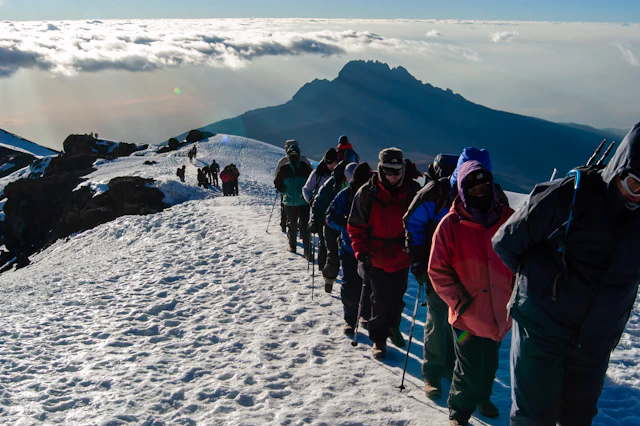
Which Kilimanjaro route has the highest success rate?
The
Northern Circuit has the highest success rate of all seven routes, around 95% on its 8-to-9-day version. The reason is the same one that decides every Kilimanjaro climb: days on the mountain. The Northern Circuit circles the whole massif, so your body climbs high and sleeps low repeatedly before summit night, which is exactly what acclimatization needs.
Lemosho on 8 days is close behind at roughly 90%, and Machame on 7 days sits near 85%. These figures assume a reputable operator running the proper schedule — the same routes climbed cut-price score 15-25% lower. If summit success is your single priority and you have the days, the Northern Circuit is the route we recommend most often.
Which is the best route for first-time climbers?
For most first-time high-altitude trekkers we recommend the 8-day
Lemosho route. It gives the best balance of scenery, gentle acclimatization, and a strong success rate near 90%, and it is not a technical climb at any point. The Northern Circuit is an even safer choice if you can commit the extra day. We steer first-timers away from the 5-6 day Marangu and away from Umbwe entirely — Marangu rushes the ascent, and Umbwe is the steepest route with fast altitude gain that is genuinely dangerous for an unacclimatized body. A beginner does not need climbing skills to summit Kilimanjaro. What a beginner needs is a longer route, a slow pole pole pace, and an honest operator. See our
beginner's guide for more.
Which is the cheapest Kilimanjaro route?
Marangu is usually the cheapest because it is the shortest at 5-6 days and the only route using huts rather than tents, which lowers the staffing and equipment load. But cheapest by route is not the same as cheapest safely. The fewer days that make Marangu affordable are exactly what drop its success to around 65% on the 6-day version and near 50% on the 5-day. Park fees alone run roughly $800-1,000 per climber on any 6-7 day climb, paid straight to the government, so a climb advertised below about $1,500 is cutting corners somewhere. If budget is the deciding factor, climb Marangu in 6 days, not 5, and choose an operator who still carries oxygen.
How many days do I need to climb Kilimanjaro?
Plan for at least 7 days on the mountain, and 8 if you can manage it. Days on the mountain is the single biggest factor in whether you reach Uhuru Peak, ahead of fitness, age, or willpower. The numbers are stark: 5-day climbs succeed roughly half the time, 6-day around 75-85%, 7-day near 88%, and 8-to-9-day climbs 90-95%. Each extra day is another night for your body to make red blood cells and adjust to thin air before the final push. The cheapest quotes shorten the climb because fewer days cost the operator less, and they pass the lower success rate on to you. After 35 years running climbs from Arusha, our consistent advice is to add the extra day — it is the cheapest insurance against turning around 200 metres below the summit.
Do I need climbing experience or technical skills?
No. For six of the seven routes Kilimanjaro is a high-altitude trek, not a technical climb. There are no ropes, harnesses, or ice-axe skills required on Machame, Lemosho, Marangu, Rongai, or the Northern Circuit — you walk up. The challenge is altitude and endurance, not vertical rock or ice. The exceptions are
Umbwe and the Crater Camp Western Breach variant, which involve steep scrambling and faster altitude gain and are genuinely expert terrain. Most people who summit Kilimanjaro had never been at high altitude before. What matters far more than any climbing background is choosing a longer route, walking pole pole, and being honest with your guide about how you feel each day. If you can hike for several hours on consecutive days, you have the physical base to attempt the mountain.
What is the success rate on Kilimanjaro?
The overall average across all routes and operators is roughly 65%, meaning about a third of climbers do not reach Uhuru Peak. That average is dragged down by short, cut-price climbs. Broken out by days on the mountain the picture is clearer: about 50% on 5-day attempts, 75-85% on 6-day, near 88% on 7-day, and 90-95% on 8-to-9-day routes. The Northern Circuit tops out near 95%. The biggest predictor of failure is not weak fitness — it is too few acclimatization days and an operator who pushes the pace to save money. Reputable operators running proper schedules with daily health checks routinely beat the global average by a wide margin. When you read a success rate, always ask which route, how many days, and whether it reflects real records or a marketing number.
When is the best time to climb?
There are two dry windows that are best: January to mid-March, and June to October. January and February are typically the warmest and clearest. June through October is the long dry season and the most reliable weather, which also makes July to September the busiest. Avoid the long rains of late March, April, and May, when trails are wet and summit views are often clouded, and the short rains of November. December is variable but workable around the festive season.
Rongai and
Marangu cope better with damp shoulder months. Full-moon climbs are popular for the extra light on summit night. For the best mix of weather and thinner crowds, aim for early March or late January over the peak July-to-September stretch.
How much should a Kilimanjaro climb cost?
A safe, properly run climb generally costs $2,000-3,500 per person, with premium expeditions running $3,500-6,000 and beyond. It cannot legitimately be cheaper because of park fees: the government charges roughly $800-1,000 per climber for a 7-day climb through a conservation fee of about $70 a day, camping fees around $50 a day, a rescue fee, and staff entry fees. Once you add fair porter wages, food, guides, transport, and safety equipment, a fair climb cannot sit under about $1,500. Operators advertising $1,400 climbs recover the gap by cutting days, underpaying and overloading porters, or leaving out emergency equipment. Treat any quote below roughly $1,700 as a warning sign and ask exactly where the savings come from.
Why are cheap Kilimanjaro climbs dangerous?
Because the savings always come out of safety. When an operator undercuts the real cost, the money is recovered in three predictable places. First, fewer days on the mountain, which lowers acclimatization and raises altitude-sickness risk while cutting your odds. Second, porter exploitation: underpaying below the KPAP fair wage and overloading past the 20kg limit — an ethics failure and a sign the operator cuts corners everywhere. Third, missing safety gear: no bottled oxygen, no pulse oximeter, no proper evacuation plan. People have died on Kilimanjaro because operators skipped these. The mountain does not care what you paid. We climb the proper number of days, pay porters fairly under KPAP-aligned standards, and carry emergency oxygen on every single climb. That is what the difference in price actually buys.
What is altitude sickness and how is it managed?
Altitude sickness, or acute mountain sickness (AMS), is your body reacting to thin air. Mild symptoms are headache, nausea, poor sleep, and loss of appetite, and they are common. The danger is when it progresses to HAPE (fluid in the lungs) or HACE (swelling in the brain), both life-threatening and requiring immediate descent. Reputable operators manage this with daily monitoring: SpO2 checks twice a day, AMS symptom screening using the Lake Louise score, and guides trained to recognise the warning signs early. The treatment that always works is descent, and a good guide will turn a climber around without hesitation when the numbers say so. Climbing pole pole, hydrating hard, choosing a longer route, and reporting symptoms honestly are your best defences. Our lead guides Geoffrey Komba and William Mwasimba run these checks every climb.
Can I combine a climb with a safari?
Yes, and most of our climbers do. The usual pattern is climb first, then recover on safari, because the mountain is the demanding early-start part of the trip and the safari is the reward your legs will thank you for. A gentle low-altitude safari such as Arusha or Tarangire also works before a climb. Because we run both the mountain and the safari under one Arusha team, your logistics are coordinated with no handoff between operators and one point of contact. Popular pairings are a
post-climb recovery safari or a
4-day Northern Circuit safari, scaling up to a full
7-day Northern Circuit if you have the time. Message us with your climb dates and we will build a combined itinerary, quoted as one trip.
Which route is best for avoiding crowds?
The
Northern Circuit is the quietest of the main routes, because its length and higher price keep numbers low while it circles the less-trafficked northern slopes.
Rongai is also quiet, as the only route from the north, with a genuine wilderness feel. Lemosho starts quietly on the western side before joining the busier Machame trail around the midpoint, so you get solitude early. The busiest route by far is Machame, followed by Marangu with its huts. Note that all southern routes converge near Barafu for the summit push, so summit night itself is busy almost everywhere. If avoiding people matters most, climb the Northern Circuit or Rongai, and consider a shoulder-season date in early March or late January rather than the July-to-September peak.