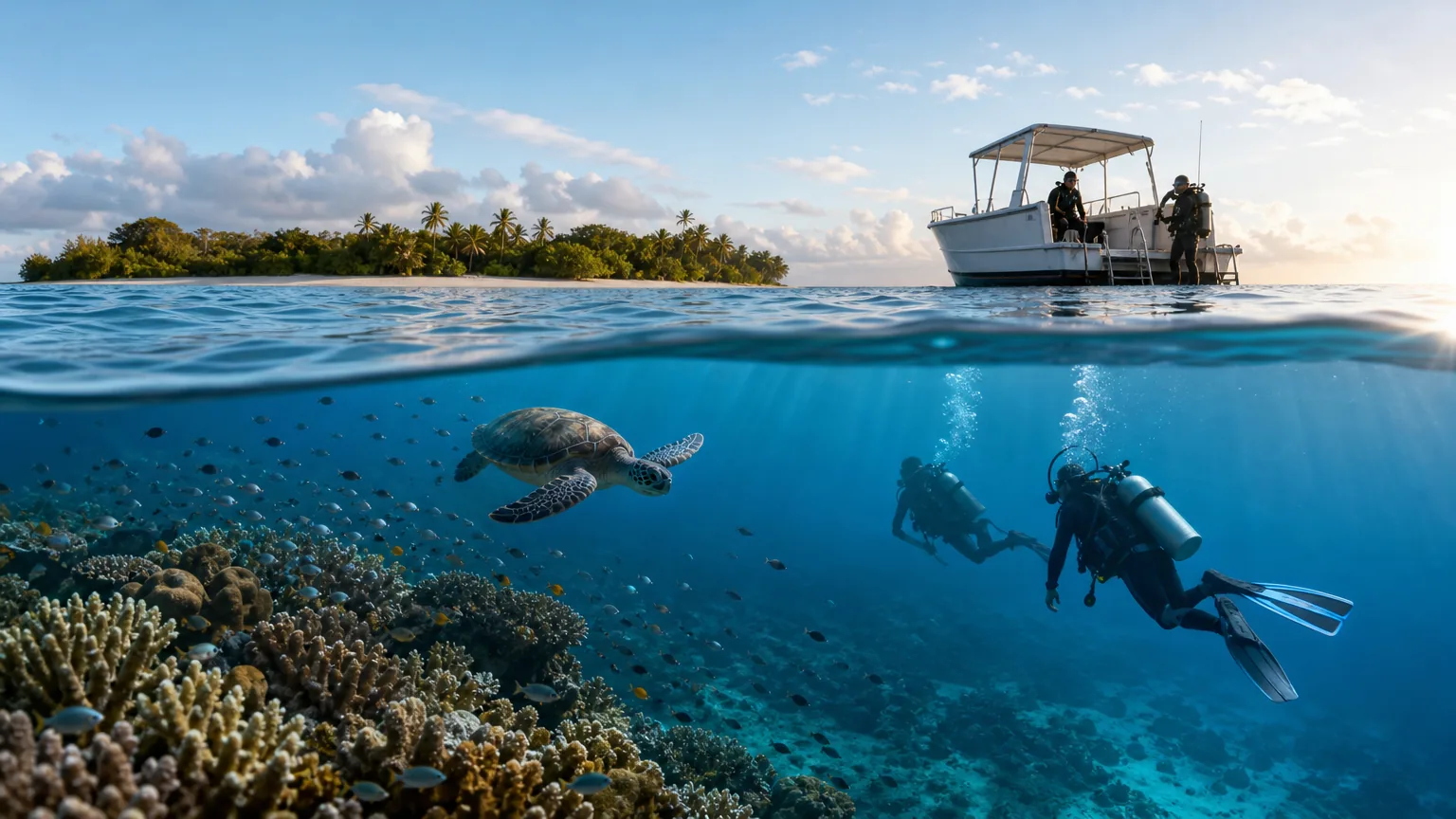
Best Mafia Island Diving Sites & Experiences
best mafia island diving sites & experiences
Best Mafia Island Diving Sites & Experiences
Discover the best Mafia Island diving spots, whale shark encounters, marine park tips, and how to plan your Tanzania dive trip with Safari TZ.
Mafia Island sits quietly off the Tanzanian coast, mostly ignored while travelers rush to Zanzibar. That's exactly what makes it special. The marine park here holds over 400 species of fish, genuine whale shark encounters, and reef walls with almost no crowds. Here's a close look at the best diving experiences on Mafia Island and what you actually need to know before you go.
1. Safari TZ (Our Top Pick)
We're Safari TZ, a Tanzanian-owned operator based in Arusha, and we've been running ground-level trips across Tanzania since 1991. We don't resell other companies' departures. We run our own itineraries with our own guides and 4x4 fleet, and we bring the same approach to Mafia Island extensions.
What that means for a diver: when you plan a Mafia Island dive trip with us, you get one team handling the entire journey. Safari, transport, the Dar es Salaam connection, the charter flight to Mafia. No hand-offs between agencies, no gaps in communication when the tide window shifts.
We also fill the information gap that frustrates most travelers researching Mafia diving online. The top YouTube guides on the island, including one from Mafia Island Marine Park, list October to March as the whale shark window but offer nothing on certification requirements, depth limits, group sizes, or what a dive package actually costs. We brief every client on those specifics before they book.
Mafia Island works brilliantly as a beach-and-dive extension after the northern circuit parks. Imagine watching a lion in Serengeti on Monday and swimming alongside a whale shark on Friday. That's the kind of itinerary we put together regularly, and it's one of the most satisfying trip shapes we run.
If you want to see what a Mafia Island dive extension looks like as part of a broader Tanzania trip, our Mafia Island tours page has current options across budget, mid-range, and private categories.
One honest caveat: we're not a dedicated dive school. We connect you with reputable local dive centers on the island and coordinate logistics around them. If you need to earn your Open Water certification from scratch, plan to arrive a couple of days earlier than your main dive schedule.
2. Manta Point — Reef Manta Ray Encounters
Manta Point is the site most divers talk about first when they come back from Mafia. It's a cleaning station, which means manta rays return here reliably rather than passing through at random. Reef mantas circle the site while small wrasse and cleaner fish pick parasites from their skin. Divers hover at the bottom and watch them pass overhead.
The best encounters happen on incoming tides when the current pushes plankton-rich water across the reef. Your dive guide will time the entry accordingly. Visibility is usually strong at Manta Point, often 20 to 30 meters on a good day, so you can watch a ray approach from a long distance before it arrives at the cleaning station.
Most operators treat this as a mid-morning dive. The rays are most active before midday, and the light angle makes photographing them much easier. A wide-angle lens setup helps here since the rays often come within a few meters of divers who stay still on the sand.
Reef mantas at Manta Point are generally calm around divers, but guide briefings are strict about not chasing or touching them. Any sudden movement breaks the cleaning behavior and the rays leave. The sites where this rule is enforced consistently have better manta activity than those where it's loose.
Manta Point suits Open Water certified divers. Depths are typically in the 12 to 18-meter range. The current can be moderate on a big tidal change, so if you're a newer diver, tell your guide and they'll pick the right slack window for you.
3. Manta Reef — Deep Wall Dives and Big Fish
Manta Reef is a different kind of dive from Manta Point. Where Manta Point is about patient observation at a cleaning station, Manta Reef is a proper wall dive with a steep drop-off that attracts pelagic visitors. This is where divers see large groupers, Napoleon wrasse well over a meter long, trevally hunting in schools, and occasional sharks cruising the deeper water.
The wall starts at around 10 meters and drops sharply. Advanced divers can follow it into the 30-meter range. The coral coverage on the upper wall is healthy, with sea fans and soft corals in the places where current keeps nutrients moving. It's one of the standout sites divers report after exploring Chole Bay, with fish life and turtles resting on the reef among the highlights.
Current at Manta Reef can be strong on tidal changes. An Advanced Open Water certification is worth having here, though experienced Open Water divers comfortable with mild current can handle the shallower sections. Always ask the dive master about conditions before entry. On a high tide cycle, visibility stretches further and the wall's upper section comes alive with smaller reef fish crowding the coral heads.
Honest assessments of Mafia's reefs note that coral coverage varies across sites — some flatter, sandy areas show more wear than the wall dives. Manta Reef's wall tends to show better coral health than those flatter sites, particularly on the sections that catch regular current. It rewards divers who take time to look closely rather than racing to depth.
4. Whale Shark Season — Snorkeling and Diving with Giants
Whale shark encounters are the headline reason most travelers pick Mafia over other Indian Ocean islands. to Mafia Island, whale sharks feed in marine park waters from October through February, and their success rate for sightings runs around 80 percent. That's not a guarantee. One group the guide mentioned went three days without seeing any. But for most visitors who time the season right, the encounter happens.
The search itself is part of the experience. You board a boat early, usually just after 7 a.m. since whale sharks are most active in the morning, and spend a couple of hours scanning the surface for the tell-tale dorsal fin. When one is spotted, the guide calls it and everyone rolls in fast. Then you swim with the shark until it moves on, climb back aboard, and find the next one.
The water at whale shark sites is not particularly deep, often 5 to 15 meters. Snorkelers participate just as fully as divers here since the sharks move in open water, not on a reef. A mask and fins are enough. That said, having a dive certification lets you drop slightly deeper to see the sharks from below, which gives a different and often more dramatic perspective on their scale.
There's a small seasonal nuance worth noting. Mafia Island Marine Park puts the window at October to March, while Afro Whale Shark lists October to February. That one-month difference matters if you're planning a late-season trip. March whale shark activity is possible but less consistent. If your dates fall in late February or March, ask your operator specifically about recent sighting patterns rather than relying on a generic season chart.
We at Safari TZ time our Mafia dive extensions to peak whale shark months when clients prioritize the encounter. Planning around the window is something we handle in the pre-trip briefing, which is the kind of specific operational detail that's often missing from the most-watched online guides on this topic.
5. Mafia Island Marine Park Zones — Conservation Diving
Mafia Island Marine Park is one of the best protected marine areas in the Indian Ocean. That isn't marketing. The park has strict zone management that separates fishing areas from fully protected no-take zones, which is why the reef fish density here is noticeably higher than in less managed areas of the East African coast.
There are over 20 dive sites inside Chole Bay alone, and the park covers a much wider area including offshore reefs, seagrass beds, and mangrove channels. When you reach the marine park boundary on a day excursion, there's an entry fee per person that goes directly toward park management and ranger patrols. It's worth every cent, because the no-take zones are what keep the coral gardens and fish populations intact.
Snorkeling inside the park shows tall coral structures crowded with reef fish. Afro Whale Shark, a day-trip operator active in the park between October and February, covers multiple snorkeling sites near rocky islands, sandbar stops, and lagoon visits, all within marine park boundaries. Their tours highlight whale sharks, vibrant coral reefs, jellyfish, lionfish, spiny lobster, eels, crocodile fish, and starfish across that range of habitats. That variety of reef, seagrass, mangrove, and open water is what makes the park valuable beyond just diving.
For divers who care about conservation, the park's presence matters practically. Sites that are actively managed show healthier soft coral coverage and bigger fish than sites nearby that aren't protected. Dive guides operating legally inside the park know the boundaries and won't take groups into restricted zones. Ask your operator whether their dive center holds a valid marine park operating permit. The established centers on the island do.
The park's protection framework is also relevant for responsible behavior underwater. No collecting, no touching coral, no feeding fish. These aren't just posted rules. The guides enforce them, and the reef quality is the visible result of that enforcement over many years.
6. Macro Dive Sites — Nudibranch, Seahorse, and Critter Hunting
Mafia's macro diving doesn't get the same marketing attention as whale sharks, but it's genuinely excellent. The muck dive sites around the sandy flats near Chole Bay hold frogfish, ghost pipefish, nudibranchs in many color forms, and seahorses tucked into soft coral. Macro diving is consistently highlighted as one of the island's standout offerings alongside its more famous pelagic encounters.
Macro sites work on a different logic from wall dives. Depths are shallow, often 8 to 14 meters, and the pace is slow. A single dive might cover 30 meters of sandy bottom while a guide points out creatures you'd swim right past without knowing they were there. The skill is in the looking. Frogfish in particular are masters of camouflage and a good guide can spot one sitting on rubble that looks like a lump of algae to everyone else.
Crocodile fish are another Mafia macro highlight. They lie flat on sand or rubble and are easy to approach if you move slowly. Afro Whale Shark, a day-trip operator active between October and February, lists crocodile fish and lionfish among the species regularly encountered in relatively shallow water, which tells you how accessible these species are even without deep dives.
For underwater photographers, the macro sites are where Mafia earns its time. The critter density is high and the sites aren't dived constantly, so animals aren't habituated to being chased. A 60mm or 100mm macro lens is ideal. If you're using a compact camera with a wet lens, the shallow depths mean you can work in good natural light without straining your strobe.
One caveat for expectation-setting: macro quality varies by season and by which specific dive site you hit. The best muck sites are often the least publicized ones, known to local guides but not appearing on generic resort maps. Ask your dive master directly about recent critter sightings in the days before your dive rather than relying on a written site list.
7. Night Dives and Specialty Dives — Drift and Wreck Options
Night dives on Mafia show a completely different cast of characters from the daytime reef. Hunting octopus move across sand flats. Moray eels extend fully from their holes. Spanish dancer nudibranchs, which spend the day hidden, come out and actually swim in open water at night. The established dive centers offer night dives at sites close to the resort jetties, keeping the surface swim short and the logistics simple.
Drift diving is possible on the sites around the outer edges of the marine park when the tidal current runs. The fish density on a good drift dive is striking because the current concentrates pelagics and reef fish along the wall edge where food is flowing. The technique is passive: you drop in, neutralize buoyancy, and let the water carry you. Your guide signals direction changes and picks the exit point. It's one of the more relaxed ways to cover a lot of reef in a single tank.
Wreck options on Mafia are limited compared to dedicated wreck destinations, but there are structures in the bay that have attracted coral growth and resident fish communities over the years. These aren't dramatic naval wrecks. They're more modest, the kind of site where the interest is in what's living on the structure rather than the structure itself. Good for a change of pace on a longer dive stay.
Specialty certifications like PADI Deep Diver or Night Diver can be completed on Mafia if you're working with a certified instructor at one of the island's dive centers. If you have the time to add a specialty course to your trip, the Night Diver course is particularly well-suited to the conditions here. The shallow depth of many sites keeps nitrogen loading low while you complete the required dives.
8. Dive Centers on Mafia Island — Big Blue and Mafia Dive Centre
Big Blue is the most well-known dive operation on Mafia. It sits inside the marine park, with access to over 20 dive sites within a short boat ride from the jetty. Dive masters brief guests on how tide cycles affect visibility and fish activity — a genuinely useful orientation. Visibility on a high tide cycle is better, but fish behavior on a low tide is more active. Knowing which you're on shapes expectations correctly.
Mafia works better as a safari extension than as a standalone dive destination. The diving is good, not world-class by global comparison, but excellent in context as part of a broader Tanzania trip. Water temperatures typically run around 26°C, slightly cooler than the 28 to 30°C many tropical destinations offer.
Mafia Dive Centre is the other established operation on the island. Travelers who stayed at lodges outside the Big Blue area often used this center. It offers PADI certification courses, equipment rental, and guided reef dives across the same Chole Bay sites. Both centers accept certified divers for fun dives and run discover scuba sessions for non-certified guests who want a taste of the underwater world.
Equipment rental is available at both centers but quality varies. If you're particular about your mask fit or regulator, bringing your own mask and computer is worth the luggage space. BCD and regulator rental is usually fine for recreational depths, but inspect the gear before the dive and flag anything that seems worn.
Pricing at both centers isn't published in detail online, which is a common frustration for prospective divers. Neither the operator websites nor the guides we reviewed disclosed specific per-dive rates. We recommend asking for a current rate card directly when you book, as pricing varies by season and group size.
9. Mafia Island vs. Zanzibar — Why Choose the Quieter Alternative
Zanzibar has Stone Town, a big airport, dozens of international hotels, and dive operators on every beach. Mafia has none of that. It has a small local market selling fresh tuna and octopus, a handful of lodges, one airstrip that only opened in 2013, and a marine park most tourists have never heard of. That contrast is precisely the point.
On Zanzibar, boat traffic at popular dive sites is heavy during peak season. Multiple operators hit the same reef within the same morning window, which affects both fish behavior and diver experience. On Mafia, you'll often have a dive site entirely to your group. The sense of discovery — that peaceful pace and genuine connection with a small local community — isn't promotional language. It's what the island actually delivers because the visitor numbers are low.
The tradeoff is convenience. Getting to Mafia takes more effort than flying direct to Zanzibar. Accommodation options are thinner. Restaurant choices are limited. If you need a wide selection of dive sites across different conditions and you want a lively beach scene in the evenings, Zanzibar wins on logistics. But if you're coming primarily to dive with fewer people and see whale sharks in a setting that feels genuinely off the beaten path, Mafia is the better choice.
For honeymoon travelers or couples planning an adventure extension after safari, Mafia hits a different note than Zanzibar's busier beach resorts. The intimacy of a small island with a lodge that does fresh seafood on the beach and Italian dinners under a fan is its own kind of luxury. Travelers who have made the trip often describe it as a hidden gem — a genuinely surprising find for those willing to seek it out.
For couples who want to combine that slow island pace with thoughtful trip planning, pairing a Mafia dive stay with good pre-trip organization matters more here than on Zanzibar, where everything is walkable and bookable on arrival.
10. Getting to Mafia Island — Flights, Ferries, and Travel Logistics
The standard route is to fly into Dar es Salaam first, then connect to Mafia on a small charter or scheduled flight. Precision Air operates scheduled service from Dar to Mafia, roughly 45 minutes with good views of the Indian Ocean. The flight is the right call. The ferry from Dar is an option but it's a long crossing and scheduling is less reliable, and travelers who have taken it back report the experience without much enthusiasm.
From Dar es Salaam's international airport, small aircraft operators serve Mafia on scheduled routes. The planes are 12 to 19-seat propeller aircraft. They can be bumpy in afternoon thermals, so morning departures are more comfortable. The Mafia airstrip was built in 2013, so all the flights you'll find are relatively recent additions to the route network.
If you're coming from Arusha for a safari-plus-dive combination, the routing goes Arusha to Dar es Salaam by air (about one hour) and then onward to Mafia. We handle that connection for our clients and make sure the timing works around dive center check-in windows, which typically don't accept equipment briefings after mid-afternoon on the first day. Charter flight pricing varies by season and seat availability; rates are available on request.
Tanzanian visa requirements apply to most nationalities. A standard Tanzanian visa covers the mainland and Zanzibar, and the same visa is valid for Mafia Island as it's part of the Tanzanian coast. Most nationalities apply online before travel. Check current requirements for your passport, as visa-on-arrival availability changes.
Once on the island, transfers between the airstrip and lodges are usually arranged by the lodge itself. The roads are basic and the island is small enough that most places are within 20 to 30 minutes of the airstrip. Some lodges are only accessible by boat across the bay, which adds to the sense of arrival.
Dive Season and Visibility: Best Months to Visit
The best diving conditions on Mafia Island run broadly from October through March. This overlaps with the whale shark season and coincides with the dry southeast monsoon's tail and the short rains period. Visibility during these months can reach 25 to 30 meters on a high tide cycle.
Our own Tanzania month-by-month weather guide notes that July to October and December to March are the strongest windows for Indian Ocean dive conditions around Pemba and Mafia. December to March is when whale sharks are most reliably present. July to October offers excellent visibility and cooler but comfortable water temperatures, around 24 to 26°C, without the whale shark guarantee.
The long rains from April through June bring choppy conditions, strong currents, and poor visibility. Most dive operations reduce or suspend guided diving during this period. If you're planning around whale sharks specifically, December through February is the strongest window. If visibility and uncrowded sites matter more than whale sharks, October or July through September both work well.
Budget Guide: What a Mafia Island Dive Trip Really Costs
This is the information most travelers can't find online. Pricing details for Mafia Island diving are rarely disclosed publicly, a gap we mentioned earlier in this guide. Here's what you should realistically budget based on the type of trip.
The marine park entry fee is approximately $20 per person per day for international visitors. This applies each time you enter park waters for snorkeling or diving. On a multi-day dive trip, that adds up, so factor in several days of park access fees when planning your overall budget.
Accommodation on Mafia ranges from basic beach bungalows at affordable per-night rates to mid-range lodges with full board. Some lodges include meals as part of the stay. Expect to pay more for that level of comfort, and note that most mid-range lodges are full-board because there aren't many independent restaurant options on the island.
Dive packages typically bundle multiple days of two-tank dives. Rates at established centers aren't publicly posted, and pricing varies by season and operator. Add a daily gear rental fee if you don't bring your own equipment.
The flights add a meaningful cost. Charter flights from Dar es Salaam to Mafia are priced per seat and vary by operator and season. Current fares should be confirmed with your operator at the time of booking.
The strongest budget decision is combining Mafia with a Tanzania safari rather than treating it as a standalone trip. The flight infrastructure you've already used to reach Tanzania does most of the work. Adding a five to seven day Mafia extension to an existing itinerary costs less per day than building a standalone trip from scratch, and the combined experience, game drives and diving, is far more memorable than either alone.
FAQ
Do you need a diving certification for Mafia Island?
Yes, scuba diving the reefs and walls of Mafia Island requires at least an Open Water certification from a recognized agency like PADI or SSI. Snorkeling with whale sharks does not require certification. Some sites, including deeper wall dives at Manta Reef, benefit from an Advanced Open Water qualification. Discover Scuba sessions are available for non-certified guests at the established dive centers. No certification data was published by the YouTube guides we reviewed, which is a common gap.
When is the best time to visit Mafia Island for diving?
December through February offers peak whale shark activity and excellent visibility, making it the most popular window. October and November are good for uncrowded diving with building whale shark numbers. July through September has very good visibility and no crowds but no whale sharks. Avoid April to June when the long rains bring rough seas and limited dive operations. Check our Tanzania weather guide for month-by-month conditions across all coastal dive areas.
How do you get to Mafia Island from Arusha or Dar es Salaam?
From Arusha, fly to Dar es Salaam (about one hour) and then connect to Mafia Island on a small propeller aircraft, roughly 45 minutes. From Dar, both scheduled services and charter flights operate to Mafia's airstrip. A ferry service from Dar exists but takes much longer and has unreliable scheduling. Most travelers and operators recommend flying. We handle the full connection for clients combining safari with a Mafia dive extension.
Is Mafia Island better for diving than Zanzibar?
Mafia Island has fewer crowds, a properly managed marine park, whale shark encounters, and reef manta rays. Zanzibar has more dive sites overall, easier access, and more accommodation options. For divers who want a quiet, well-preserved marine environment with big animal encounters, Mafia wins on experience. For travelers who want convenience and variety, Zanzibar is more straightforward. The two can also be combined on a longer Tanzania trip.
What marine life can you see diving on Mafia Island?
Mafia Island marine life includes whale sharks, reef manta rays, sea turtles, eagle rays, large groupers, Napoleon wrasse, stingrays, and over 400 reef fish species. Macro diving reveals seahorses, nudibranchs, frogfish, ghost pipefish, and crocodile fish. Afro Whale Shark also lists jellyfish, lionfish, spiny lobster, eels, and starfish as common sightings on their day trips. The marine park's no-take zones keep fish populations noticeably higher than unprotected reefs nearby.
How much does a Mafia Island dive trip cost?
Marine park entry costs around $20 per person per day. A five-day, two-tank-per-day dive package at an established center is available on request and varies by season and operator. Charter flight pricing from Dar es Salaam varies by season and availability. Full-board lodges vary widely. Adding Mafia as an extension to a Tanzania safari is more cost-effective than a standalone trip, since you're already in the country and the internal flights become a minor addition.
Conclusion
Mafia Island rewards the extra effort it takes to get there. The marine park is genuinely well-managed, the whale shark season is one of the most reliable in East Africa, and the absence of crowds makes every dive feel personal. For anyone already planning a Tanzania safari, adding a Mafia dive extension is one of the best trip decisions you can make. Get in touch with us at Safari TZ to build an itinerary that puts you underwater during the right tide window, with the right guide, at the right time of year.