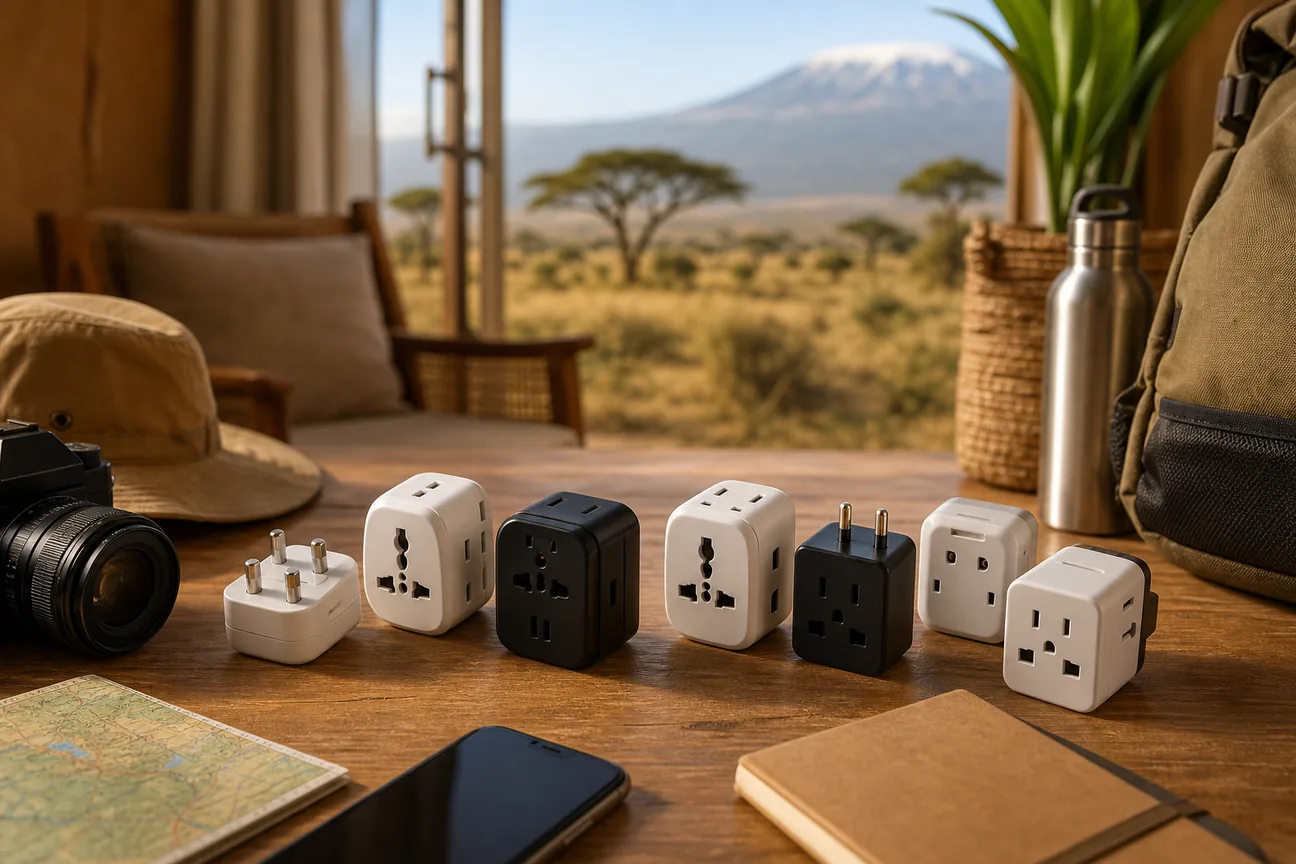
Best Tanzania Power Plug Adapter Options for Travelers
best tanzania power plug adapter options for travelers
Best Tanzania Power Plug Adapter Options for Travelers
Discover the top 10 Tanzania power plug adapters, from Safari TZ's travel kit to universal adapters, with safety tips and buying guide for your African adventure.
Landing in Tanzania and finding the wall socket looks nothing like home. You'll need the right plug adapter fast, or you'll be hunting for a charger in the middle of a game drive. Below are the ten adapters we trust, plus a quick checklist to pick the one that fits your safari style.
1. Safari TZ (Our Top Pick) — Full-Service Power Plug Adapter Kit
Safari TZ puts together a kit that covers every Tanzanian outlet you’ll meet on a safari. The kit comes in four flavors , Deluxe, Standard PLUS, Standard, and Basic , each with a mix of grounded and non‑grounded plugs. Grounded adapters let you use dual‑voltage laptops safely, while the non‑grounded ones work for phones and cameras that already have their own protection.
What makes this kit stand out is the inclusion of a surge‑protected power strip. In the field, power spikes happen when generators kick in; the strip helps keep your gear safe. The adapters handle up to 240 V, which matches Tanzania’s 230‑240 V supply, so you won’t need a voltage converter for most modern devices.
Because we run our own 4×4 fleet and stay in camps that often have only one socket, we always pack a spare adapter. That habit saves us from scrambling for a local vendor when the morning drive starts.
One drawback: the kit is sold as a set, so you can’t pick just a single adapter if you’re on a tight budget.
For a detailed packing list that includes our recommended adapter, see our Tanzania Safari Packing List , 15kg Reality.
2. Type G Universal Travel Adapter — 2 USB‑A, 1 USB‑C PD
A Type G universal travel adapter with two USB‑A ports and one USB‑C Power‑Delivery port works well in Tanzania's British‑style sockets, which dominate lodges and camps across the country. The USB‑C PD port handles laptops and tablets, while the two USB‑A ports keep phones and cameras charged simultaneously.
It's built for the Type G socket that dominates Tanzanian lodges. The adapter's built‑in fuse and safety shutters provide confidence when you plug into a generator‑powered outlet.
Our field teams have tested adapters of this type on long game drives; the USB‑C port powers a laptop while the USB‑A ports keep phones and cameras alive. The LED indicator shows when the adapter is active, which is handy when you're in a dimly lit tent.
However, adapters in this category do not always list voltage support on the packaging, and they typically lack surge protection — a risk we flag for anyone carrying expensive camera gear.
3. Africa‑Specific Universal Kit — Interchangeable Plugs
Some compact kits swap plug heads for over 50 African countries, including Tanzania's Type G and the rarer Type D. Each head snaps onto a single U.S.‑style base, so you carry one core unit and a handful of attachments.
The better kits include built‑in surge protection and an LED voltage indicator, addressing the safety gap we found in many "universal" adapters that skip voltage info. The interchangeable design means you can reuse the same unit on future trips across the continent.
Travelers love the lightweight pouch; it slides into a daypack without adding bulk. The metal contacts stay firm even after repeated swaps, so you won't lose power due to a loose fit.
One limitation: the USB ports on many of these kits are limited to 18 W total, which may feel slow for a high‑power laptop.
4. Type D Adapter — Simple & Cheap
If you know you'll stay in a lodge that only offers the round‑pin Type D sockets, a dedicated Type D adapter is the cheapest route. You can find inexpensive models on local markets or online.
The design is straightforward: two flat U.S. blades slide into the round pins. It's a good backup if your primary Type G adapter fails, because some remote camps still use the older round‑pin system.
Because these adapters are non‑grounded, they should only be used with devices that already have their own grounding, such as phone chargers.
Be aware that the pins are uninsulated; a partially pulled plug can expose live metal, so keep them out of children's reach.
5. Multi‑Port USB Travel Charger — Power + USB
The TESSAN Type G adapter with three USB ports (one USB‑C 20 W, two USB‑A 12 W) adds a small AC outlet to the mix. It’s perfect for a quick charge on a short flight or a camp with a single socket.
Its compact size (about 70 mm × 60 mm) means it fits in a pocket. The USB‑C port can power a laptop charger that supports Power Delivery, while the USB‑A ports keep phones and cameras topped up.
Our guides carry one on every vehicle for the crew, so we can charge navigation tablets even when the 4×4’s battery is low.
The downside is the lack of surge protection; a sudden spike could affect sensitive gear.
6. Type G Universal Travel Adapter — 2 USB‑A, 1 USB‑C PD
A Type G universal travel adapter with two USB‑A ports and one USB‑C Power‑Delivery port covers the broadest range of devices in a single unit. It fits Tanzania's standard Type G sockets and handles phones, cameras, and most laptops without needing extra cables or converters.
Because it combines USB‑A and USB‑C outputs, you won't need a separate plug for older devices that still rely on USB‑A chargers — a practical advantage when the whole group is charging at once after a long day on safari.
It does not include surge protection, so if you're travelling with sensitive electronics, keep that in mind and consider your lodge's power stability before relying on it for high‑value gear.
7. Surge‑Protected Type G Adapter — For Laptops
When you travel with a power‑hungry laptop, a surge‑protected adapter with a dedicated AC socket is worth the extra bulk. Look for a grounded Type G travel adapter kit that includes surge protection and USB ports — these are available from several travel accessory brands and offer meaningful protection for sensitive electronics.
Its internal fuse trips at 13 A, matching the rating of Tanzanian Type G outlets. The surge protector clamps any spike caused by generator start‑ups, which is common in remote lodges.
We've used surge‑protected adapters on multi‑day Kilimanjaro treks where the camp's power is solar‑backed and occasional surges occur at dusk.
The main caveat is size — the unit is about the length of a standard power strip, so it takes up a bit of luggage space.
8. Local Tanzanian Market Adapter — Buy On Arrival
If you prefer to travel light, you can pick up a basic Type G adapter at markets in Arusha or Moshi. Vendors sell simple, non‑grounded plugs for a modest price.
This option works in a pinch, but quality varies. Some adapters lack proper insulation, and you may end up with a loose fit that could expose live pins.
Because power surges happen, look for a model with a built‑in fuse or surge blocker. If you can't verify that, bring a small surge‑protected unit from home as a safety net.
9. Hotel‑Provided Adapter — Convenience Option
Many mid‑range hotels and lodges in Tanzania already have Type G sockets, and some even provide a complimentary adapter at reception. This can be handy if you forget your own.
The provided adapters are usually grounded and may include a USB port. However, you can't count on every property to have them, especially in remote camps.
Relying on hotel adapters also means you have less control over surge protection. It's a good backup but not a primary solution.
10. Travel Power Strip with Multiple Outlets — For Group Gear
A compact multi-outlet power strip lets a group charge phones, cameras, tablets, and a laptop from a single Type G socket. Look for a flame‑resistant model with a built‑in fuse for added safety.
In our safari camps, we plug the strip into the only wall outlet and then charge all devices overnight. It reduces the need to scramble for extra adapters.
Be mindful that the strip itself does not convert voltage; you still need a proper adapter for the plug shape.
How to Choose the Right Adapter – Quick Checklist
Before you buy, run through these points:
- Do you need a grounded plug? (Laptops and cameras usually do.)
- Will you charge multiple devices at once? Look for USB‑C PD and extra AC outlets.
- Is surge protection a must? Choose a model with a built‑in fuse or external protector.
- How much weight can you carry? Slim USB‑C‑only adapters save space.
- Will you rely on hotel sockets or bring a backup? Pack at least one adapter you trust.
Matching these criteria to your itinerary helps you avoid the common pitfall of buying a “universal” adapter that skips safety specs.
Comparison of the 10 Adapter Options
FAQ
Do I need a voltage converter for Tanzania?
Most modern phones, laptops, and cameras accept 100‑240 V, so a simple plug adapter is enough. Only single‑voltage gear like some hair dryers requires a converter.
Which plug type is most common in Tanzanian hotels?
The dominant socket is the British‑style Type G, three rectangular pins, used in most lodges and camps.
Can I use a Type D adapter in Tanzania?
Type D sockets exist in older or remote buildings, but they're rare. It's smart to bring a dual‑compatible kit if you'll visit such sites.
Is surge protection really needed?
Generators and unstable grids can cause spikes. An adapter with a built‑in fuse or surge strip reduces the risk of damaging expensive electronics.
How many devices can I charge at once?
Adapters with multiple USB ports or a power strip let you run three to six devices simultaneously. Check the total wattage rating to stay within the 13 A limit of Tanzanian outlets.
Will a cheap market adapter be safe?
Low‑cost adapters may lack proper insulation and fuse protection. If you buy one locally, inspect it for solid construction and consider pairing it with a surge‑protected strip.
Ready to lock in the right adapter? Grab our recommended Safari TZ kit before you depart, then double‑check your checklist. For deeper planning tips, explore our Free Tanzania Safari Planning Guide 2026 and hit the road with confidence.