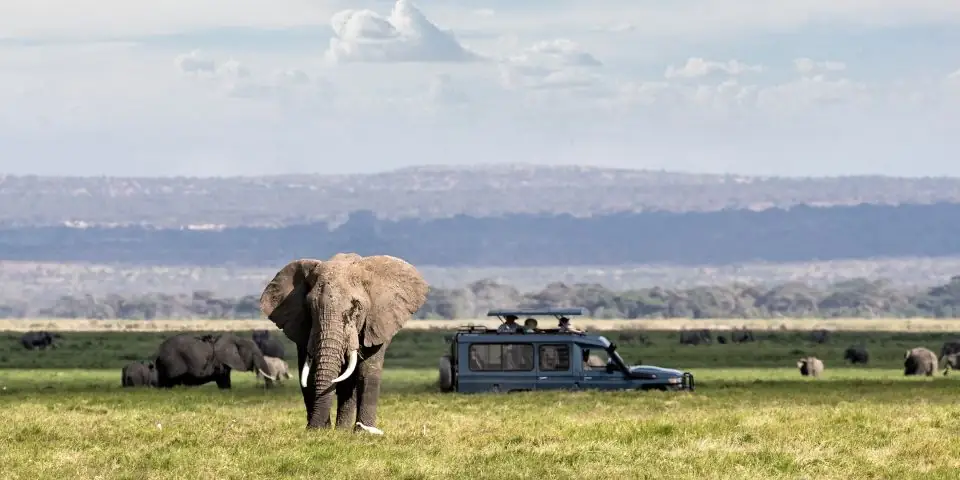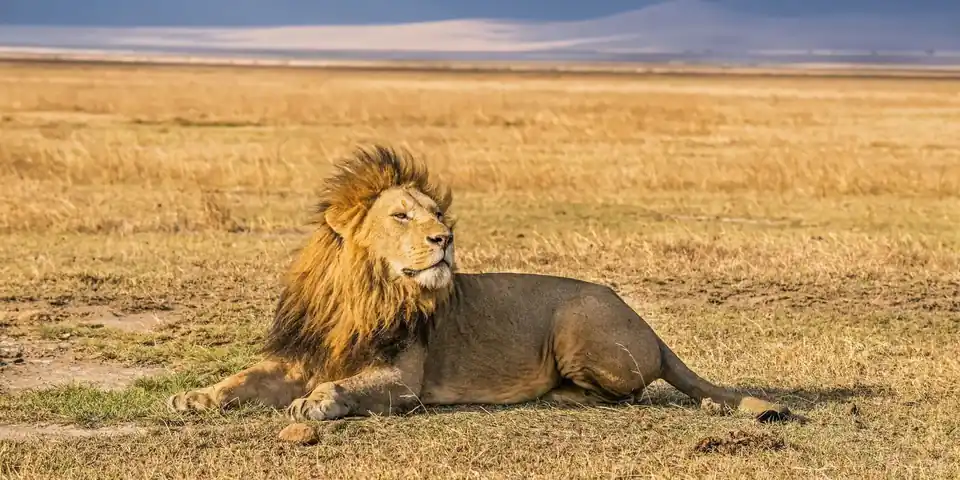
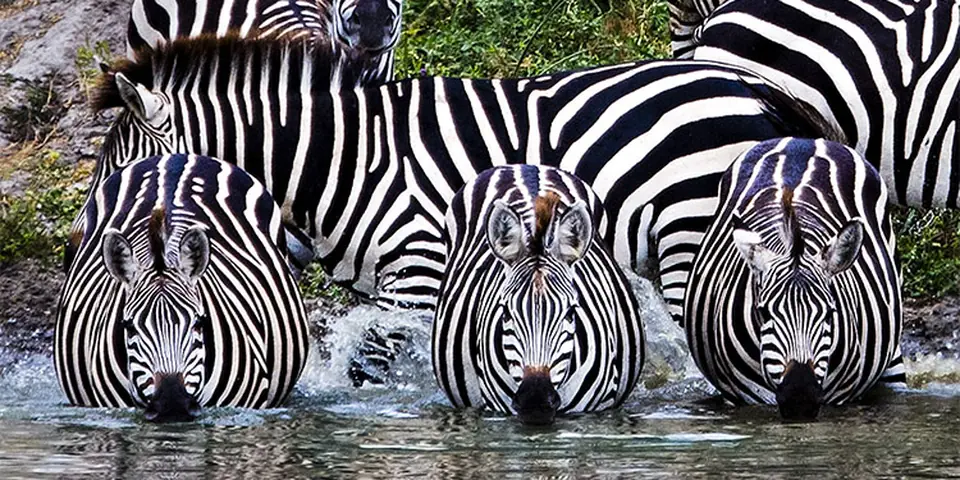
Budget Safari
- Public campsites and basic tented camps
- Serengeti, Ngorongoro, Tarangire
- Shared group vehicle (4–6 pax)
- Professional licensed guide
- All meals included at camp
Tanzania safari costs range from $1,500 to $15,000+ per person depending on duration, accommodation tier, group size, route, and season. Budget safaris start at $1,500–2,500 pp using public campsites and shared vehicles. Mid-range safaris run $2,500–5,000 pp with private vehicles and tented camps. Luxury safaris from $5,000–15,000+ pp with exclusive lodges and fully private service. All prices on safari-tz.com include national park fees, a licensed guide, vehicle, accommodation, and meals — and carry no aggregator commission layer.
The table below shows per-person costs for a 7-day Northern Circuit safari as the baseline comparison — the most popular itinerary duration covering Serengeti, Ngorongoro, and Tarangire. All prices include park fees, guide, vehicle, accommodation, and meals. Prices are in USD.
| Tier | Accommodation | 2 People (pp) | 4 People (pp) | 6 People (pp) | Vehicle |
|---|---|---|---|---|---|
| Budget | Public campsites | $2,200–2,800 | $1,700–2,100 | $1,500–1,900 | Shared / group |
| Mid-Range | Mid-tier tented camps | $3,200–4,200 | $2,600–3,400 | $2,200–2,900 | Private 4x4 |
| Upper Mid | Superior tented camps / lodges | $4,500–6,500 | $3,800–5,200 | $3,200–4,500 | Private 4x4 |
| Luxury | Premium lodges / exclusive camps | $7,000–12,000 | $6,000–10,000 | $5,500–9,000 | Private 4x4 |
| Ultra Luxury | Exclusive private camps | $12,000–20,000+ | $10,000–16,000+ | $8,500–14,000+ | Private + fly-in |
* Per-person cost decreases as group size increases because vehicle and guide costs are shared. Prices reflect 7-day Northern Circuit departures booked direct through safari-tz.com in peak season. Green season prices run 20–40% lower.
Tanzania safari pricing is not arbitrary — every cost component is traceable to a specific operational expense. Understanding these eight variables allows you to build an itinerary that maximises value at any budget.
TANAPA fees are fixed by the government and non-negotiable. Serengeti and Ngorongoro each run approximately $70 per person per day. Tarangire and Lake Manyara run ~$45 per person per day. On a 7-day Northern Circuit with 2 days in each major park, park fees alone add $400–500 per person to the base cost. All safari-tz.com packages include park fees — no gate surprises.
Ngorongoro has two fee layers: a Conservation Area entry fee and a separate crater descent fee (~$70 pp per entry). Vehicles also pay a fee. Most operators include one crater descent in Northern Circuit packages; additional descents cost extra. Always confirm how many crater entries are included before comparing quotes.
Some of the best wildlife areas — private concessions bordering the Serengeti, Ndutu, and parts of Tarangire — charge concession fees on top of park fees, ranging from $50–150 per person per day. These areas allow off-road driving and night game drives that national parks prohibit. Worth the premium for serious wildlife photographers and repeat visitors.
A private 4x4 Land Cruiser with a pop-up roof, charging points, and a cooler box costs significantly more per person than a shared minibus on a group departure — but the gap narrows fast above 4 passengers. For 6 people sharing a private vehicle, per-person vehicle cost is comparable to a budget group departure. Vehicle age, maintenance standard, and roof design (full pop-up vs half) vary significantly between operators.
Tanzania requires guides to hold a Tanzania Tourist Guide Licence (TTGL) from the College of African Wildlife Management (Mweka). Senior guides with 10+ years of Serengeti experience command higher rates — and produce materially better safaris. At safari-tz.com, all guides are licensed and vetted; you will never be assigned an unlicensed trainee guide to reduce costs.
Accommodation is the single largest variable in safari pricing. Public campsites: $30–60 pp/night. Private campsites and basic tented camps: $80–150 pp/night. Mid-range lodges and tented camps: $150–350 pp/night. Luxury lodges: $350–700 pp/night. Exclusive private camps: $700–1,500+ pp/night. On a 7-night itinerary, moving one tier up in accommodation adds $700–3,000+ per person to the total cost.
Driving from Arusha to the central Serengeti takes 8–9 hours. Domestic flights from Arusha or Kilimanjaro airport to Seronera (central Serengeti) or Grumeti airstrip take 45–90 minutes and cost $200–350 per person one-way. Fly-in safaris save 2–3 days of driving per circuit and dramatically improve comfort — but add $400–700+ per person to the total cost. Most budget and mid-range packages use road transfers.
Peak season (July–October) sees lodge and camp rates at their highest — demand for Great Migration viewing drives a 20–50% premium over green season rates. The green season (November–March) offers the same wildlife at materially lower prices, with the added benefit of fewer vehicles at sightings. June and late October are the "sweet spot" — good wildlife, declining peak-season pricing.
Each park has different entry fees, logistics costs, and optimal durations. The per-park costs below are the fixed government fees for international non-resident visitors, which are included in all safari-tz.com packages. The "recommended days" guidance reflects what 35 years of operating these routes tells us you actually need to see each park properly.
The Serengeti is Tanzania's flagship park — 30,000 km² of open savannah, year-round Big Five sightings, and the Great Migration. Recommended minimum: 2 nights / 3 days in the park. Driving from Arusha takes 7–8 hours via Ngorongoro; fly-in is 45–60 minutes. Concession areas (Ndutu, Lamai, Sayari) charge additional fees but offer off-road driving and night game drives. Browse Serengeti safari packages →
The Ngorongoro Crater is the world's largest intact volcanic caldera — a self-contained ecosystem with the highest lion density in Africa. Entry to the Conservation Area and a crater floor descent are two separate fees. Recommended: 1 full crater day (most circuits include one descent). The rim itself offers spectacular views and excellent game in the forested upper slopes. Browse Ngorongoro packages →
Tarangire is underrated and deliberately so — those who know it value the lower vehicle density and extraordinary elephant concentrations (the Tarangire ecosystem holds one of Africa's largest elephant populations). Iconic baobab landscapes. Recommended minimum: 1 night / 2 days. Typically the first or last stop on the Northern Circuit from Arusha. Lower fee than Serengeti makes it excellent value. See tours including Tarangire →
Lake Manyara is compact (325 km²) and frequently underestimated. Tree-climbing lions, massive flamingo flocks, and dense riverine forest make it one of East Africa's most visually diverse parks. Recommended: 1 half-day to full day — most circuits use it as a transit stop. Its proximity to Arusha (2 hours) makes it ideal as an opening or closing day park.
Arusha National Park sits 25 minutes from Arusha town centre — the most accessible park in Tanzania and an excellent option for a day trip before or after a longer circuit. Giraffe, buffalo, zebra, colobus monkeys, and views of Mt Meru. Ideal for 1-day add-on. Canoe safaris are available on Momella Lakes — unique in Tanzania's Northern Circuit.
Ruaha National Park and Nyerere National Park (formerly Selous) make up the Southern Circuit — wilder, more remote, and with far fewer vehicles than the North. The trade-off is logistics: most Southern Circuit safaris require domestic flights from Dar es Salaam, adding cost. Recommended minimum: 4–5 days in circuit. Best suited to repeat Tanzania visitors seeking genuine wilderness. Total Southern Circuit packages typically run $4,000–12,000+ pp depending on tier.
Every tour on safari-tz.com is owned and operated locally — no middlemen, no inflated platform fees. Filter by duration, destination, budget, and travel style to find your exact safari.
Duration is one of the most direct levers on total cost — but the relationship is not purely linear. Shorter safaris carry a higher per-day cost because fixed overheads (vehicle mobilisation, airport transfers, guide minimum days) are spread across fewer days. The six durations below show realistic per-person cost ranges at mid-range level for the Northern Circuit, in a private vehicle for 2 people.
All ranges above: mid-range tier, private vehicle, 2 people. Budget tier runs 30–40% lower; luxury tier runs 80–200% higher. Green season prices are 20–40% below peak-season rates shown.
Style determines more than comfort — it shapes your route options, your wildlife access, and your per-day cost more than almost any other single variable. The six main safari styles operating in Tanzania each have distinct pricing logic.
Public campsite safaris are the entry point to Tanzania — no frills, but the full wildlife experience. You sleep in tents, meals are prepared by a camp cook, and ablution blocks are shared. Private campsites offer more space and exclusivity without upgrading to a lodge. Camping safaris are best for travellers who are comfortable with basic conditions and want maximum time in the parks for minimum spend. All camping tours on safari-tz.com include a licensed guide, vehicle, tent, bedding, and meals.
Lodge safaris use fixed accommodation — everything from simple park-boundary lodges to architecturally spectacular private camps. The advantage over camping: hot showers, restaurant dining, swimming pools at some properties, and consistent infrastructure regardless of weather. Mid-range lodges ($150–350 pp/night) hit the best value point: comfortable rooms, en-suite facilities, and quality food. Browse lodge safari options →
Fly-in safaris use domestic light aircraft to move between parks — eliminating 8–9 hour road transfers and maximising game time. One-way domestic flights run $200–350 per person. For a 7-day itinerary with 2 inter-park flights, add $400–700 per person over the road-transfer equivalent. For travellers with limited time or who want a seamless high-end experience, fly-in routes are the standard. Most ultra-luxury camps in the Serengeti and Ruaha are designed around fly-in arrival.
Honeymoon safaris typically combine the Northern Circuit with a Zanzibar beach extension — 5–7 days on safari followed by 4–6 nights on the Zanzibar coast. The combination adds $800–2,500 per person (Zanzibar accommodation and Dar es Salaam domestic transfer costs). Many luxury camps offer honeymoon-specific inclusions: private dining, sundowners, in-tent bath setup. Always request honeymoon additions at the time of booking — they are rarely included as standard.
Tanzania is one of Africa's most family-friendly safari destinations — children are welcome in all national parks, and the Northern Circuit's road-based safaris require no long walks or strenuous activity. Group size works in families' favour: a family of 4 in a private vehicle pays the same vehicle and guide cost as a couple, dramatically reducing per-person costs. Children under 5 pay zero park fees at most parks; children 5–15 pay 50% of adult non-resident fees. Always confirm the operator's minimum age policy.
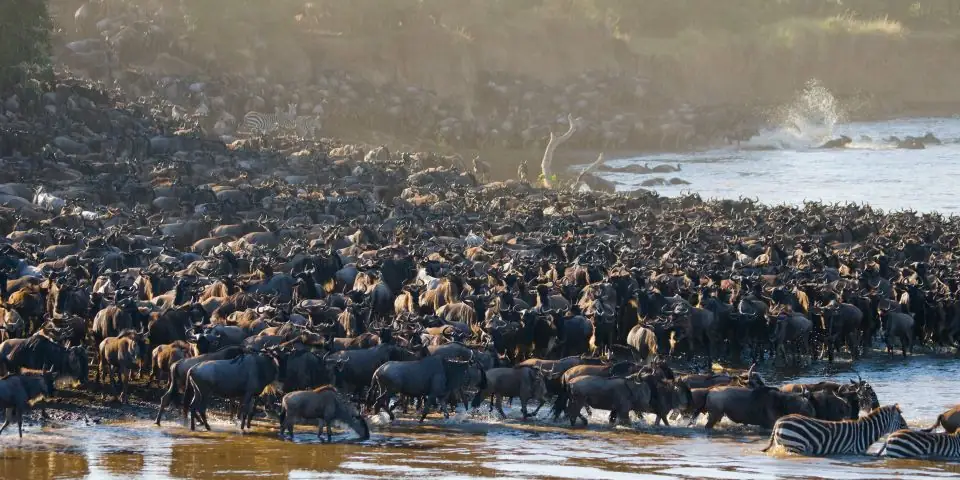
The Great Migration — 1.5 million wildebeest moving continuously through the Serengeti ecosystem — is not a single event. The river crossings at the Mara River (July–October) are the most dramatic and heavily demanded; June and early July offer calving season in the south (Ndutu) with newborn wildebeest and concentrated predator action. Peak-season Migration camps carry a significant premium: some exclusive camps book 12–18 months ahead for July–September. Booking through safari-tz.com gives you direct access to current camp availability without an aggregator's allocation constraints.
Season is the most powerful cost lever available to budget-conscious travellers — a 20–40% saving is achievable simply by shifting travel window from peak to green season, with no reduction in wildlife quality for most itineraries. Here is how the year breaks down from a pricing and wildlife perspective.
| Month(s) | Season | Relative Price | Wildlife Highlights | Notes |
|---|---|---|---|---|
| Jan–Mar | Green Season | Base price − 20–30% | Calving season (Ndutu, S. Serengeti). Dense predator action. Lush landscapes, exceptional birdwatching. | Short rains may fall in Nov–Dec. Jan–Mar is generally dry and green. Fewer vehicles. Best value window. |
| Apr–May | Low Season | Base price − 30–40% | Wildlife excellent but dispersed. Long rains (heaviest Apr–May). Some tracks become impassable. | Lowest prices of the year. Some camps close. Not recommended for first-time visitors or families with children. |
| Jun | Shoulder Season | Base price − 5–15% | Migration begins moving north. Dry season begins — vegetation thins, wildlife concentrates at water. | Excellent value relative to quality. Camps reopening. Good availability. Highly recommended. |
| Jul–Oct | Peak Season | Base price (highest) | Mara River crossings (Aug–Sep peak). Highest wildlife concentrations. Clearest skies. Best photography light. | Book 9–12 months ahead for premium properties. Higher vehicle density at sightings. Worth the premium for Migration. |
| Nov | Shoulder Season | Base price − 10–20% | Migration moves south. Short rains begin (light and brief). Wildlife dispersing across ecosystem. | Good availability. Prices beginning to drop from peak. Good wildlife if timing rains correctly. |
| Dec | Green Season | Base price − 15–25% (ex. festive) | Short rains ending. Southern Serengeti (Ndutu) comes alive with early calving arrivals. Wildflowers and birds. | Christmas / New Year dates carry a festive supplement (typically +15–25%). Outside festive dates, excellent value. |
Key insight: The best value window for Tanzania is January to March — calving season in the southern Serengeti, dry weather, crowd-free parks, and lodge rates 20–30% below peak. Wildlife quality during this period rivals peak season in terms of predator activity. For the Great Migration river crossings specifically, July–October is essential. For everything else, green season delivers outstanding safari value.
Two quotes for an apparently identical 7-day Northern Circuit can differ by $1,500–3,000 per person. Here is what is actually driving that gap — and what to ask before you commit.
The single most common pricing sleight of hand in the safari industry. An operator quotes $1,200 pp for a 6-day safari — but the park fees alone on a Northern Circuit itinerary run $400–500 pp. The real price is $1,600–1,700 pp once fees are added. Always ask: "Does your quoted price include all national park and crater fees?" Safari-tz.com includes all park fees in every published package price.
A safari vehicle with a full-width pop-up roof, seatbelts for all passengers, working charging points, and a functioning cooler is materially different from an ageing minibus with a partially functional hatch. Vehicle maintenance in remote environments is expensive — operators cutting costs here cut it visibly in safari quality. Ask how old the vehicle fleet is and whether you will have exclusive use of the vehicle.
Every licensed guide in Tanzania must hold a Tanzania Tourist Guide Licence from Mweka College. The licence is the floor, not the ceiling. A 20-year Serengeti veteran with deep knowledge of animal behaviour, bird identification, and off-road route finding delivers a fundamentally different experience to a newly licensed guide on their first solo circuit. Ask specifically: how many years of Serengeti experience does the guide have? Will the same guide accompany us for the full itinerary?
Some operators quote a mid-range lodge name in their itinerary but reserve the right to substitute "a property of similar standard" — which in practice can mean a downgrade at short notice if the named lodge fills. Always confirm that accommodation is specifically reserved in your name and that the itinerary names the actual properties, not category placeholders. Safari-tz.com confirms specific lodges and camps at the time of booking.
International travel agencies and safari booking platforms source tours from Tanzania ground operators — then add a commission of 15–30% (sometimes more) to the ground price before presenting a quote to the traveller. The traveller pays the marked-up price; the extra cost funds the intermediary's margin, not the safari. Booking direct through a locally operated Arusha platform like safari-tz.com removes this layer entirely. The ground price is the price you pay.
This is not a marketing claim — it is operational economics. Here is exactly what the commission layer costs you, in real money, and what it means for your safari experience.
Average international aggregator commission added on top of ground operator price
What $1,050 could upgrade on a direct-booked 7-day mid-range safari
Every safari-tz.com package is priced from the ground up — actual vehicle costs, actual guide salaries, actual park fees, actual accommodation rates at the properties we use. There is no intermediary cost built into our prices. When you enquire through our site, you are speaking directly with the Arusha team that designs, operates, and guides your safari. No call centre. No offshore booking desk.
Safari-tz.com has operated from Arusha since 1990. That means established relationships with every major lodge, camp, and park authority in Tanzania — enabling rack-rate negotiations, priority allocation at peak-demand properties, and the logistical knowledge to build itineraries that minimise dead driving time. These are not advantages a recently launched aggregator platform can replicate. Learn more about safari-tz.com →
Safari-tz.com is a member of the Tanzania Association of Tour Operators (TATO) — Tanzania's industry regulatory body. TATO membership requires compliance with operational, financial, and ethical standards. It is one of the clearest signals of a legitimate, accountable ground operator in a market where fly-by-night operators are a real risk.
Abstract price ranges are useful for planning. These three worked examples show exactly what a real safari package includes at each tier, based on actual safari-tz.com tours operating in 2026.
All examples above are available directly on safari-tz.com. Browse the full tour catalogue to see current departures and pricing.
Your safari package price is the largest line item — but not the only one. Factor these seven costs into your total trip budget to avoid surprises.
Most nationalities pay $50 USD for a single-entry tourist visa, available online at the Tanzania immigration e-visa portal or on arrival at Kilimanjaro International Airport (KIA) and Julius Nyerere International Airport (DAR). East African Tourist Visa (covering Tanzania, Kenya, Uganda) costs $100. Confirm your nationality's visa requirements before booking.
Safari packages are priced in USD and typically paid by international bank transfer or credit card. International wire transfer fees run $15–40 per transfer. Credit card foreign transaction fees add 1.5–3.5% on top of the package cost. For a $7,000 safari, that can add $105–245 in processing costs. Ask safari-tz.com about preferred payment methods to minimise conversion costs.
Gratuities are customary and genuinely meaningful for safari guides and camp staff. Standard guidance: $10–20 per person per day for your guide, $3–5 per person per day for your driver (if separate from guide), and a communal tip for camp staff of $5–10 per person per night. On a 7-day safari for 2 people, budget $200–400 total for gratuities.
The Serengeti balloon safari (operated by Serengeti Balloon Safaris) costs approximately $600–700 per person and runs at dawn, landing for a champagne breakfast in the bush. It is not included in any standard safari package and must be pre-booked through safari-tz.com or directly with the balloon operator. It is one of the most memorable experiences in East Africa, but it is strictly a premium add-on.
If your itinerary uses road transfers (standard for most budget and mid-range tours), no domestic flights are needed. Fly-in upgrades cost $200–350 per person one-way between Arusha and the Serengeti. Arusha–Zanzibar domestic flights run approximately $120–200 one-way. These are priced separately from the safari package unless specifically included. Coastal Aviation, Auric Air, and Air Excel are the main domestic operators.
Travel insurance covering emergency medical evacuation is essential for Tanzania safaris. Medical evacuation from a remote Serengeti camp to Nairobi or Arusha costs $5,000–20,000+ without cover. AMREF Flying Doctors provides the most comprehensive regional rescue coverage — annual membership runs approximately $25–45 per person. Standard travel insurance policies run $80–200 per person per trip depending on your origin country and level of coverage.
Solo travellers on private safaris pay the full vehicle and guide cost without a travel partner to share it. Solo supplements on a 7-day private Northern Circuit run $400–800 extra over the two-person per-person rate. Joining a group departure eliminates the solo supplement. Christmas and New Year periods (roughly Dec 20–Jan 5) carry festive surcharges at most lodges and camps — typically +15–25% on accommodation.
Adding a Zanzibar beach stay to a Northern Circuit safari is the single most popular Tanzania trip extension. Zanzibar costs vary widely: budget guesthouses from $40–80 per room per night; mid-range beach hotels $120–250 per room; luxury resorts $300–800+ per room. Internal flights from Arusha to Zanzibar run $120–200 one-way. Budget $600–2,000+ per person for 4–6 nights in Zanzibar on top of your safari package.
Tanzania safari costs are built on fixed, non-negotiable government fees — Serengeti and Ngorongoro each charge approximately $70 per person per day. These fees fund Tanzania's conservation infrastructure and are the same for every operator. Add the operational costs of maintaining 4x4 vehicles in remote terrain (no roadside garages in the Serengeti), fuel costs across 600–900km circuits, licensed guide salaries, and the logistics of supplying remote camps, and the base cost is substantial before accommodation is factored in.
Accommodation is where the range opens up: public campsites add $30–60 per person per night; exclusive private camps add $700–1,500+. The safari experience at the campsite and the exclusive camp is, in wildlife terms, identical. What you are paying for at the premium end is privacy, comfort, and personalised service.
One cost that is avoidable: the 15–30% aggregator commission added by international booking platforms. Booking direct through safari-tz.com removes this entirely.
The cheapest Tanzania safari starts from approximately $1,500 per person for a 6-day Northern Circuit using public campsites, a shared group vehicle, and a licensed guide. To reach the lowest price point:
Even at budget tier, all safari-tz.com packages include park fees, a licensed guide, a 4x4 vehicle, all meals, and camping accommodation. The wildlife experience at budget level is identical to luxury.
At comparable accommodation tiers, Tanzania and Kenya are broadly similar in total cost. Kenya's Masai Mara private conservancies charge $100–150 per person per day on top of park entry fees — pushing daily costs above Tanzania's Serengeti rates. Tanzania's national park fee schedule, while not cheap, is more straightforward.
Tanzania's advantage for the budget and mid-range buyer is volume: with 300+ tours operating from Arusha across all price tiers, there is genuine price competition and departure availability that Kenya's more consolidated market does not match.
In terms of destination value, Tanzania includes the full Serengeti ecosystem (six times larger than the Masai Mara), Ngorongoro Crater, Tarangire, and Kilimanjaro — coverage that Kenya cannot replicate. For wildlife encounter value per dollar, Tanzania is consistently stronger.
A 7-day safari including the Serengeti for 2 people costs approximately:
Serengeti park fees alone run approximately $70 per person per day and are included in all safari-tz.com packages. The Serengeti requires a minimum of 2 nights / 3 game drive days to do justice to the ecosystem — itineraries with less time than this risk spending more hours in transit than in game drives.
For a realistic total trip budget, add the following to your safari package cost:
A realistic total trip budget for a 7-day mid-range Northern Circuit safari for 2 people, including return flights from Europe and Zanzibar extension: $12,000–18,000 total, or $10,000–15,000 from North America depending on airline and travel dates.
All safari-tz.com packages include national park entry fees — you will not receive a separate bill at the gate or a surprise invoice after booking. This is not universal across the Tanzania safari market.
Some operators, particularly those advertising very low headline prices online, exclude park fees from the quoted cost. When comparing quotes, always confirm: "Does this price include all national park fees, Ngorongoro Conservation Area fees, and crater descent fees?"
Park fees are a significant fixed cost: Serengeti ~$70 pp/day, Ngorongoro ~$70 pp/day (plus crater fee ~$70 per entry), Tarangire ~$45 pp/day, Lake Manyara ~$45 pp/day. On a 7-day Northern Circuit, park fees total approximately $400–500 per person — enough to swing a comparison between two headline prices significantly.
TANAPA (Tanzania National Parks Authority) applies three pricing tiers to all national park entry fees:
If you hold a valid Tanzania residence permit, inform safari-tz.com at the time of enquiry. We will confirm your eligibility and apply resident park fee rates, which reduces your total package cost accordingly.
300+ tours. Every budget. 35 years of operational knowledge. No aggregator markup — just the ground price, direct from the operator who runs your safari.
Or call us directly in Arusha: +255 743 100-673 | info@safari-tz.com | Send an enquiry form